
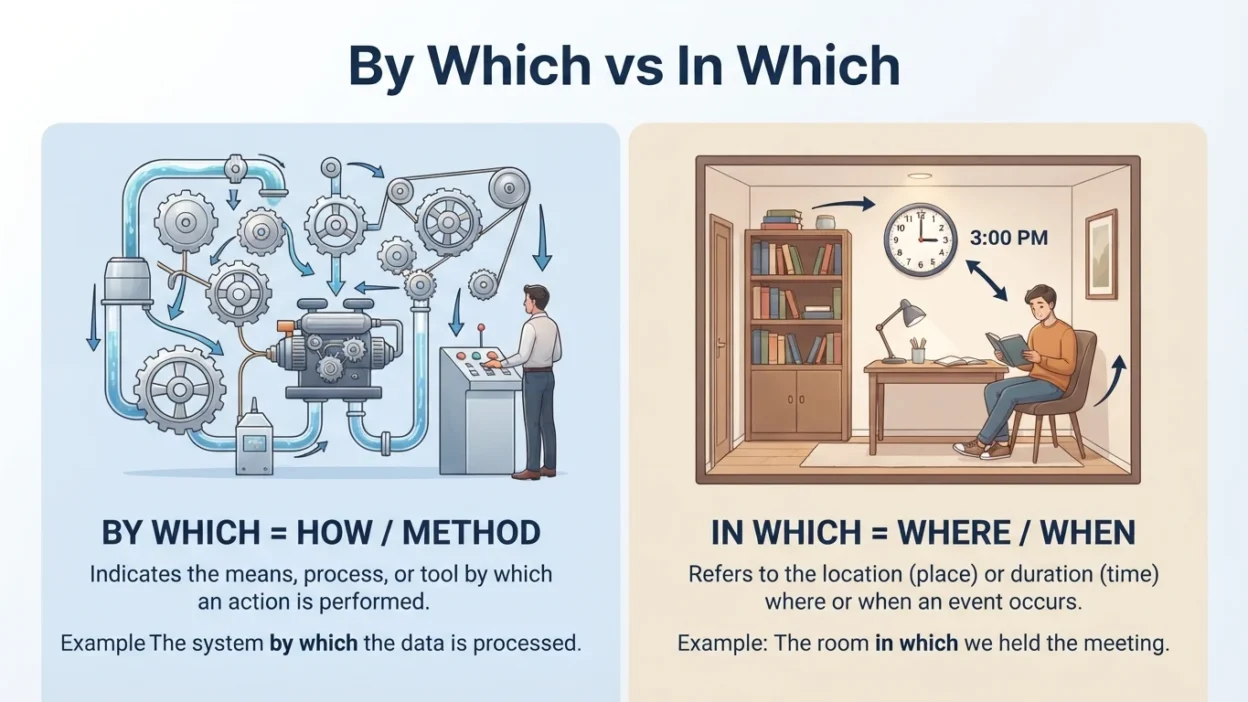
“By which” and “in which” can look very similar, but they are used for different relationships between ideas. The main difference is the preposition: by usually expresses a method, means, agent, or deadline, while in often refers to a place, situation, condition, period, or container.
For example, “The method by which we solved the problem” means the method through which we solved it. On the other hand, “The room in which we met” means the room where we met. Understanding this small distinction can make your writing sound much more natural and precise.
Quick Answer
Use “by which” when you mean through which, by means of which, or by the action of which.
- This is the method by which the machine works.
Use “in which” when you mean where, inside which, or during which. - This is the room in which we had the meeting.
A simple rule is: by = method/means; in = place/situation/time.
Why People Confuse “By Which” and “In Which”
The confusion happens because both expressions introduce a relative clause and are often followed by a noun phrase or pronoun.
Compare:
- The system by which the company operates is efficient.
- The system in which the company stores its data is secure.
The first sentence focuses on the method or system used to operate. The second focuses on the system or environment where something is stored.
The correct choice depends on the relationship you want to express, not simply on the noun before “which.”
By Which: Meaning and Use
“By which” is generally used when you want to describe the method, process, means, or way something happens.
It can often be replaced by:
- through which
- by means of which
- using which
- sometimes simply how
For example: - The process by which water is purified is complicated.
- We studied the method by which the machine detects errors.
- She explained the procedure by which applications are reviewed.
Here, by which connects an action to the method or process used to accomplish it.
Examples of “By Which”
- This is the method by which the problem was solved.
- We need to understand the process by which decisions are made.
- The system by which payments are processed is highly secure.
- They developed a technique by which the material can be recycled.
- This is the mechanism by which the device produces electricity.
- The rules by which the competition is judged are clearly stated.
- She described the procedure by which new employees are selected.
- The agreement established the terms by which the partnership would operate.
- This is the means by which the information was transferred.
- Researchers discovered the process by which the cells communicate.
In Which: Meaning and Use
“In which” is generally used when you are talking about a place, situation, condition, environment, container, or period of time.
It can often be replaced by:
- where when referring to a place or situation
- during which when referring to a period
- inside which when referring to something physically contained
For example: - The house in which I grew up is still standing.
- We entered a period in which prices increased rapidly.
- She created an environment in which everyone felt comfortable.
In each case, in which identifies the place, situation, or period in which something happens.
Examples of “In Which”
- This is the house in which I grew up.
- We visited the room in which the ceremony took place.
- It was a situation in which nobody knew what to do.
- She entered a period in which she worked extremely hard.
- They created an environment in which students could learn.
- This is the box in which I keep my old photographs.
- The company entered a phase in which it expanded rapidly.
- We discussed the circumstances in which the accident occurred.
- He described the situation in which he had found himself.
- That was a time in which communication was much slower.
By Which vs In Which: Comparison Table
| Expression | Main Meaning | Common Replacement | Example |
|---|---|---|---|
| By which | Method or means | through which | The method by which it works |
| In which | Place or situation | where | The room in which we met |
| In which | Period of time | during which | A period in which prices rose |
| By which | Process or mechanism | by means of which | The process by which it operates |
| In which | Environment or condition | where | An environment in which people thrive |
By Which vs In Which in Similar Sentences
Seeing the expressions side by side makes the difference clearer.
1. Method vs situation
- The method by which the problem was solved was impressive.
- The situation in which the problem occurred was unusual.
2. Process vs environment - We examined the process by which the product is made.
- We examined the environment in which the product is made.
3. Means vs place - They developed a system by which customers can pay online.
- They developed a system in which customer information is stored.
The first focuses on how something is done; the second focuses on where or within what system something exists.
When to Use “By Which”
Use by which when the noun before it represents a method, means, process, mechanism, rule, or procedure.
Common patterns include:
- the method by which
- the process by which
- the means by which
- the way by which
- the mechanism by which
- the procedure by which
For example:
The process by which the brain stores memories is complex.
Here, by which means roughly through which.
When to Use “In Which”
Use in which when the noun before it represents a place, situation, condition, environment, system, container, or period of time.
Common patterns include:
- the place in which
- the situation in which
- the environment in which
- the period in which
- the circumstances in which
- the system in which
For example:
This is the environment in which the plants grow best.
Here, in which means roughly where.
Can “By Which” Mean “Whereby”?
Yes, in some contexts by which has a meaning similar to whereby, especially when describing a method or arrangement.
For example:
- They created a system by which customers could receive refunds.
- They created a system whereby customers could receive refunds.
Both can express the idea of a system through which something happens. However, whereby can sound more formal and is less common in everyday conversation.
Can “In Which” Be Replaced by “Where”?
Often, yes.
For example:
- This is the house in which I was born.
- This is the house where I was born.
Both are grammatically correct.
In which tends to sound more formal, while where is usually more natural in everyday English.
However, where should not automatically replace in which in every context. For periods, situations, and abstract nouns, the replacement may change the meaning or sound less natural.
Common Mistakes
Mistake 1: Using “in which” for a method
Incorrect or awkward:
- This is the method in which the machine works.
Better: - This is the method by which the machine works.
Mistake 2: Using “by which” for a physical location
Incorrect:
- This is the room by which we had the meeting.
Correct: - This is the room in which we had the meeting.
Mistake 3: Thinking the noun determines the preposition
The noun alone does not always determine whether you need by or in. Think about the relationship between the noun and the following action.
- How does it happen? → by which
- Where/within what does it happen? → in which
Mistake 4: Overusing formal constructions
Although by which and in which are grammatically useful, everyday English often prefers simpler alternatives.
Instead of:
- The manner by which she completed the task…
You could say: - The way she completed the task…
Instead of: - The building in which we met…
You could simply say: - The building where we met…
Easy Memory Trick
Remember:
BY = HOW
IN = WHERE/WHEN
If you are explaining how something happens, consider by which.
The method by which it works.
If you are explaining where, when, or in what situation something happens, consider in which.
The situation in which it happened.
This simple trick will help you choose the correct expression in most cases.
American vs British English
There is generally no major difference between American and British English in the basic use of by which and in which.
Both varieties use:
- by which for methods, processes, and means
- in which for places, situations, conditions, and periods
The main difference is often one of style and formality. In both varieties, everyday speakers may prefer simpler alternatives such as how, where, or when.
Similar Expressions
Several expressions can have meanings close to by which or in which.
| Expression | Meaning | Example |
|---|---|---|
| By which | Through which / by means of which | The method by which it works |
| In which | Where / inside which | The room in which we met |
| Through which | Through or by means of which | The process through which it develops |
| Where | In/at the place where | The house where I live |
| During which | During that period | The year during which it happened |
| Whereby | By which means | A system whereby users can register |
Frequently Asked Questions
Is “by which” grammatically correct?
Yes. By which is grammatically correct when by expresses a method, means, process, mechanism, or similar relationship.
Is “in which” grammatically correct?
Yes. In which is commonly used to refer to a place, situation, condition, environment, container, or period of time.
What is the difference between “by which” and “in which”?
By which generally means through which or by means of which, while in which generally means where, inside which, or during which.
Can I use “where” instead of “in which”?
Often, yes, especially when referring to a physical or figurative place.
- The house in which she lives.
- The house where she lives.
Can I use “through which” instead of “by which”?
Sometimes. If by which describes a method or process, through which can often express a similar idea.
Is “by which” formal?
It can sound formal, especially in academic, legal, technical, and professional writing. It is nevertheless standard English.
Is “in which” more formal than “where”?
Generally, in which can sound more formal than where, although both are correct in many contexts.
Which is correct: “the way by which” or “the way in which”?
“The way in which” is the more natural and common expression.
For example:
- I admire the way in which she handled the situation.
You can also simply say: - I admire how she handled the situation.
Final Verdict
The key difference is simple:
By which = through which / by means of which / how
In which = where / inside which / during which
Use by which for methods, processes, mechanisms, and means:
The process by which the product is made.
Use in which for places, situations, environments, conditions, and periods:
The factory in which the product is made.
When in doubt, ask yourself: Am I describing how something happens, or where/when/in what situation it happens?
Conclusion
“By which” and “in which” are both useful relative constructions, but they perform different jobs. By which focuses on the means or process through which something happens, whereas in which focuses on the setting, situation, place, or period in which something happens.
Once you connect by with how and in with where/when, the difference becomes much easier to remember. In everyday English, simpler alternatives such as how, where, and when are often more natural, but by which and in which remain important in formal and precise writing.
Remember This
BY WHICH → HOW
IN WHICH → WHERE / WHEN
- The method by which it works.
- The place in which it happens.
- The period in which it occurred.
- The process by which it was created.

Daniel Whitmore is a faith-inspired author dedicated to writing content that uplifts and motivates. His focus is on hope, resilience, and moral clarity, offering readers guidance for navigating life with confidence and belief.