“He is risen” and “He has risen” are both grammatically correct expressions, but they differ in grammatical structure and usage. Both are especially familiar in Christian contexts, where they refer to the resurrection of Jesus Christ.
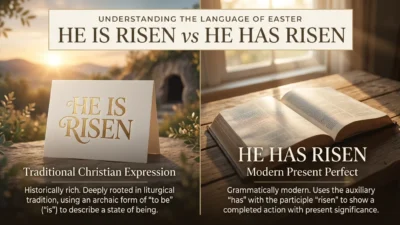
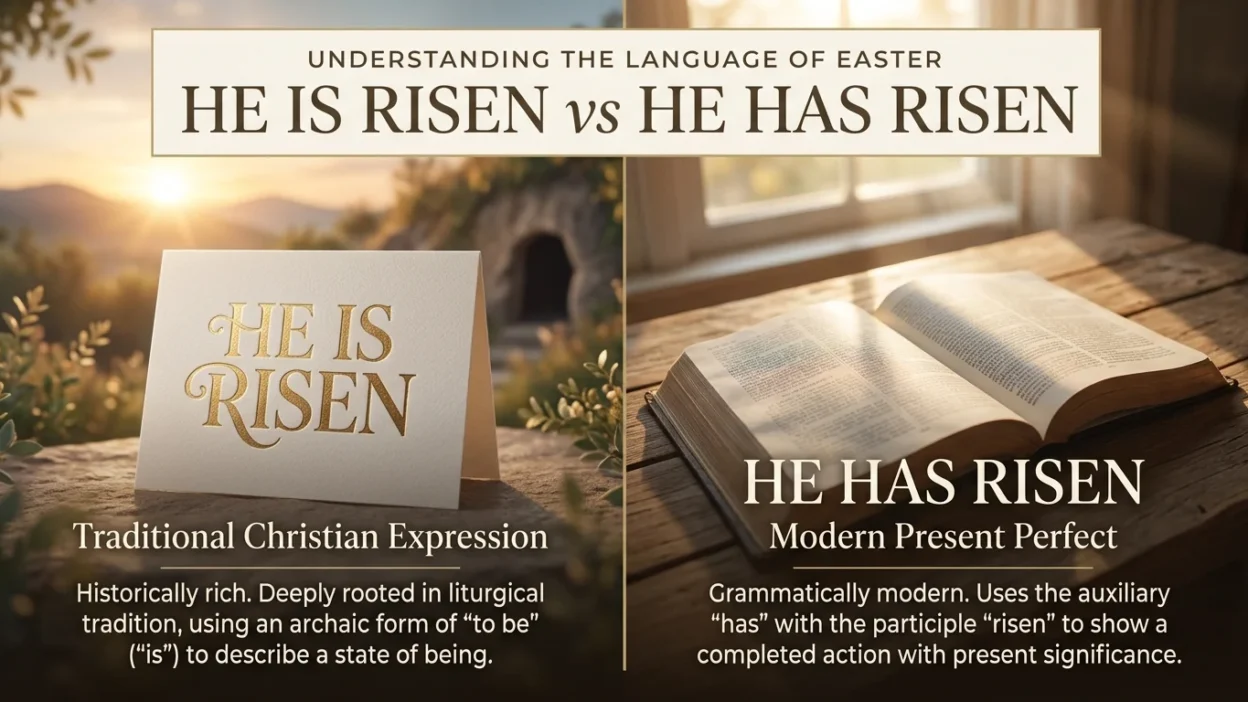
“He has risen” is the standard modern English present perfect construction. It emphasizes that the action of rising has happened. “He is risen” is an older construction that uses is with the past participle and emphasizes the resulting state. It is particularly familiar in traditional Christian language, hymns, and Easter greetings.
For example, “He has risen!” is a natural way to announce the resurrection, while “He is risen!” is a traditional Easter proclamation. Both communicate the central message that Jesus has risen from the dead.
Quick Answer
- He has risen = modern present perfect; emphasizes the completed event.
- He is risen = traditional construction; emphasizes the resulting state and is especially common in religious language.
| Phrase | Meaning | Common Usage |
|—|—|—|
| He has risen | He has risen from the dead; the event has occurred | Modern English and Christian writing |
| He is risen | He is in the state of having risen | Traditional Christian language and Easter greetings |
Why Do People Confuse “He Is Risen” and “He Has Risen”?
The confusion comes from the unusual use of is in “He is risen.” In modern English, we normally use has with a past participle to form the present perfect tense.
For example:
- She has arrived.
- He has returned.
- Jesus has risen.
However, English historically used be with certain verbs of movement or change of state to form perfect constructions. This older pattern survives in expressions such as “He is risen.”
The phrase is therefore not simply a mistake or an incorrect substitute for “He has risen.” It is a traditional grammatical construction that remains familiar in religious English.
What Does “He Has Risen” Mean?
“He has risen” uses the present perfect tense: has + past participle.
The verb rise means to move upward, get up, or emerge from a previous state. In Christian usage, “He has risen” means that Jesus has risen from the dead.
The present perfect connects a past event with the present. It announces that the resurrection has happened and remains significant now.
Examples of “He Has Risen”
- He has risen, just as He promised.
- Christians celebrate because He has risen.
- The pastor announced, “He has risen!”
- The message of Easter reminds believers that He has risen.
- The church service celebrated the belief that He has risen from the dead.
- The congregation sang about Christ because He has risen.
- The Easter message proclaimed, “He has risen indeed!”
- The sermon focused on the hope associated with the declaration that He has risen.
What Does “He Is Risen” Mean?
“He is risen” is a traditional English construction in which is combines with the past participle risen.
In this expression, risen describes the resulting state: he has risen and is now risen. The construction survives particularly in religious language, where traditional wording is often preserved.
The phrase is widely associated with Easter celebrations and the resurrection of Jesus Christ.
Examples of “He Is Risen”
- He is risen! Happy Easter!
- The congregation declared, “He is risen indeed!”
- The hymn celebrates the truth that He is risen.
- The pastor proclaimed, “Christ is risen!”
- The Easter service began with the traditional greeting, “He is risen!”
- The message of the celebration was simple: He is risen.
- The congregation responded, “He is risen indeed!”
- The church displayed a banner announcing, “He is risen!”
He Is Risen vs He Has Risen: Comparison Table
| Feature | He Is Risen | He Has Risen |
|---|---|---|
| Grammar | Traditional be + past participle construction | Present perfect tense |
| Meaning | Emphasizes the resulting state | Emphasizes the completed event and its present relevance |
| Style | Traditional, religious, and sometimes literary | Standard modern English |
| Common context | Easter greetings, hymns, liturgy | Everyday English, sermons, writing |
| Correctness | Correct | Correct |
| Example | He is risen indeed! | He has risen from the dead. |
When to Use “He Has Risen”
Use “He has risen” when you want a natural, standard modern English construction that emphasizes the event.
It is suitable for:
- General writing
- Modern religious writing
- Explanations of the resurrection
- Sermons and speeches
- Everyday conversation
For example:
Christians believe that Jesus has risen from the dead.
This sentence uses the present perfect in its familiar modern form.
When to Use “He Is Risen”
Use “He is risen” when you want the traditional religious expression, especially in Christian contexts.
It is especially appropriate for:
- Easter greetings
- Traditional hymns
- Church liturgy
- Religious banners and messages
- Traditional Christian proclamations
For example:
He is risen! He is risen indeed!
This is a traditional Easter greeting and response used in many Christian communities, though wording and customs vary.
Is “He Is Risen” Grammatically Correct?
Yes. “He is risen” is grammatically correct as a traditional construction.
Although modern English usually forms the present perfect with has or have, older English used be as an auxiliary with some verbs, including verbs expressing movement or a change of state.
This older pattern has largely disappeared from everyday English, but it remains in established expressions such as:
- He is risen.
- The time is come. (archaic or literary)
- Christ is born. (traditional religious expression)
For most ordinary modern contexts, however, “He has risen” is the more familiar grammatical pattern.
“He Is Risen Indeed” vs “He Has Risen Indeed”
Both expressions are understandable, but “He is risen indeed!” is the more established traditional response in many Easter services.
The word indeed means truly or certainly. In this greeting, it affirms the declaration of the resurrection.
Example:
- Person 1: “He is risen!”
- Person 2: “He is risen indeed!”
The response can vary among Christian traditions, but this exchange is a familiar Easter custom.
Common Mistakes
Mistake 1: Assuming “He Is Risen” Is Always Wrong
Incorrect claim:
“He is risen” is grammatically incorrect.
Correction:
“He is risen” is a traditional, established construction, particularly in religious English.
Mistake 2: Assuming the Two Phrases Have Completely Different Meanings
Both expressions refer to the same central idea in Christian usage: Jesus has risen from the dead. Their main difference is grammatical structure, emphasis, and style.
Mistake 3: Confusing “Risen” With “Raised”
These words are related but are not always interchangeable.
- He has risen means he rose or came up.
- He was raised is a passive construction that can mean someone raised him; in Christian contexts, it can refer to God raising Jesus from the dead.
For example:
Christians believe that God raised Jesus from the dead.
A Simple Memory Trick
Remember:
HAS RISEN = MODERN GRAMMAR
IS RISEN = TRADITIONAL EASTER EXPRESSION
If you’re writing a normal modern English sentence, “He has risen” is a safe choice.
If you’re writing an Easter greeting, church message, or traditional religious proclamation, “He is risen” is entirely appropriate.
He Is Risen vs He Has Risen: American and British English
There is no major difference between American and British English in the meaning of these phrases.
Both varieties use “He has risen” as the standard modern present perfect construction and recognize “He is risen” as a traditional religious expression.
The choice is mainly about context and style, rather than geography.
Similar Expressions
- Christ is risen — traditional Christian proclamation.
- Christ has risen — modern present perfect construction.
- He has risen from the dead — a clear statement of the resurrection.
- He is risen indeed — a traditional Easter response.
- Jesus was raised from the dead — passive construction emphasizing that Jesus was raised.
Frequently Asked Questions
Is “He is risen” grammatically correct?
Yes. It is a traditional construction preserved in Christian and literary English. It is especially familiar in Easter greetings and religious services.
Is “He has risen” more grammatically correct than “He is risen”?
Not exactly. “He has risen” follows the standard modern present perfect pattern, while “He is risen” is an established older construction. Both are correct in their appropriate contexts.
Which is better: “He is risen” or “He has risen”?
For ordinary modern English, “He has risen” is usually the more natural choice. For traditional Easter greetings and church proclamations, “He is risen” is especially familiar.
What does “He is risen indeed” mean?
It means “He has truly risen.” It is a traditional Christian response affirming the resurrection of Jesus Christ.
Can I write “He has risen indeed”?
Yes. It is grammatically correct and understandable, although “He is risen indeed” is the more established traditional Easter response in many churches.
Why does the Bible say “He is risen”?
Some traditional English Bible translations use this older construction. Wording differs among Bible translations, so the exact phrase depends on the translation.
Is “Christ is risen” the same as “Christ has risen”?
Both express the resurrection of Christ. “Christ is risen” has a traditional religious tone, while “Christ has risen” follows the standard modern present perfect construction.
Final Verdict
“He is risen” and “He has risen” are both correct.
Use “He has risen” for standard modern English, especially when describing the completed event. Use “He is risen” when you want the traditional Christian expression commonly heard in Easter greetings, hymns, and church services.
The easiest rule is:
He has risen = standard modern construction.
He is risen = traditional religious expression.
Conclusion
The difference between “He is risen” and “He has risen” is mainly grammatical and stylistic, not a difference in the central message. Both are used to proclaim the resurrection of Jesus Christ.
If you’re writing an ordinary sentence, “He has risen” is a natural modern choice. If you’re sharing a traditional Easter greeting, “He is risen!” is a familiar and meaningful expression.
Remember This
HE HAS RISEN = MODERN PRESENT PERFECT
HE IS RISEN = TRADITIONAL CHRISTIAN EXPRESSION

Daniel Whitmore is a faith-inspired author dedicated to writing content that uplifts and motivates. His focus is on hope, resilience, and moral clarity, offering readers guidance for navigating life with confidence and belief.