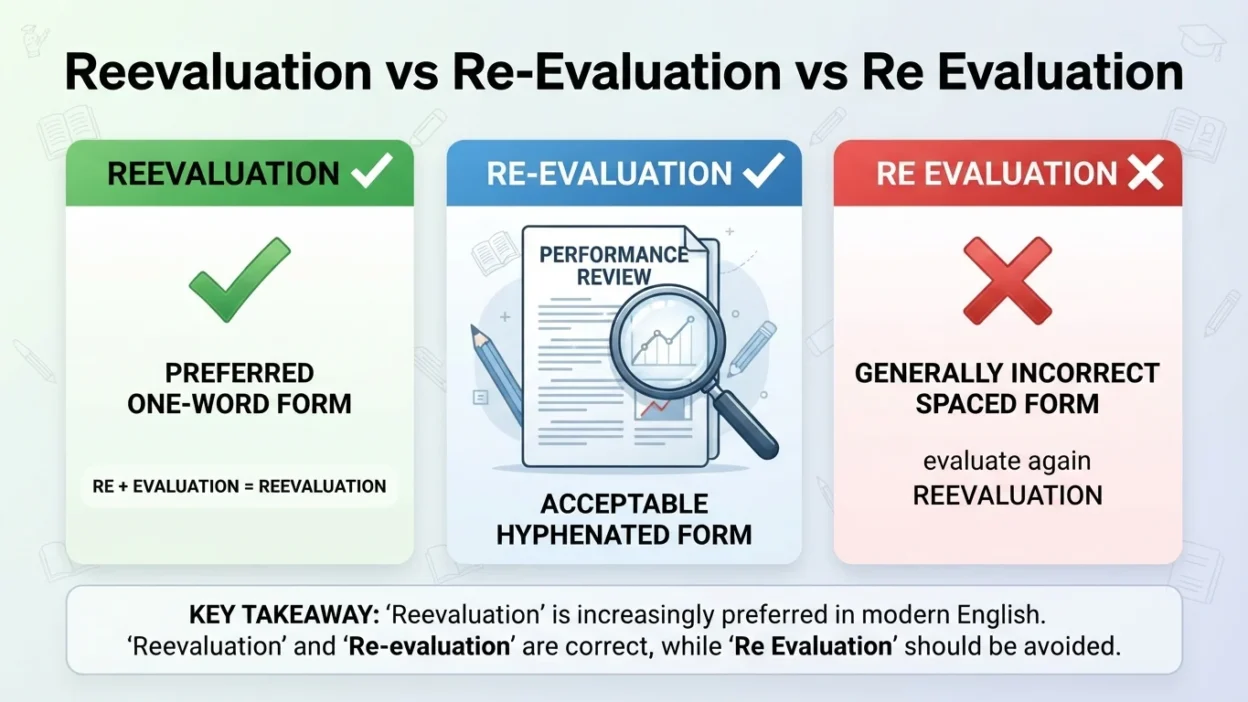
Reevaluation and re-evaluation have the same meaning: the process of evaluating or assessing something again. The main difference is spelling style. In modern standard English, reevaluation is generally preferred, while re-evaluation is also accepted and can be useful when the writer wants to make the prefix re- especially clear.
Re evaluation, written as two separate words, is generally not the standard spelling of the noun. If you are writing an essay, article, report, email, or other professional content, reevaluation is usually the safest choice. However, consistency with a particular style guide or organization’s preferred spelling can also matter.
Quick Answer
Reevaluation is the preferred modern spelling in most standard English writing.
- Reevaluation ✅ = preferred
- Re-evaluation ✅ = also acceptable
- Re evaluation ❌ = generally not standard
All refer to the act of evaluating something again.
Example:
The committee requested a reevaluation of the proposal.
What Does “Reevaluation” Mean?
Reevaluation means evaluating, reviewing, or assessing something again.
The word is formed from:
re- + evaluation = reevaluation
The prefix re- means again or anew.
For example:
The doctor recommended a reevaluation of the patient’s condition.
This means the condition should be assessed again.
Reevaluation can involve:
- Reviewing a decision
- Reassessing a situation
- Examining results again
- Reviewing someone’s performance
- Reconsidering a plan
- Checking a previous assessment
Reevaluation
Reevaluation is written as one word and is generally the best choice for standard modern English.
Examples:
- The project needs reevaluation.
- The company conducted a reevaluation of its strategy.
- A reevaluation of the results revealed several errors.
- The teacher requested a reevaluation of the student’s work.
The double e may look unusual, but it is correct:
re + evaluation → reevaluation
Re-Evaluation
Re-evaluation is written with a hyphen.
It has the same meaning as reevaluation.
Examples:
- The committee ordered a re-evaluation of the policy.
- The results require further re-evaluation.
- The employee requested a re-evaluation of the decision.
The hyphen can make the structure easier to read because it clearly separates the prefix re- from evaluation.
However, in general modern usage, the closed form reevaluation is often preferred.
Re Evaluation
Re evaluation, with a space and no hyphen, is generally not the standard form when you mean the noun reevaluation.
Avoid:
❌ The proposal requires a re evaluation.
Prefer:
✅ The proposal requires a reevaluation.
or:
✅ The proposal requires a re-evaluation.
Reevaluation vs Re-Evaluation vs Re Evaluation
| Form | Standard? | Meaning | Recommendation |
|---|---|---|---|
| reevaluation | ✅ | Evaluation again | Preferred |
| re-evaluation | ✅ | Evaluation again | Acceptable |
| re evaluation | ❌ Generally not | Evaluation again | Avoid |
When to Use “Reevaluation”
Use reevaluation when you mean that something needs to be examined or assessed again.
Examples:
- The situation requires reevaluation.
- The results led to a reevaluation of the original theory.
- The company is conducting a reevaluation of its goals.
- The student’s work is undergoing reevaluation.
- The decision is subject to reevaluation.
It works naturally in academic, business, technical, and everyday writing.
When to Use “Re-Evaluation”
Use re-evaluation when a style guide, publication, institution, or organization prefers hyphenated forms.
It can also be useful when the writer wants to make the prefix structure visually clear.
For example:
The committee began a re-evaluation of the evidence.
The hyphen makes it immediately obvious that re- means “again.”
In many contexts, however, reevaluation is more streamlined.
When Not to Use “Re Evaluation”
Avoid separating re and evaluation with a space when they form the single noun reevaluation.
❌ We need a re evaluation.
✅ We need a reevaluation.
✅ We need a re-evaluation.
The space makes the phrase look like two independent words rather than a word formed with the prefix re-.
Reevaluation Examples
- The manager requested a reevaluation of the proposal.
- The results prompted a reevaluation of the original plan.
- The student appealed for a reevaluation of the exam.
- The policy is currently undergoing reevaluation.
- The doctor recommended a reevaluation after several weeks.
- The data led to a reevaluation of the research findings.
- A reevaluation of the budget may be necessary.
- The committee completed its reevaluation of the application.
- The situation deserves careful reevaluation.
- The company announced a reevaluation of its long-term strategy.
- The evidence resulted in a reevaluation of the case.
- The teacher agreed to a reevaluation of the assignment.
Reevaluation in Different Contexts
Education
The student requested a reevaluation of the final grade.
Business
The company is conducting a reevaluation of its marketing strategy.
Research
The new evidence resulted in a reevaluation of the hypothesis.
Personal Decisions
After considering the new information, she began a reevaluation of her plans.
Policy
The government announced a reevaluation of the existing policy.
The word works across many contexts because its basic meaning is simply evaluation again.
Common Mistakes
Mistake 1: Writing “Re Evaluation”
❌ The plan needs re evaluation.
✅ The plan needs reevaluation.
Mistake 2: Thinking the Double “E” Is Wrong
Some people mistakenly write revaluation when they mean reevaluation.
These are different words.
Reevaluation = evaluating again.
Revaluation = determining a new or revised value, especially in financial or economic contexts.
Mistake 3: Using “Re-Evaluation” and “Reevaluation” Randomly
Both forms can be acceptable, but consistency is important within a document.
If you choose reevaluation, use it consistently unless a quotation or official name requires otherwise.
Mistake 4: Confusing “Reevaluation” With “Revaluation”
These words have related but different meanings:
- Reevaluation = assessing something again
- Revaluation = changing or reassessing its value
For example:
The teacher conducted a reevaluation of the student’s work.
The company announced a revaluation of its assets.
Reevaluation vs Revaluation
The spelling difference is small, but the meanings are different.
| Word | Meaning | Example |
|---|---|---|
| Reevaluation | Assessment again | The proposal needs reevaluation. |
| Revaluation | Assessment or change of value | The currency underwent revaluation. |
| Do not use revaluation when you simply mean “evaluation again.” |
Reevaluation vs Reassessment
Reevaluation and reassessment are often interchangeable because both can mean examining something again.
Examples:
- The situation needs reevaluation.
- The situation needs reassessment.
However, reassessment is sometimes more natural when discussing a previous judgment, risk, or situation.
American vs British English
Reevaluation and re-evaluation can be found in both American and British English. There is no major difference in meaning between the two varieties.
Modern spelling practices generally favor closed forms for many re- words when there is no risk of confusion, while hyphenation may still appear according to house style or individual preference.
The important point is consistency.
Similar Words
Several words are related to reevaluation:
- Reassessment — assessment again
- Review — examination or consideration
- Reconsideration — thinking about something again
- Reexamination — examination again
- Reanalysis — analysis again
- Reappraisal — assessment of value or importance again
Choose the word that best matches your intended meaning.
Frequently Asked Questions
Is it reevaluation or re evaluation?
Reevaluation is the standard closed form. Re evaluation with a space is generally not recommended.
Is re-evaluation correct?
Yes. Re-evaluation is an accepted hyphenated form of reevaluation.
Which is better: reevaluation or re-evaluation?
Reevaluation is generally the preferred modern spelling, while re-evaluation is also acceptable depending on style.
What does reevaluation mean?
Reevaluation means assessing, reviewing, or examining something again.
Is reevaluation one word?
Yes. Reevaluation is normally written as one word.
Is reevaluation the same as reassessment?
They are often used interchangeably, although the exact nuance can depend on context.
What is the difference between reevaluation and revaluation?
Reevaluation means evaluating something again. Revaluation generally refers to determining a new value, especially in financial or economic contexts.
Should I hyphenate re-evaluation?
You can use re-evaluation, but reevaluation is generally the simpler modern spelling. Follow the style guide you’re using if it specifies a preference.
Final Verdict
The best default choice is:
Reevaluation ✅
You may also use:
Re-evaluation ✅
Avoid:
Re evaluation ❌
If you’re writing general professional or academic English, reevaluation is usually the cleanest choice. Most importantly, keep your spelling consistent throughout the document.
Conclusion
Reevaluation means evaluating or assessing something again. The standard modern spelling is generally reevaluation, written as one word. The hyphenated form re-evaluation is also acceptable in many contexts, particularly when following a particular style preference.
The spaced form re evaluation is generally not the standard spelling. When you are unsure, choose reevaluation and use it consistently. Also remember that reevaluation and revaluation are different words with different meanings.
Remember This
REEVALUATION = preferred ✅
RE-EVALUATION = acceptable ✅
RE EVALUATION = generally avoid ❌
Think:
re- + evaluation → reevaluation
And remember:
reevaluation = evaluate again
revaluation = determine a new value

Lucas Bennett is an American writer passionate about spiritual insight and meaningful storytelling. His work blends faith-centered ideas with real-life experiences, encouraging readers to reflect deeply and live with intention.