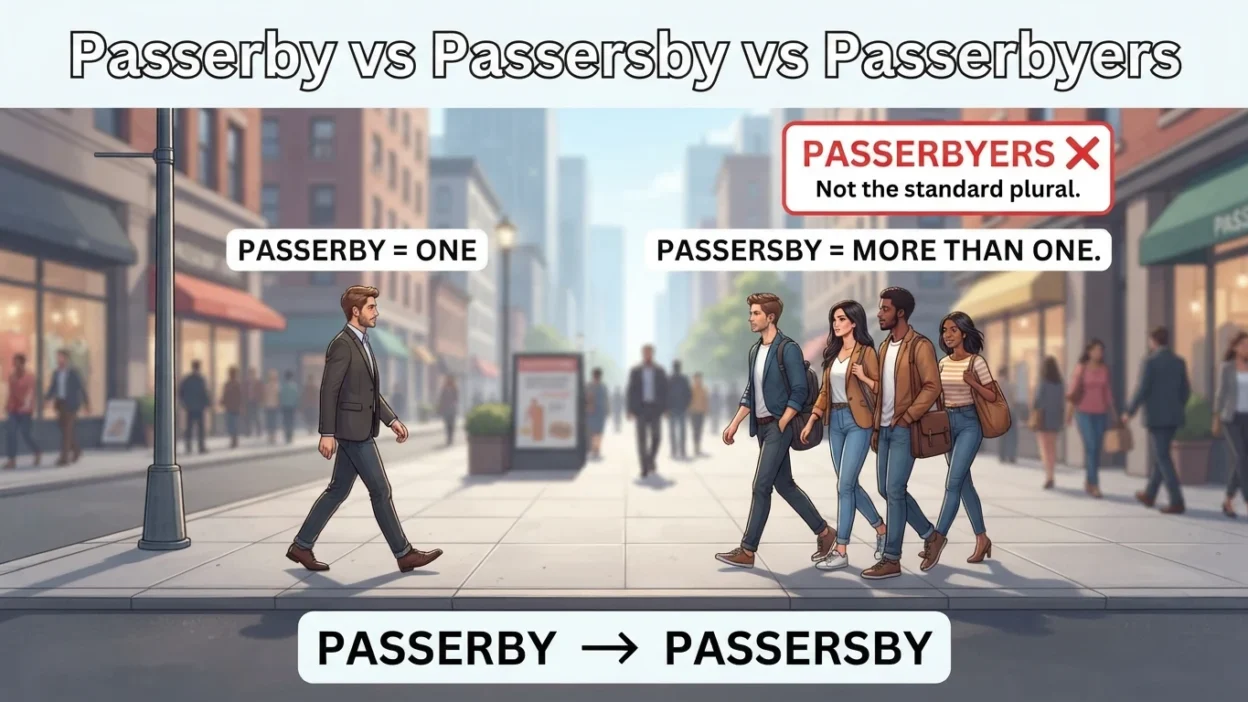
Passerby is the singular form, while passersby is the standard plural form. Passerbyers is not the standard plural and should generally be avoided. The unusual plural passersby comes from the fact that passerby is formed from the phrase passer + by, so the plural changes the main noun rather than adding -s to the end.
For example, you can say, “A passerby helped the injured cyclist,” when referring to one person, and “Several passersby stopped to help,” when referring to more than one person. Although passerby may look like an ordinary compound noun, its plural form follows a different pattern from words such as bystander or visitor.
Quick Answer
- Passerby ✅ = singular
- Passersby ✅ = plural
- Passerbyers ❌ = nonstandard and generally incorrect
Examples: - A passerby called the police.
- Several passersby stopped to watch.
The plural is formed by changing passer to passers, not by adding -ers to passerby.
Why People Confuse Them
The confusion comes from the unusual structure of passerby. Many people see passer and assume that the plural should be formed by adding -s to the whole word, producing passerbys, or they may create passerbyers because they think passerby refers to someone who “passes by.”
English compound nouns do not always form their plurals in the same way. With passerby, the plural is traditionally formed on the first part:
passerby → passersby
This is similar to other compounds where the principal noun appears before another word.
Passerby: Singular Form
Passerby means a person who happens to be walking or traveling past a particular place.
Use passerby when you are talking about one person.
Examples:
- A passerby helped the older people man.
- One passerby noticed the broken window.
- A passerby called an ambulance.
- The passerby stopped to ask what had happened.
You can use articles such as a or the with the singular form: - a passerby
- the passerby
- one passerby
Passersby: Plural Form
Passersby is the standard plural of passerby.
It means two or more people who happen to be passing a particular place.
Examples:
- Several passersby stopped to help.
- The police questioned the passersby.
- A crowd of passersby gathered outside.
- Two passersby witnessed the accident.
Notice that the s goes after passer:
passer + s + by = passersby
Passerbyers: Is It Correct?
Passerbyers is not the standard plural form of passerby.
It may occasionally appear as an informal or mistaken formation, but it should not be used in standard English.
Instead of:
❌ Several passerbyers saw the accident.
Write:
✅ Several passersby saw the accident.
The word passerby already means a person who passes by, so adding -ers creates an unnecessary and nonstandard form.
Passerby vs Passersby Comparison Table
| Form | Number | Correct? | Meaning | Example |
|---|---|---|---|---|
| Passerby | Singular | ✅ | One person passing by | A passerby helped us. |
| Passersby | Plural | ✅ | Two or more people passing by | Several passersby stopped. |
| Passerbyers | Plural | ❌ | Nonstandard formation | Avoid this form. |
| Passerbys | Plural | ❌ | Incorrect plural formation | Avoid this form. |
When to Use “Passerby”
Use passerby when referring to one person who is passing a particular location.
Examples:
- A passerby found the lost wallet.
- The passerby offered directions.
- I asked a passerby for help.
- A passerby reported the incident.
A useful test is to replace the word with one person. If the sentence still makes sense, you probably need passerby.
When to Use “Passersby”
Use passersby when referring to more than one person.
Examples:
- Several passersby stopped to look.
- The noise attracted many passersby.
- Police asked passersby whether they had seen anything.
- The street was crowded with passersby.
A useful test is to replace the word with people or several people.
15 Examples of Passerby and Passersby
Singular: Passerby
- A passerby called for help.
- The passerby noticed the unusual noise.
- One passerby stopped to assist the driver.
- A passerby gave me directions.
- The passerby returned the wallet.
- I asked a passerby where the station was.
- A passerby witnessed the incident.
Plural: Passersby
- Several passersby stopped to watch.
- The passersby gathered around the performer.
- Many passersby ignored the advertisement.
- The police spoke to several passersby.
- Two passersby helped move the injured person.
- The street was full of passersby.
- Passersby noticed smoke coming from the building.
- Several passersby took photographs of the unusual scene.
Common Mistakes
Mistake 1: Using “Passerbyers”
❌ Several passerbyers helped.
✅ Several passersby helped.
Passerbyers is not the standard plural.
Mistake 2: Writing “Passerbys”
❌ The passerbys stopped.
✅ The passersby stopped.
The plural s goes after passer, not at the very end.
Mistake 3: Using “Passersby” for One Person
❌ A passersby helped me.
✅ A passerby helped me.
Passerby is singular; passersby is plural.
Mistake 4: Forgetting Subject-Verb Agreement
Because passersby is plural, it takes a plural verb.
✅ The passersby were waiting.
Not:
❌ The passersby was waiting.
With passerby, use a singular verb:
✅ The passerby was waiting.
Passerby in Different Sentence Structures
With “a”
- A passerby helped the child.
With “the”
- The passerby called the police.
With “one”
- One passerby noticed the problem.
With “several”
- Several passersby witnessed the event.
With “many”
- Many passersby stopped to watch.
With “two”
- Two passersby offered assistance.
These patterns make the singular/plural difference easy to recognize.
Why Is the Plural “Passersby”?
Passerby is a compound noun made from passer and by. Historically and grammatically, passer is the main noun-like element, while by functions as an accompanying particle.
Therefore, the plural is formed as:
passer → passers
passerby → passersby
This is why passersby is preferred instead of passerbys.
Similar Compound Nouns
English has other compound nouns where the plural does not simply involve adding -s to the end.
Examples include:
- mother-in-law → mothers-in-law
- attorney general → attorneys general
- commander-in-chief → commanders-in-chief
- passerby → passersby
The general idea is that the part carrying the main noun function may take the plural ending.
American vs British English
Passerby and passersby are used in both American and British English.
There is no major difference in the basic singular and plural forms.
American English:
Several passersby stopped to help.
British English:
Several passersby stopped to help.
The spelling and meaning remain the same.
Synonyms for Passerby
Depending on the context, you can use:
- Pedestrian
- Bystander
- Person walking past
- Onlooker
- Observer
These words are not always exact replacements.
For example, a bystander is someone who is present and observes an event, while a passerby specifically suggests someone who is passing by.
Passerby vs Bystander
These words are related but have slightly different meanings.
A passerby is someone who happens to be passing a particular location.
A bystander is someone who is present at an event or situation but is not directly involved.
Example:
A passerby saw the accident and became a bystander.
The person was initially passing by and then remained to observe what happened.
Frequently Asked Questions
Is it “passerby” or “passersby”?
Both are correct, but they have different numbers. Passerby is singular, while passersby is plural.
Is “passerbyers” a word?
Passerbyers is not the standard plural of passerby and should generally be avoided in standard English.
What is the plural of passerby?
The standard plural is passersby.
Is “passerbys” correct?
No. The standard plural is passersby, not passerbys.
Is “passersby” singular or plural?
Passersby is plural. It refers to two or more people who are passing by.
What is the singular of passersby?
The singular is passerby.
Do you say “a passerby” or “a passersby”?
Say a passerby because a is used with a singular noun.
Does passerby take a hyphen?
Passerby is normally written as one word, without a hyphen.
Final Verdict
The correct forms are straightforward:
Passerby = one person
Passersby = more than one person
Passerbyers = not the standard plural
Remember that the plural s is added to passer, producing passersby, rather than being added to the end of the entire word.
Conclusion
The word passerby refers to one person who happens to be passing a particular place. When you are talking about multiple people, the correct plural is passersby. This unusual plural can seem confusing because most English nouns simply take -s at the end.
The form passerbyers should be avoided in standard English. If you remember the simple pattern passerby → passersby, you will be able to use the word confidently in writing and conversation.
Remember This
PASSERBY = ONE
A passerby helped me.
PASSERSBY = MORE THAN ONE
Several passersby helped me.
PASSERBYERS = ❌ NOT THE STANDARD FORM
The easiest memory trick is:
Passer → Passers
Passerby → Passersby

Lucas Bennett is an American writer passionate about spiritual insight and meaningful storytelling. His work blends faith-centered ideas with real-life experiences, encouraging readers to reflect deeply and live with intention.