“At the house” and “in the house” are both correct English expressions, but they do not mean exactly the same thing. The difference is mainly about location and position.
We use “at the house” when we mean someone is at or around a particular house, often focusing on the house as a location. We use “in the house” when we mean someone is physically inside the house. Understanding this small difference can make your English sound much more natural.
Quick Answer
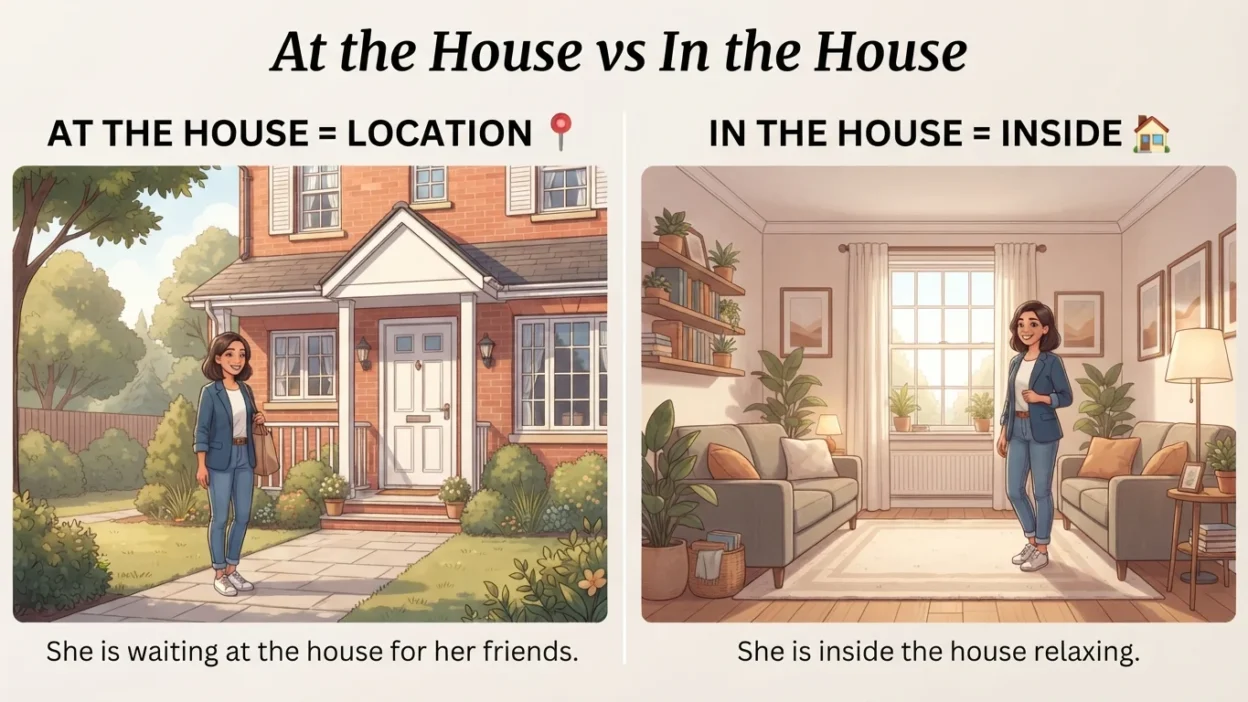
At the house means someone is at the location of the house, which can include the house, yard, driveway, or nearby area.
In the house means someone is physically inside the house.
For example:
- She is at the house. → She is at that house/location.
- She is in the house. → She is inside the house.
A simple way to remember it is: at = location, in = inside.
Why Do People Confuse “At the House” and “In the House”?
The confusion happens because both expressions can describe where someone is. However, the prepositions at and in focus on slightly different ideas.
At usually identifies a general place or location. In emphasizes being inside an enclosed space.
Compare:
- John is at the house. → John is at the house/location.
- John is in the house. → John is inside the house.
The difference may seem small, but it can change the meaning of a sentence.
What Does “At the House” Mean?
“At the house” means being at the location of a particular house. It does not necessarily tell us that the person is inside the building.
Someone who is at the house could be:
- Inside the house
- Standing outside the house
- In the driveway
- In the yard
- Near the house
For example:
“I’ll meet you at the house.”
This means the house is the meeting location. It does not necessarily mean the speaker will meet you inside.
Examples of “At the House”
- My parents are at the house.
- I left my keys at the house.
- We’ll meet at the house at six.
- There were several people at the house.
- She is waiting at the house.
- The children are playing at the house next door.
- I’ll be at the house all afternoon.
- He arrived at the house early.
- The police were called to the house.
- Is Sarah at the house?
What Does “In the House” Mean?
“In the house” means physically inside the house or within its interior.
This expression is more specific than “at the house.”
For example:
“Tom is in the house.”
This tells us that Tom is inside the building.
Examples of “In the House”
- My brother is in the house.
- There is someone in the house.
- I left my phone in the house.
- The children are playing in the house.
- She is cooking in the house.
- It’s cold outside, so let’s stay in the house.
- I heard a strange noise in the house.
- Everyone is in the house now.
- The dog is sleeping in the house.
- He found his wallet in the house.
At the House vs In the House: Comparison Table
| Expression | Meaning | Focus | Example |
|---|---|---|---|
| At the house | At the location of the house | General location | She is at the house. |
| In the house | Inside the house | Interior/inside | She is in the house. |
| At the house | May be inside or outside | Place | We’ll meet at the house. |
| In the house | Definitely inside | Interior | He is sleeping in the house. |
At the House vs In the House: Key Difference
The easiest way to understand the difference is to imagine a house as a point versus a container.
At the house treats the house as a location.
In the house treats the house as an enclosed space.
For example:
“We are at the house.”
This tells someone where you are generally.
“We are in the house.”
This specifically tells someone that you are inside.
When Should You Use “At the House”?
Use “at the house” when the exact position inside or outside is not important.
It is especially common when:
- Referring to a meeting location
- Talking about someone’s general location
- Describing an event taking place at a house
- Saying someone has arrived at a house
Examples:
“I’ll see you at the house.”
“Everyone is at the house for the party.”
“He arrived at the house around noon.”
In these examples, the focus is the house as a location rather than the interior.
When Should You Use “In the House”?
Use “in the house” when you specifically mean inside the building.
Examples:
“The children are in the house.”
“Someone is in the house.”
“I left my jacket in the house.”
“There’s plenty of food in the house.”
Here, being inside matters to the meaning.
“At My House” vs “In My House”
The same distinction applies to my house, your house, his house, and their house.
At My House
“At my house” means at my home/location.
Example:
“We’re having dinner at my house.”
The focus is the location where dinner will happen.
In My House
“In my house” means inside my home.
Example:
“There are three bedrooms in my house.”
The focus is the interior of the home.
Compare:
- We’re having a party at my house. → My house is the location of the party.
- There are ten people in my house. → Ten people are physically inside.
At the House vs At Home
“At the house” and “at home” are not always interchangeable.
At home usually emphasizes being in one’s own home or usual residence.
At the house usually identifies a particular house as a location.
For example:
“I’m at home.”
This generally means I am in my home.
“I’m at the house.”
This could refer to a particular house, especially one already mentioned.
For example:
“Where are you?”
“I’m at the house.”
This might mean the house you were discussing, visiting, repairing, or meeting at.
Common Mistakes
Mistake 1: Thinking “At the House” Always Means Inside
Incorrect assumption: “At the house” means the person is definitely inside.
Not necessarily. Someone at the house could be standing outside.
If you specifically mean inside, use “in the house.”
Mistake 2: Using “In the House” for a Meeting Location
If you’re simply describing where an event or meeting takes place, “at the house” is often more natural.
Natural: We’ll meet at the house.
Also possible but more specific: We’ll meet in the house.
The second sentence emphasizes that the meeting will happen inside.
Mistake 3: Confusing “At Home” With “In the House”
These expressions can overlap, but they are not identical.
At home focuses on someone’s home status or location.
In the house focuses on being physically inside the building.
American vs British English
Both “at the house” and “in the house” are used in American and British English.
The basic distinction remains the same:
- At the house = at the house/location
- In the house = inside the house
However, everyday usage can vary depending on context and regional speaking habits.
Similar Expressions
Here are some related expressions:
- At home — at one’s home
- Inside the house — explicitly inside the house
- Outside the house — outside the building
- By the house — near the house
- Near the house — close to the house
- Around the house — in the surrounding area
- At my place — at my home
- In my home — inside my home
Frequently Asked Questions
Is “at the house” grammatically correct?
Yes. “At the house” is grammatically correct and commonly used when referring to a house as a location.
Is “in the house” grammatically correct?
Yes. “In the house” is correct when you mean physically inside the house.
What is the difference between “at the house” and “in the house”?
At the house refers generally to the house as a location, while in the house specifically means inside the house.
Does “at the house” mean inside?
Not necessarily. Someone at the house could be inside, outside, in the yard, or in the driveway.
Can I say “I am at the house”?
Yes. “I am at the house” is natural when the house is the location you are referring to.
Can I say “I am in the house”?
Yes. “I am in the house” means you are physically inside the house.
Which is more specific: “at the house” or “in the house”?
“In the house” is more specific because it tells us that the person or object is inside.
Is “at my house” different from “in my house”?
Yes. At my house refers to your home as a location, while in my house emphasizes being inside the building.
Final Verdict
Both “at the house” and “in the house” are correct, but they serve different purposes.
Use “at the house” when you are talking about the house as a general location. Use “in the house” when you specifically mean inside the house.
If you’re unsure, ask yourself: Am I talking about the location, or am I emphasizing the interior?
Conclusion
The difference between “at the house” and “in the house” is mainly the difference between a general location and a specific interior location. At treats the house as a point or destination, while in places someone or something inside it.
So remember: at the house = at the location; in the house = inside the building. Once you understand this distinction, choosing the right preposition becomes much easier.
Remember This
AT = LOCATION 📍
IN = INSIDE 🏠
- I’m at the house. → I’m at that location.
- I’m in the house. → I’m inside the house.
A quick memory trick: “At” points to a place; “in” puts you inside it.

Daniel Whitmore is a faith-inspired author dedicated to writing content that uplifts and motivates. His focus is on hope, resilience, and moral clarity, offering readers guidance for navigating life with confidence and belief.