
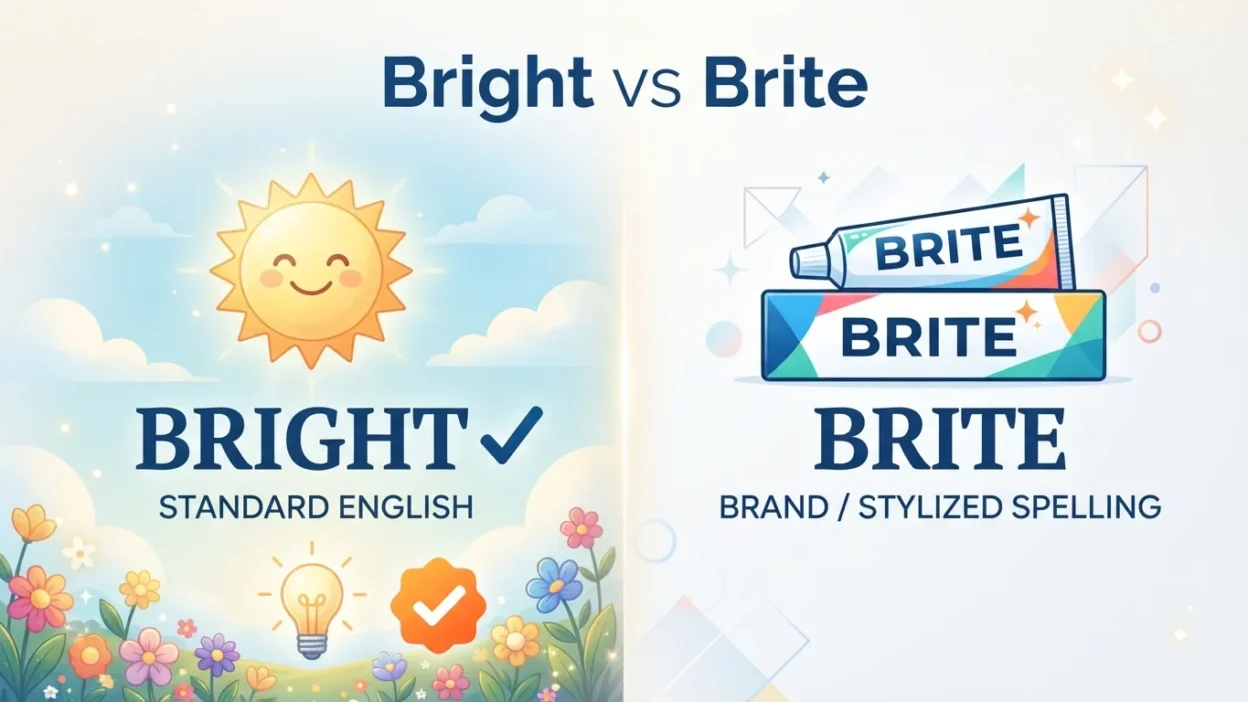
“Bright” and “brite” sound the same, but they are not used in the same way. Bright is the standard English spelling and is the word you should normally use in writing. Brite is a nonstandard or specialized spelling that appears mainly in brand names, product names, business names, and informal or stylized writing.
For example, you would write, “The room is bright,” not “The room is brite.” You might, however, see Brite in a company or product name because businesses sometimes deliberately use alternative spellings for branding.
Understanding the difference is useful because these two spellings can be confusing, especially when you encounter Brite in advertisements, packaging, websites, or names.
Quick Answer
Bright is the standard and correct spelling in ordinary English.
Brite is generally a variant or stylized spelling used in specific names, brands, products, or informal contexts.
- Bright = standard English word
- Brite = nonstandard/stylized spelling in most contexts
Examples
- The sun is very bright today. ✓
- She has a bright smile. ✓
- He is a bright student. ✓
- The company is called Brite. ✓ if that is the official name
If you are writing a normal sentence, choose bright.
Why People Confuse “Bright” and “Brite”
The main reason for the confusion is pronunciation. Bright and brite are pronounced the same way: /braɪt/.
Because English has many words with unusual spelling patterns, it can be tempting to assume that brite is simply another accepted spelling of bright.
In standard modern English, however, bright is the normal dictionary spelling. Brite is typically used for particular names, labels, trademarks, or deliberately shortened/stylized forms.
Bright: Meaning and Use
Bright is the standard English adjective and has several common meanings.
It can describe something that:
- gives off a lot of light
- has a vivid or intense color
- is intelligent
- looks cheerful or lively
- is promising or hopeful
For example: - The bright sunlight filled the room.
- She wore a bright yellow dress.
- He is a very bright student.
- The future looks bright for the young company.
Bright can also function as an adverb in certain expressions, such as bright and early.
Examples of “Bright”
- The stars were bright in the clear night sky.
- Please turn down the bright lights.
- She bought a bright blue jacket.
- He is a bright child who learns quickly.
- We woke up bright and early.
- The kitchen has a bright, cheerful atmosphere.
- Her future looks bright.
- The screen was too bright for my eyes.
- I love the bright colors in this painting.
- A bright idea suddenly came to him.
Brite: Meaning and Use
Brite is generally not the standard spelling of the adjective “bright.” Instead, it is often used as a stylized spelling.
You may encounter Brite in:
- brand names
- company names
- product names
- advertising
- usernames or business names
- specialized labels
For example, if a company officially calls its product Brite, you should preserve that spelling when referring to the product.
However, you should not normally replace bright with brite in ordinary English writing.
Examples of “Brite”
- The product is officially called Brite.
- I saw a Brite sign outside the store.
- The company recently launched a new Brite product.
- The package uses the spelling Brite as part of its brand name.
The important point is that these examples use Brite as a name or stylized term, rather than as the ordinary adjective.
Bright vs Brite: Comparison Table
| Feature | Bright | Brite |
|---|---|---|
| Standard English spelling | Yes | Usually no |
| Pronunciation | /braɪt/ | Usually /braɪt/ |
| Used as an ordinary adjective | Yes | Generally no |
| Used in formal writing | Yes | Only when it is a proper name or official term |
| Used in brand names | Yes | Yes |
| Means “giving off light” | Yes | Not normally |
| Means “intelligent” | Yes | Not normally |
| Means “vivid in color” | Yes | Not normally |
When to Use “Bright”
Use bright whenever you are using the ordinary English adjective.
For light
- The room is bright.
- The lamp is very bright.
For color
- She wore a bright red coat.
- The flowers have bright colors.
For intelligence
- He is a bright student.
- She is bright and hardworking.
For a positive future
- The team has a bright future.
- Things are looking bright for the business.
For ideas
- That’s a bright idea.
Here, bright can mean clever, intelligent, or promising depending on the context.
When to Use “Brite”
Use Brite when it is the official spelling of a particular name, brand, product, organization, or other proper term.
For example, if a business officially uses Brite in its name, changing it to Bright would make the name inaccurate.
This is similar to how companies sometimes use unusual spellings such as “Krispy” instead of “Crispy.” A stylized spelling does not necessarily become the standard spelling of the underlying English word.
Bright vs Brite in a Sentence
Compare these examples:
Standard English:
The classroom is bright and comfortable.
Brand or proper name:
The company sells a product called Brite.
The first sentence uses bright as an adjective. The second uses Brite as a specific name.
Common Mistakes
Mistake 1: Writing “brite” in ordinary English
Incorrect in standard writing:
The room is very brite.
Correct:
The room is very bright.
Mistake 2: Assuming Brite is an equal standard spelling
Although Brite may appear frequently in names and advertisements, it does not normally replace bright in standard English.
Mistake 3: Changing an official brand name
If a company or product officially uses Brite, don’t automatically “correct” it to Bright.
For example:
The product is called Brite.
Here, the unusual spelling may be intentional.
Mistake 4: Using “brite” in academic or professional writing
In essays, reports, emails, and other formal writing, use bright unless Brite is part of an official name or quotation.
Is “Brite” a Correct Word?
Brite can be a valid spelling in specific contexts, especially as a name, brand, or stylized term. But it is not the standard spelling of the ordinary English word “bright.”
Therefore, if you are writing a sentence such as “The light is bright,” use bright.
Is “Brite” a Scrabble Word?
Whether a word is accepted in a particular word game depends on the dictionary or word list that game uses. Brite should not be treated as the standard spelling of “bright” in general English.
For normal writing and communication, bright is the spelling to use.
Bright vs Brite: Easy Memory Trick
Remember:
BRIGHT = standard English
BRITE = stylized/name spelling
Think of the GH in bright as part of the standard spelling.
So:
The sun is BRIGHT.
But:
Brite can be a brand or product name.
If you’re not referring to a specific name, choose bright.
American vs British English
There is no major American-versus-British spelling difference here. Bright is the standard spelling in both American and British English.
You may encounter Brite in commercial names or specialized usage in either variety, but it is not the normal alternative spelling of bright in everyday standard English.
Related Words
If you are looking for words related to bright, several alternatives may fit depending on the meaning.
| Meaning of Bright | Alternatives |
|---|---|
| Giving off light | Shining, luminous, radiant |
| Strong in color | Vivid, colorful, brilliant |
| Intelligent | Clever, smart, intelligent |
| Cheerful | Cheerful, lively, happy |
| Promising | Hopeful, promising, encouraging |
| For example: |
- A bright light → a shining light
- A bright color → a vivid color
- A bright student → an intelligent student
- A bright future → a promising future
Frequently Asked Questions
Is “bright” or “brite” correct?
Bright is the standard spelling in ordinary English. Brite is generally used as a stylized spelling, brand name, or proper name.
Are bright and brite pronounced the same?
Yes. When brite is used as a spelling variant or name, it is generally pronounced the same as bright: /braɪt/.
Can I write “brite” instead of “bright”?
Usually no. In standard writing, use bright. Use Brite when it is part of an official name or intentionally stylized term.
Is “brite” a misspelling?
In ordinary English, brite would generally be considered a nonstandard spelling or misspelling of bright. However, it can be perfectly intentional when used in a brand or proper name.
Which is correct: “bright colors” or “brite colors”?
Bright colors is correct in standard English.
Which is correct: “bright student” or “brite student”?
Bright student is correct. Here, bright means intelligent.
Why do companies use “Brite” instead of “Bright”?
Companies sometimes use alternative spellings to create a distinctive brand identity, make a name shorter, or make it more memorable. The exact reason depends on the individual brand.
Is “Brite” an abbreviation of “bright”?
Not normally. It is better understood as a variant or stylized spelling rather than a standard abbreviation.
Final Verdict
The difference between bright and brite is mainly about standard spelling versus stylized usage.
Use bright in normal English:
The room is bright.
She is a bright student.
We have a bright future ahead.
Use Brite only when the spelling is intentionally part of a brand name, product name, business name, or other official term.
Conclusion
Bright is the correct standard English spelling and is used for things that give off light, vivid colors, intelligent people, cheerful appearances, and promising situations. It is the spelling you should choose in essays, articles, emails, schoolwork, and professional writing.
Brite may look like a simple alternative spelling, but it is generally associated with names and stylized usage rather than standard English. When you are unsure, remember the simple rule: ordinary word = bright; official or stylized name = Brite.
Remember This
BRIGHT = standard English word
BRITE = usually a name, brand, or stylized spelling
- The sun is bright. ✓
- She is a bright student. ✓
- The colors are bright. ✓
- Brite is the official name of a product. ✓

Daniel Whitmore is a faith-inspired author dedicated to writing content that uplifts and motivates. His focus is on hope, resilience, and moral clarity, offering readers guidance for navigating life with confidence and belief.