
Have you ever wondered whether to write heard, herd, or hurd? These words can be confusing because heard and herd sound alike in most English accents, while hurd looks similar to both. However, their meanings and standard usage are different.
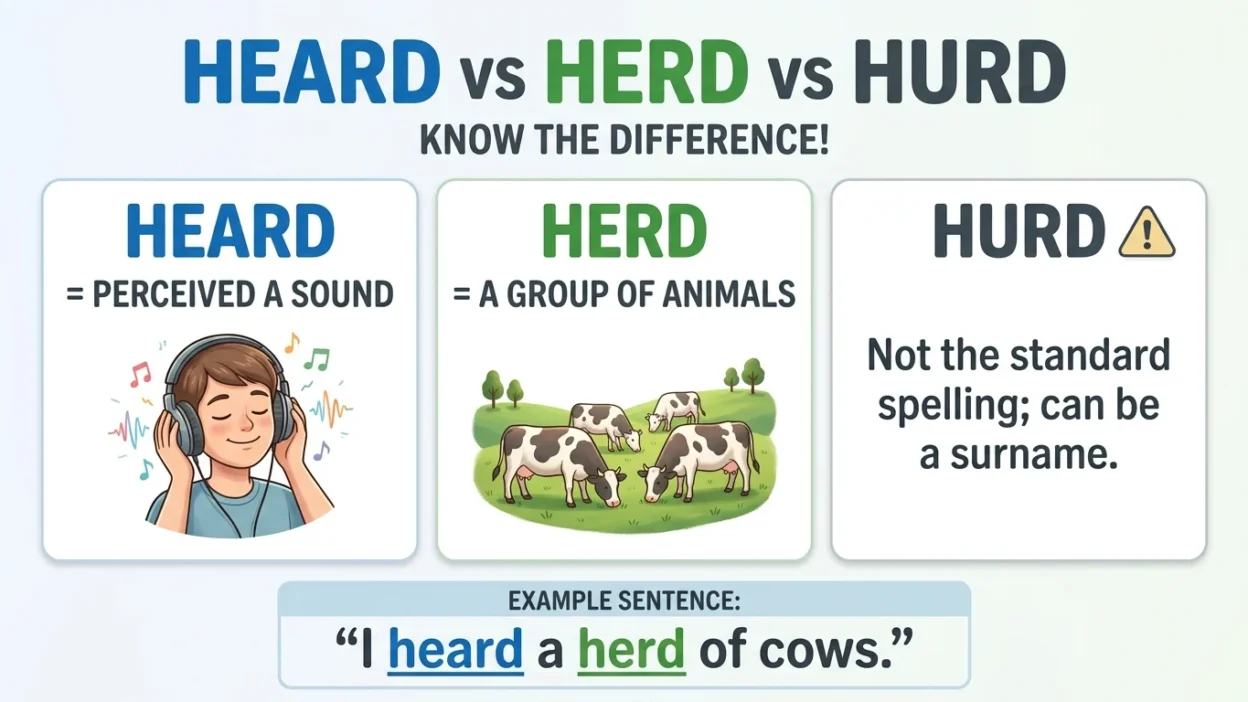
Heard is the past tense and past participle of hear, meaning to perceive a sound or receive information. Herd is a noun for a group of animals or a verb meaning to gather and guide a group. Hurd is not a standard spelling of either word, although it can appear as a surname or proper name.
Understanding these differences will help you choose the correct word in conversations, schoolwork, emails, and professional writing.
Quick Answer: Heard vs Herd vs Hurd
- Heard: The past tense of hear. Example: “I heard a strange noise.”
- Herd: A group of animals or the act of gathering and guiding them. Example: “A herd of cows crossed the road.”
- Hurd: Generally not a standard English word for either heard or herd. It may be used as a name.
Memory tip: You heard a sound, a herd contains animals, and hurd is usually the wrong spelling when you mean either of the first two words.
What Does Heard Mean?
“Heard” is the past tense and past participle of the verb hear. It describes perceiving sounds, listening to something, or receiving information.
Examples of Heard
- I heard someone calling my name.
- She heard the news yesterday.
- Have you heard this song before?
- We heard a loud noise outside.
- He heard the teacher explain the lesson.
- I have heard good things about that restaurant.
- They heard the announcement clearly.
- Nobody heard the alarm.
- I heard that you got a new job.
- Her concerns were finally heard.
In the last example, heard means that someone listened to and acknowledged her concerns.
What Does Herd Mean?
“Herd” has two common uses. As a noun, it means a group of animals, particularly cattle, elephants, deer, or similar animals. As a verb, it means to gather, move, or guide a group.
Herd as a Noun
- A herd of elephants walked across the grassland.
- The farmer owns a large herd of cattle.
- We watched a herd of deer near the forest.
Herd as a Verb
- The shepherd herded the sheep into the field.
- The farmer helped herd the cattle into the barn.
- Parents tried to herd the children toward the exit.
The verb forms are herd, herded, herded.
What Does Hurd Mean?
“Hurd” is not the standard spelling of heard or herd. In ordinary writing, people who type “hurd” usually mean one of those two words.
However, Hurd can be a surname or part of a proper name. In that context, it may be perfectly correct.
Examples:
- “I heard the announcement.” — Correct when referring to a sound.
- “The herd entered the field.” — Correct when referring to a group of animals.
- “I hurd the announcement.” — Incorrect if heard is intended.
- “Mr. Hurd arrived early.” — Correct if Hurd is the person’s surname.
Heard vs Herd vs Hurd: Comparison Table
| Feature | Heard | Herd | Hurd |
|---|---|---|---|
| Standard English word | Yes | Yes | Not generally, for these meanings |
| Part of speech | Verb form | Noun or verb | Usually a proper name |
| Main meaning | Perceived sound or information | Group of animals; gather or guide a group | Often a surname |
| Example | “I heard a bird.” | “A herd of cattle passed.” | “Ms. Hurd called.” |
| Common mistake | Using it for a group of animals | Using it for the past tense of hear | Using it instead of heard or herd |
Heard vs Herd: What Is the Difference?
The key difference is their meaning, not their pronunciation. In most English accents, heard and herd are homophones, meaning they sound the same but have different meanings and spellings.
Use heard when talking about sounds, conversations, news, or information you received.
Use herd when referring to a group of animals or the act of moving a group together.
Compare these sentences:
- “I heard a herd of cattle.” — I perceived the sound of a group of cattle.
- “The farmer herded the cattle.” — The farmer guided the animals.
Both heard and herd can appear in the same sentence, but they do different jobs.
10 Example Sentences Using Heard and Herd
- I heard a noise coming from the kitchen.
- A herd of buffalo grazed in the field.
- We heard the birds singing at sunrise.
- The farmer herded the sheep into the pen.
- Have you heard the latest news?
- A herd of wild horses ran across the plain.
- She heard the door slam.
- The rancher helped herd the cattle.
- I have never heard that expression before.
- The herd moved toward the river.
Common Mistakes to Avoid
Mistake 1: Writing Herd Instead of Heard
- Incorrect: “I herd a strange sound.”
- Correct: “I heard a strange sound.”
Use heard when you mean that you perceived a sound.
Mistake 2: Writing Heard Instead of Herd
- Incorrect: “A heard of cows crossed the road.”
- Correct: “A herd of cows crossed the road.”
Use herd for a group of animals.
Mistake 3: Using Hurd as a Standard Spelling
- Incorrect: “I hurd the music.”
- Correct: “I heard the music.”
Remember that hurd is not the standard spelling for the past tense of hear.
Mistake 4: Confusing Sound With Meaning
Since heard and herd usually sound alike, you cannot always identify the correct spelling by listening. Consider the meaning of the sentence to decide which word fits.
Easy Tricks to Remember the Difference
- Heard = ear: Both relate to hearing or sounds.
- Herd = animals: Think of a herd of cows, sheep, or elephants.
- Hurd = name: Treat it as a proper name unless a specific context establishes another use.
A simple sentence to remember is: “I heard a herd of cows.”
It uses both correct words together and makes their different meanings easy to understand.
Frequently Asked Questions
Is it heard, herd, or hurd?
Heard and herd are both correct English words with different meanings. Hurd is not the standard spelling of either word, although it can be a name.
Are heard and herd pronounced the same?
Yes, in most English accents, heard and herd are pronounced alike. They are homophones.
What does heard mean?
Heard is the past tense and past participle of hear. It means perceived a sound or received information.
What does herd mean?
A herd is a group of animals. As a verb, herd means to gather, move, or guide a group.
Is hurd a real word?
It is not a standard alternative spelling for heard or herd. However, Hurd can be a surname or proper name.
How do you use heard and herd in one sentence?
You can say, “I heard a herd of sheep moving through the field.” Here, heard describes perceiving a sound, while herd refers to the group of animals.
What is the past tense of herd?
The past tense is herded. For example: “The farmer herded the sheep into the barn.”
Final Verdict
Heard means perceived a sound or received information. Herd means a group of animals or the act of guiding a group. Hurd is generally not the correct spelling for either meaning, though it may be a proper name.
Conclusion
Although these three spellings look similar, heard and herd have distinct meanings. Remember that heard relates to hearing, while herd relates to groups of animals or guiding a group. Both are standard English words, and their similar pronunciation makes spelling mistakes easy.
When writing, focus on the meaning of the sentence rather than the sound alone. This simple habit will help you choose the correct word and avoid confusing heard, herd, and hurd.
Remember This
Heard = listened or perceived. Herd = a group of animals or to guide a group. Hurd = usually a name, not a standard substitute for either word.

Daniel Whitmore is a faith-inspired author dedicated to writing content that uplifts and motivates. His focus is on hope, resilience, and moral clarity, offering readers guidance for navigating life with confidence and belief.