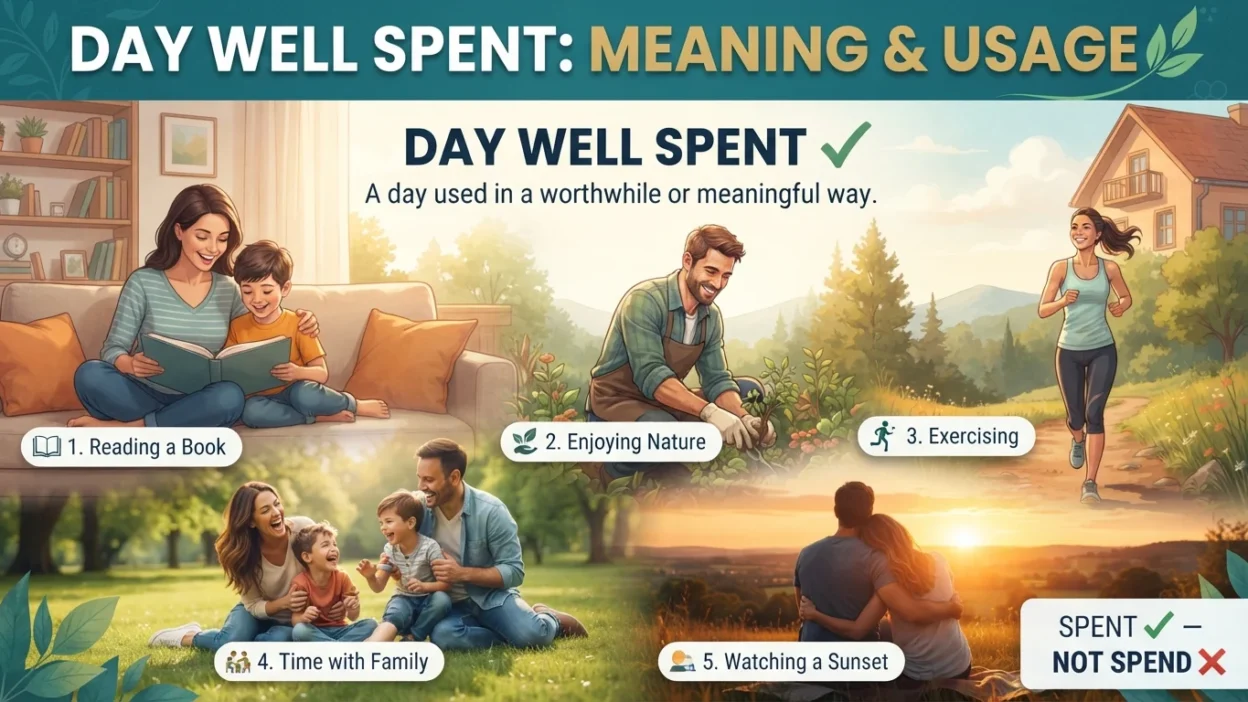
“Day well spent” is a common English expression used to say that a day was used in a worthwhile, enjoyable, productive, or meaningful way. It usually suggests that the time you spent during the day was valuable and that you have no regrets about how you spent it.
You can use day well spent after completing something enjoyable or productive, such as spending time with family, learning something new, finishing important work, traveling, exercising, or simply enjoying a peaceful day. The expression is often used in social media captions and casual conversation, but it can also appear in more reflective writing.
Quick Answer
“Day well spent” means a day spent in a worthwhile or satisfying way.
Examples:
- What a day well spent!
- A day well spent with family.
- Today was a day well spent.
It is often used to express satisfaction with how you used your time.
What Does “Day Well Spent” Mean?
The phrase day well spent means that the activities, experiences, or time spent during the day were worthwhile.
For example:
A day well spent with the people I love.
This means the speaker considers the time spent with loved ones valuable and meaningful.
It does not necessarily mean the day was productive. A relaxing day can also be a day well spent if it provided enjoyment, rest, or emotional value.
Is “Day Well Spent” Correct?
Yes. Day well spent is a correct and natural expression.
The word spent is the past participle of spend. Here, spent means that time was used or experienced.
The phrase can be understood as:
a day that was well spent
The shorter form day well spent is especially common in captions, titles, and informal expressions.
Why Do We Say “Spent”?
We use spent because English commonly uses spend with time.
For example:
- I spent the day with my friends.
- She spent the afternoon reading.
- We spent the weekend at the beach.
When the day was spent in a worthwhile way, we can describe it as:
a day well spent
So spent does not mean only “used money.” It can also mean used time.
“Day Well Spent” vs “Well-Spent Day”
Both forms are possible, but they are used slightly differently.
Day Well Spent
This is especially common as a short expression or caption.
A beautiful day well spent.
What a day well spent!
Well-Spent Day
Here, well-spent works as a compound adjective before the noun.
It was a well-spent day.
Both convey the idea that the day was worthwhile.
Day Well Spent Examples
- What a day well spent!
- A day well spent with my family.
- Today was a day well spent.
- It was a day well spent at the beach.
- A day well spent learning something new.
- A day well spent with good friends is always memorable.
- Reading, exercising, and relaxing made it a day well spent.
- We laughed, talked, and enjoyed the sunset—a day well spent.
- Helping others made it a truly well-spent day.
- After finishing the project, I felt like it had been a day well spent.
- A quiet day at home can be a day well spent.
- Spending time with loved ones is always a day well spent.
- Exploring the city with friends was a day well spent.
- Learning something useful made today a day well spent.
- No regrets—just a day well spent.
“A Day Well Spent” Usage
The most common full form is:
a day well spent
Examples:
- It was a day well spent.
- I had a day well spent with my family.
However, the second example is less natural than:
I had a wonderful day with my family.
or:
It was a day well spent with my family.
The expression works especially naturally after was, felt like, or as a standalone caption.
“A Day Well Spent” vs “A Day Well-Spent”
When well spent comes after the noun, it is normally written as:
a day well spent
When well-spent comes directly before a noun as an adjective, the hyphen is useful:
a well-spent day
So:
- A day well spent ✅
- A well-spent day ✅
- A well spent day ⚠️ Usually use the hyphen here.
Day Well Spent as a Caption
“Day well spent” is especially popular as a social media caption.
Examples:
- Day well spent. ❤️
- A day well spent with my favorite people.
- Good food, great company, day well spent.
- Sunshine, laughter, and a day well spent.
- No regrets. Just a day well spent.
The phrase works well as a caption because it is short and expressive.
Day Well Spent vs Good Day
These expressions are similar but not identical.
Good day simply means the day was enjoyable, successful, pleasant, or satisfactory.
Day well spent specifically emphasizes that the time was used in a worthwhile way.
Compare:
I had a good day.
This simply says the day was good.
It was a day well spent.
This suggests the activities or experiences made the time worthwhile.
Day Well Spent vs Productive Day
A productive day usually means you accomplished a lot.
A day well spent has a broader meaning. It can involve:
- Productivity
- Relaxation
- Family time
- Friendship
- Travel
- Learning
- Exercise
- Personal growth
- Enjoyment
For example:
I spent the entire afternoon reading in the garden. It wasn’t particularly productive, but it was a day well spent.
The expression is therefore about value, not necessarily productivity.
Common Mistakes
Mistake 1: “Day Well Spend”
❌ Day well spend.
✅ Day well spent.
Spent is the correct past participle of spend.
Mistake 2: “A Day Well Spending”
❌ A day well spending.
✅ A day well spent.
Mistake 3: Unnecessary Hyphen
When the phrase comes after the noun:
✅ It was a day well spent.
When it comes before the noun:
✅ It was a well-spent day.
Mistake 4: Assuming It Means Only Productivity
A day can be well spent even if you did not accomplish work.
For example:
A relaxing day with my family was a day well spent.
The phrase is about whether the time felt worthwhile, not necessarily whether it produced measurable results.
American vs British English
Day well spent is natural in both American and British English.
There is no meaningful difference in its basic meaning or grammatical structure.
Examples:
- American English: It was a day well spent.
- British English: It was a day well spent.
The expression is also widely understood internationally.
Similar Expressions
Depending on the context, you can use:
- A day well spent
- A day worth remembering
- A productive day
- A fulfilling day
- A meaningful day
- A wonderful day
- A rewarding day
- Time well spent
For example:
Spending time with my grandparents was time well spent.
This is similar to a day well spent, but it focuses on the specific period of time rather than the entire day.
“Time Well Spent” vs “Day Well Spent”
Time well spent is a broader expression.
It can refer to minutes, hours, days, or longer periods.
Reading books is time well spent.
Day well spent specifically refers to an entire day.
Reading, exercising, and relaxing made it a day well spent.
Frequently Asked Questions
What does “day well spent” mean?
Day well spent means that a day was spent in a worthwhile, enjoyable, meaningful, or satisfying way.
Is “day well spent” grammatically correct?
Yes. Day well spent is a correct expression. It is a shortened form of a day that was well spent.
Can I use “day well spent” as a caption?
Yes. It is a very natural caption.
For example:
Day well spent with my favorite people.
Is it “day well spent” or “day well spend”?
The correct expression is day well spent. Spent is the past participle of spend.
What is the difference between “a day well spent” and “a good day”?
A good day simply describes a pleasant or successful day. A day well spent emphasizes that the time was worthwhile.
Can a relaxing day be a “day well spent”?
Yes. The phrase does not require productivity. Rest, relaxation, family time, or enjoyment can all make a day feel well spent.
Is “well-spent day” correct?
Yes. Well-spent day is correct when the phrase comes before the noun.
For example:
It was a well-spent day.
Is “day well spent” formal or informal?
It works in both contexts, but it is particularly common in captions, casual writing, and reflective statements.
Final Verdict
“Day well spent” is a correct and natural expression meaning that a day was used in a worthwhile, meaningful, enjoyable, or satisfying way.
Use:
- A day well spent → after the noun
- A well-spent day → before the noun
Remember that spent is the correct form, not spend or spending.
Conclusion
The phrase day well spent is a simple way to express satisfaction with how you used your time. It can describe a productive day, a fun day with friends, a peaceful day at home, or a meaningful day with family.
The expression is flexible because “well spent” is about the value of the time, not necessarily how much work you accomplished. Whether you learned something new or simply enjoyed a beautiful afternoon, you can call it a day well spent.
Remember This
DAY WELL SPENT = a day used in a worthwhile way.
✅ It was a day well spent.
✅ A day well spent with family.
✅ What a day well spent!
✅ It was a well-spent day.
❌ Day well spend.
❌ Day well spending.
Easy rule:
After the noun → day well spent
Before the noun → well-spent day

Daniel Whitmore is a faith-inspired author dedicated to writing content that uplifts and motivates. His focus is on hope, resilience, and moral clarity, offering readers guidance for navigating life with confidence and belief.