“I didn’t do nothing” and “I didn’t do anything” may sound similar, but they are different in standard English. The key issue is double negation. In standard English, didn’t is already negative, so it is normally followed by anything, not nothing, when you mean that no action occurred.
For example, if someone asks, “What did you do today?” you can naturally answer, “I didn’t do anything.” This means you did not do any activity. “I didn’t do nothing” is commonly heard in informal speech and some dialects, where multiple negatives can be used for emphasis, but it can be considered nonstandard in formal Standard English.
Quick Answer
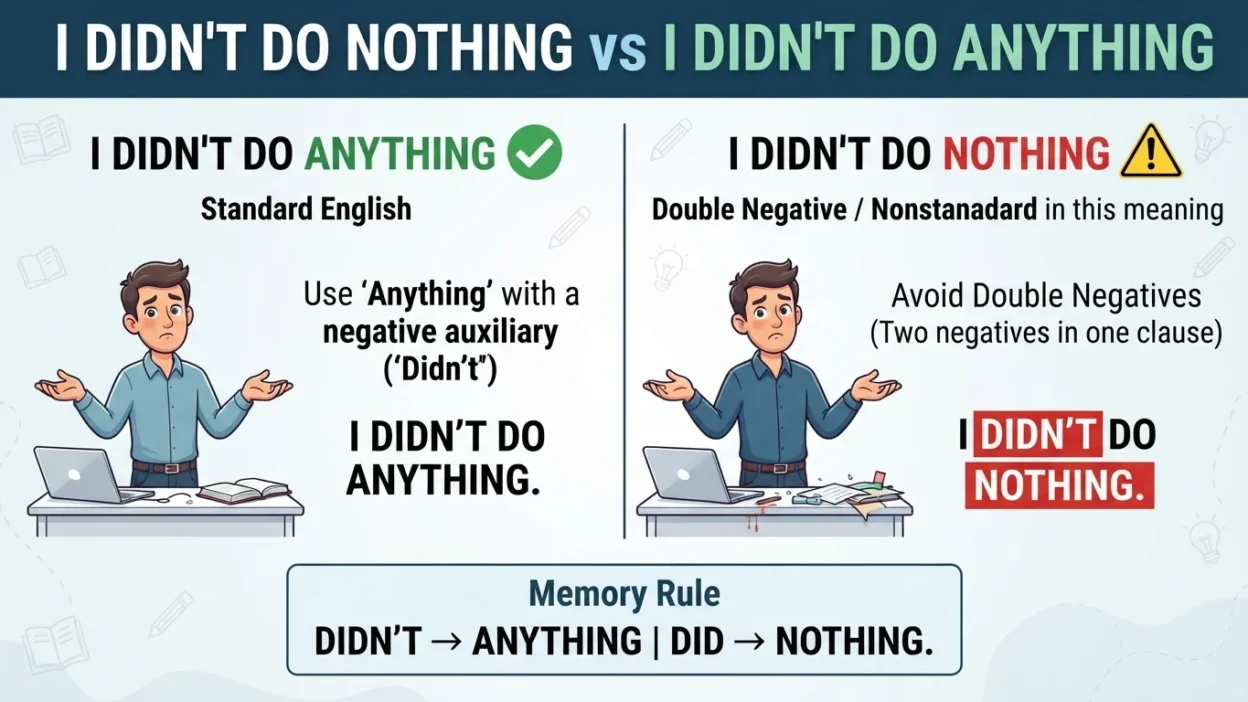
In standard English, use “I didn’t do anything” when you mean you did not do any activity.
- I didn’t do anything. ✅ Standard English
- I didn’t do nothing. ⚠️ Nonstandard double negative in this meaning
The basic rule is:
didn’t + anything
Example:
I didn’t do anything yesterday.
Why People Confuse Them
The confusion comes from the fact that nothing and anything can both refer to an absence of things or actions.
The important difference is that nothing is already negative, while anything is normally used with a negative verb.
Compare:
- I did nothing. ✅
- I didn’t do anything. ✅
Both mean essentially the same thing.
But: - I didn’t do nothing. ⚠️
contains two negative elements: didn’t + nothing.
I Didn’t Do Anything
“I didn’t do anything” is the standard form when making a negative statement about an action.
It means:
I did not do any activity or action.
Examples:
- I didn’t do anything yesterday.
- I didn’t do anything wrong.
- I didn’t do anything after work.
- I didn’t do anything all weekend.
This is the form you should normally use in school, professional writing, formal communication, and standard written English.
I Did Nothing
Another completely standard option is:
I did nothing.
It has essentially the same meaning as “I didn’t do anything.”
Compare:
- I didn’t do anything. ✅
- I did nothing. ✅
The first uses didn’t + anything, while the second uses the negative word nothing with the positive verb did.
This is an important pattern in English:
I didn’t see anybody.
I saw nobody.
Both can mean that I saw no person.
I Didn’t Do Nothing
“I didn’t do nothing” contains a double negative.
In Standard English, two negatives can create a logical problem or an unintended meaning.
For example:
I didn’t do nothing.
Taken literally, the two negatives can suggest “I did something,” although that is not usually what the speaker intends.
In some dialects and informal varieties of English, multiple negatives are used as a grammatical feature called negative concord. In those varieties, “I didn’t do nothing” can mean “I didn’t do anything.”
Therefore, the expression is common in some speech, but it should generally be avoided if you are aiming for standard formal English.
Comparison Table
| Expression | Standard English? | Meaning |
|---|---|---|
| I didn’t do anything. | ✅ Yes | I did no activity. |
| I did nothing. | ✅ Yes | I did no activity. |
| I didn’t do nothing. | ⚠️ Nonstandard in this meaning | Often intended to mean I did no activity. |
| I did not do anything. | ✅ Yes | More formal version of “I didn’t do anything.” |
When to Use “I Didn’t Do Anything”
Use “I didn’t do anything” when you want to make a negative statement about an action.
Examples:
- I didn’t do anything this morning.
- I didn’t do anything to upset her.
- I didn’t do anything after dinner.
- I didn’t do anything unusual.
- I didn’t do anything wrong.
This structure is especially useful when the sentence contains another negative idea.
For example:
I didn’t do anything wrong.
Here, anything fits naturally after the negative didn’t.
When to Use “I Did Nothing”
Use “I did nothing” when you want a more direct or sometimes slightly stronger statement.
Examples:
- I did nothing all day.
- I did nothing wrong.
- I did nothing to cause the problem.
- I did nothing but watch television.
The two forms are usually interchangeable:
I didn’t do anything.
I did nothing.
Both can mean that no action was performed.
Examples: “I Didn’t Do Anything”
- I didn’t do anything yesterday.
- I didn’t do anything after lunch.
- I didn’t do anything wrong.
- I didn’t do anything to cause the problem.
- I didn’t do anything unusual today.
- I didn’t do anything during the weekend.
- I didn’t do anything because I was tired.
- I didn’t do anything without asking first.
- I didn’t do anything to hurt you.
- I didn’t do anything special for my birthday.
Examples: “I Did Nothing”
- I did nothing all afternoon.
- I did nothing wrong.
- I did nothing to deserve this.
- I did nothing except wait.
- I did nothing after I got home.
- I did nothing unusual today.
- I did nothing but sleep.
- I did nothing about the problem.
- I did nothing to interfere.
- I did nothing while they were talking.
Common Mistakes
Mistake 1: Using “didn’t” with “nothing”
❌ I didn’t do nothing.
For standard English, use:
✅ I didn’t do anything.
Or:
✅ I did nothing.
Mistake 2: Thinking “anything” always means “something”
Anything can be used in negative sentences.
For example:
I didn’t eat anything.
This means I ate nothing.
Mistake 3: Thinking “nothing” must always have “didn’t”
It doesn’t.
You can say:
I did nothing.
The verb did is positive, while nothing provides the negative meaning.
Mistake 4: Assuming every double negative has the same meaning
In some English dialects, double negatives can function as negative concord, where multiple negative words reinforce one negative meaning. In Standard English, however, double negatives can be interpreted differently or considered nonstandard.
Double Negatives in English
A double negative occurs when two negative elements appear in the same clause.
For example:
I didn’t do nothing.
Here, didn’t and nothing are both negative.
In Standard English, the usual pattern is:
negative verb + any-word
Examples:
- I didn’t see anybody.
- I didn’t go anywhere.
- I didn’t buy anything.
- I didn’t do anything.
Alternatively, use a positive verb with a negative word: - I saw nobody.
- I went nowhere.
- I bought nothing.
- I did nothing.
“Anything” vs “Nothing”
Understanding these words makes the rule easier.
Anything
Anything commonly appears in questions and negative sentences:
- Did you see anything?
- I didn’t see anything.
- I don’t want anything.
Nothing
Nothing is itself negative:
- I saw nothing.
- I want nothing.
- Nothing happened.
Avoid adding another negative verb when using nothing in Standard English.
American vs British English
“I didn’t do anything” is standard in both American and British English.
“I did nothing” is also standard in both.
You may hear forms such as “I didn’t do nothing” in some informal speech and regional dialects in both countries. In those varieties, the construction can function as negative concord, meaning multiple negative elements work together to express one negative meaning.
For formal or standard written English, however, “I didn’t do anything” is the safer choice.
Similar Examples
The same pattern applies to other negative words.
| Nonstandard/Double Negative | Standard Alternative |
|---|---|
| I didn’t see nobody. | I didn’t see anybody. |
| I didn’t go nowhere. | I didn’t go anywhere. |
| I didn’t buy nothing. | I didn’t buy anything. |
| I don’t know nothing. | I don’t know anything. |
| I can’t find nothing. | I can’t find anything. |
| The general pattern is: | |
| Negative verb → anything / anybody / anywhere | |
| or | |
| Positive verb → nothing / nobody / nowhere |
How to Remember the Rule
Think of it as a simple matching system:
DIDN’T → ANYTHING
DID → NOTHING
So:
I didn’t do anything. ✅
I did nothing. ✅
Avoid:
I didn’t do nothing. ⚠️
This memory trick works for many similar constructions:
- I didn’t see anybody.
- I saw nobody.
- I didn’t go anywhere.
- I went nowhere.
Frequently Asked Questions
Is “I didn’t do nothing” grammatically correct?
In Standard English, it is generally considered nonstandard when intended to mean “I didn’t do anything” because it contains a double negative. Some dialects use it as negative concord.
Which is correct: “I didn’t do anything” or “I didn’t do nothing”?
For standard English, use “I didn’t do anything.”
Can I say “I did nothing”?
Yes. “I did nothing” is completely standard and means essentially the same as “I didn’t do anything.”
Why is “anything” used after “didn’t”?
Because anything is commonly used in negative sentences. The negative meaning comes from didn’t.
Does “I didn’t do nothing” mean I did something?
In formal logical interpretation, two negatives can potentially suggest an affirmative meaning. However, speakers who use negative concord often intend it simply to mean “I didn’t do anything.” Context and dialect matter.
Is “I didn’t do nothing” slang?
It can occur in informal speech and regional or social dialects. Calling it simply “slang” can be misleading because negative concord is a systematic grammatical feature in some varieties of English.
Which sounds more natural: “I didn’t do anything” or “I did nothing”?
Both are natural. I didn’t do anything is especially common in everyday conversation, while I did nothing can sound more direct or emphatic.
Final Verdict
For Standard English, the best choices are:
✅ I didn’t do anything.
✅ I did nothing.
Avoid “I didn’t do nothing” in formal and standard written English when you mean that you did no activity. It contains two negative elements, although it is used naturally in some dialects through negative concord.
The easiest rule to remember is:
didn’t + anything
did + nothing
Conclusion
The difference between “I didn’t do nothing” and “I didn’t do anything” comes down to how English handles negative words. In Standard English, didn’t already creates the negative, so anything is normally used: “I didn’t do anything.”
If you want to use nothing, remove the negative auxiliary and say “I did nothing.” Once you learn these two patterns, you can apply the same rule to words such as anybody, nobody, anywhere, and nowhere.
Remember This
Standard English:
- I didn’t do anything. ✅
- I did nothing. ✅
- I didn’t do nothing. ⚠️ Usually nonstandard in formal/standard English
Easy rule:
DIDN’T → ANYTHING
DID → NOTHING

Daniel Whitmore is a faith-inspired author dedicated to writing content that uplifts and motivates. His focus is on hope, resilience, and moral clarity, offering readers guidance for navigating life with confidence and belief.