
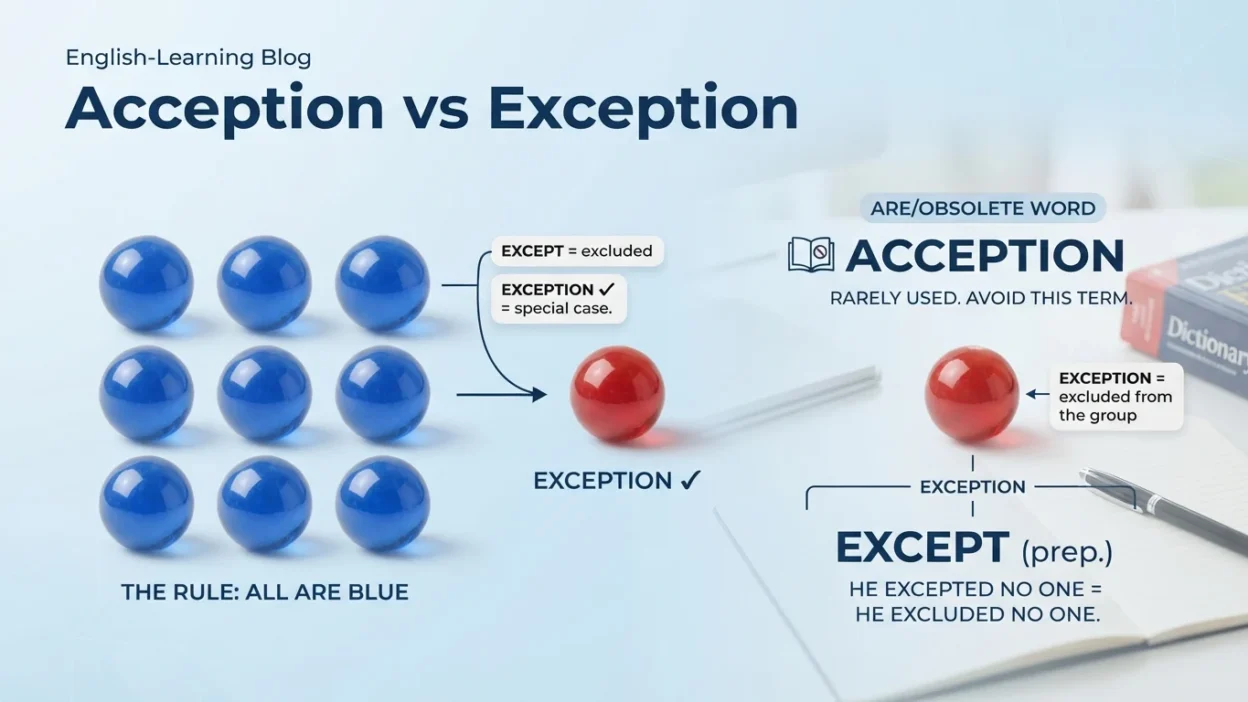
Acception and exception look and sound similar, so it is easy to mix them up. However, they have very different meanings and are not interchangeable in everyday English. If you’re trying to say that something is excluded from a general rule, the word you almost certainly need is exception.
Exception is a common English noun meaning something that does not follow a general rule, pattern, or expectation. For example, “Everyone passed the test except Tom” and “There is an exception to this rule” use the idea of something being different from the general case. Acception, on the other hand, is a rare and largely obsolete word related to the act of accepting or receiving something. In modern English, it is generally not the word you want. Knowing this distinction can prevent a very common spelling and vocabulary mistake.
Quick Answer
Exception is the common modern English word meaning a person or thing that does not follow a general rule. Acception is a rare, archaic term related to acceptance or the way something is received. In normal modern writing, use exception.
Why People Confuse It
The words are confusing because they differ by only one letter:
- acception
- exception
They also share the ending -ception, which appears in several English words.
But the meanings are different.
Exception = something that does not follow the usual rule.
Acception = a rare/obsolete word related to accepting or receiving.
If you’re writing everyday English, academic work, business communication, or online content, exception is overwhelmingly more likely to be the word you need.
Acception
Acception is a rare and largely obsolete noun.
Historically, it has been used in senses related to acceptance, receiving, or taking something in a particular sense or interpretation.
You may encounter it in older texts, historical dictionaries, or specialized discussions of language and theology.
For modern everyday English, however, acception is generally not used.
Example
The word was used in an unusual acception in the old text.
This is a highly uncommon and specialized use.
In modern English, a writer would usually choose a more familiar word such as acceptance, interpretation, or meaning, depending on the intended sense.
Exception
Exception is a common modern English noun.
It refers to something or someone that does not follow a general rule, statement, or pattern.
For example:
Everyone is invited, with one exception.
This means one person or group is not included.
Another example:
There is an exception to this rule.
This means the rule does not apply in one particular case.
Exception in Everyday English
You will commonly see exception in phrases such as:
- An exception to the rule
- Make an exception
- With the exception of
- No exception
- An obvious exception
- A rare exception
Acception vs Exception: Comparison Table
| Word | Meaning | Modern Usage | Example |
|---|---|---|---|
| Acception | A rare/obsolete term related to acceptance or interpretation | Very uncommon | The term had a different acception in the old text. |
| Exception | Something that does not follow a general rule or pattern | Very common | There is an exception to the rule. |
The Easy Rule
If you mean “something that is different from the rule,” use:
EXCEPTION ✅
When to Use Each
Use “Exception”
Use exception when talking about:
- A rule that does not apply in one case
- Someone or something excluded from a general statement
- A person or thing that differs from the norm
- A special case
- Something unusual
Examples:
Everyone attended, with the exception of John.
There are no exceptions to this policy.
She is an exception to the usual pattern.
Use “Acception”
In ordinary modern English, you will rarely need acception.
If you encounter it in historical or specialized writing, its exact meaning should be determined from the context.
For most modern writing, acceptance or interpretation may be the more appropriate word.
Examples of Acception vs Exception
- There is an exception to the rule.
One case does not follow the general rule. - Everyone passed, with the exception of two students.
Two students were not included in the general statement. - The manager made an exception for the customer.
The manager allowed something that normally wasn’t allowed. - Every employee must follow the policy, without exception.
Nobody is excluded from the rule. - This case is an exception to the usual pattern.
It is different from what normally happens. - She is an exception to the general rule.
She does not behave or qualify in the usual way. - There are a few exceptions to this grammar rule.
Some cases work differently. - The old document uses the word in a different acception.
Here, acception is being used in its rare historical sense. - With the exception of Friday, the store is open every day.
Friday is excluded from the general statement. - The teacher made an exception and allowed extra time.
A special allowance was made.
Common Mistakes
Mistake 1: Writing “acception” when you mean “exception”
❌ There is an acception to the rule.
✅ There is an exception to the rule.
This is the most important distinction.
Mistake 2: Confusing “exception” with “acceptance”
Acceptance means receiving or approving something.
She received acceptance into the program.
Exception means a special case that does not follow a general rule.
There was an exception to the admission policy.
Mistake 3: Confusing “except” and “accept”
These are also different:
Except = excluding.
Everyone came except Sarah.
Accept = receive or agree to something.
I accept your offer.
Mistake 4: Assuming every “-ception” word has a similar meaning
Words such as acceptance, exception, conception, and perception have different meanings despite their similar endings.
Memory Trick
Here’s a simple way to remember exception:
EXCEPTION = EXCLUDED
Both words begin with EX.
If something is excluded from a general rule, it is an exception.
For example:
Everyone is invited except Mark.
Mark is the exception.
Remember:
EXCEPTION → EXCLUDED CASE
American vs British English
There is no significant difference between American and British English regarding exception.
Both varieties commonly use:
exception
The rare word acception is also not a normal everyday alternative in British English or American English.
So whether you’re writing for an American or British audience, use exception when you mean a special case or departure from a rule.
Similar Words
Except
Means excluding someone or something.
Everyone came except Ali.
Accept
Means to receive, agree to, or approve something.
She accepted the invitation.
Acceptance
The act of accepting something.
His acceptance of the offer surprised everyone.
Exclusion
The act of leaving someone or something out.
The rule allows no exclusion.
Special Case
Something that is treated differently from the normal situation.
This is a special case.
Deviation
A departure from the usual pattern or standard.
The result was a significant deviation from the norm.
FAQs
Is it acception or exception?
If you mean a special case that does not follow a general rule, the correct word is exception.
Is acception a real word?
Yes, acception has appeared as a rare or obsolete English word, but it is not commonly used in modern English.
What does exception mean?
Exception means something or someone that does not follow a general rule, statement, or pattern.
What is the difference between acceptance and exception?
Acceptance means receiving, approving, or agreeing to something. Exception means a special case that does not follow a general rule.
What does “with the exception of” mean?
“With the exception of” means excluding.
Everyone attended with the exception of Sarah.
This means Sarah did not attend.
What does “make an exception” mean?
To make an exception means to allow something that would normally not be allowed under a rule.
The teacher made an exception and accepted the late assignment.
Is exception common in English?
Yes. Exception is a very common word in everyday, academic, professional, and formal English.
Final Verdict
If you’re choosing between acception and exception, exception is almost certainly the word you need in modern English. Use it for a special case, something that does not follow a rule, or something excluded from a general statement.
Acception is a rare historical or specialized word and should not normally be used as a synonym for exception. If you mean “a case that is different from the rule,” always choose exception.
Conclusion
The difference between acception and exception becomes easy once you focus on meaning rather than spelling. Exception is the everyday word for something that falls outside a general rule or pattern, while acception is rarely encountered outside historical or specialized contexts.
When you’re unsure, remember the connection between exception and except. If something is excepted or excluded, it is an exception. That simple association can help you choose the correct word every time.
Remember This
EXCEPTION ✅ = a special case or something excluded from a rule
There is an exception to the rule.
ACCEPTION ⚠️ = rare/obsolete word related to acceptance or interpretation
For normal modern English, choose:
EXCEPTION

Daniel Whitmore is a faith-inspired author dedicated to writing content that uplifts and motivates. His focus is on hope, resilience, and moral clarity, offering readers guidance for navigating life with confidence and belief.