If you’ve ever hesitated between message and messege, you’re not alone. The two spellings look almost identical, but there is an important difference: message is the correct English spelling, while messege is a common spelling mistake. This small error often happens because the pronunciation can make the word’s vowel pattern difficult to remember.
The word message is extremely common in everyday English. It can refer to a piece of information sent to someone, a written or spoken communication, or the main idea behind a speech, book, movie, or story. Whether you’re talking about a text message, an email, a phone message, or the central message of a story, the correct spelling is always message. Learning a simple memory trick can make this spelling easy to remember.
Quick Answer
Message is the correct spelling. Messege is incorrect and should not be used in standard English. Remember the spelling as MESS + AGE = MESSAGE. Use message for texts, communications, information, or the main idea of something.
Why People Confuse It
The mistake happens because message is pronounced approximately like “MESS-ij,” while the spelling contains -age.
People sometimes write messege because they hear the middle vowel sound differently.
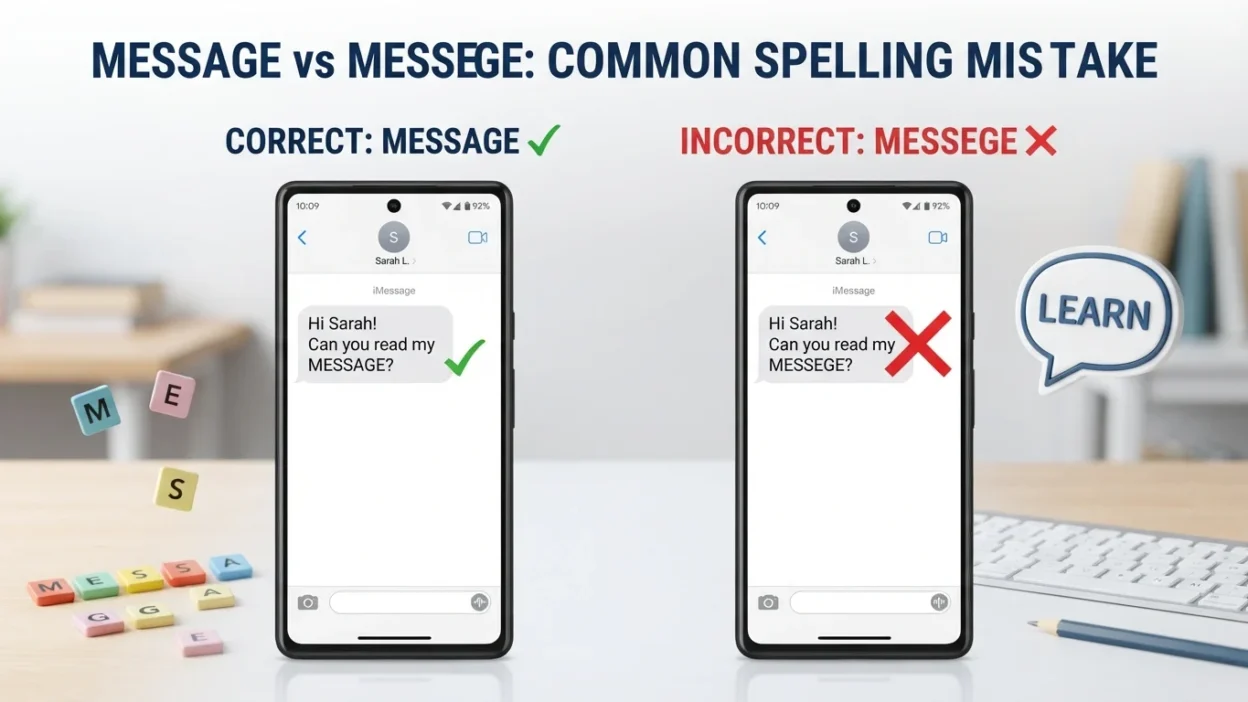
The correct spelling is:
MESSAGE ✅
The incorrect spelling is:
MESSEGE ❌
A useful way to remember it is to break the word into:
MESS + AGE = MESSAGE
There is only one e between the g and the final a sound pattern.
Message
Message is the standard and correct English word.
As a noun, it can mean a piece of information or communication sent from one person to another.
I received your message this morning.
It can also mean the central idea or meaning of something.
The movie has a powerful message about friendship.
As a verb, message means to send someone a message, particularly through digital communication.
I’ll message you when I arrive.
Common Uses of Message
You can use message for:
- Text messages
- Phone messages
- Email messages
- Social media messages
- Written communication
- Spoken information
- Warnings
- Instructions
- The main idea of a story
- The meaning or lesson of a work
Messege
Messege is not the standard spelling of the English word.
If you see messege in a text, email, article, assignment, or professional document, it is almost certainly a spelling error.
❌ Please send me a messege.
✅ Please send me a message.
The correct spelling should always be message.
Message vs Messege: Comparison Table
| Spelling | Correct? | Meaning | Example |
|---|---|---|---|
| Message | ✅ Yes | Communication or main idea | I sent her a message. |
| Messege | ❌ No | Incorrect spelling of message | Please don’t write “messege.” |
There is no difference in meaning because messege is simply a misspelling.
When to Use Each
There is only one correct choice in standard English:
Use “message”
Use message whenever you mean:
- A text sent to someone
- Information communicated to another person
- A written or spoken communication
- The main idea of a story, speech, or movie
- A digital communication
Examples:
Did you get my message?
The teacher left a message for the students.
What is the message of the book?
Do Not Use “messege”
Messege should not be used in standard English writing.
If you’re writing a:
- School assignment
- Blog post
- Business document
- Social media post
- Application
- Professional message
always use message.
Examples of Message vs Messege
- I sent you a message yesterday.
Correct spelling. - Did you receive my message?
Correct spelling. - She left a message on my phone.
Correct spelling. - The teacher sent a message to the parents.
Correct spelling. - I’ll message you later.
Correct verb usage. - The movie delivers an important message.
Here, message means the central idea. - His speech had a positive message.
Correct spelling. - Please message me when you get home.
Correct digital communication usage. - I didn’t see your message until this morning.
Correct spelling. - The campaign’s message was easy to understand.
Correct spelling. - She received a short message from her friend.
Correct spelling. - Messege is an incorrect spelling of message.
Here, messege is being discussed as an error.
Common Mistakes
Mistake 1: Writing “messege”
❌ I received your messege.
✅ I received your message.
The correct spelling contains -age, not -ege.
Mistake 2: Adding an extra “e”
A common spelling pattern is:
❌ MESSEGE
The correct form is:
✅ MESSAGE
Mistake 3: Thinking the pronunciation determines the spelling
English spelling does not always match pronunciation perfectly. Even though message sounds roughly like “mess-ij,” its standard spelling remains message.
Memory Trick
Try this simple trick:
MESS + AGE = MESSAGE
Break the word into two parts:
MESS + AGE
That gives you:
MESSAGE
Another useful reminder is:
A message has AGE, not EGE.
So whenever you’re unsure, think:
mess + age → message
American vs British English
There is no spelling difference between American and British English for this word.
Both varieties use:
message ✅
The spelling messege is incorrect in both American and British English.
The word is widely used in both varieties for communication, information, and the central idea of something.
For example:
American English: I sent you a message.
British English: I sent you a message.
The spelling remains exactly the same.
Similar Words
Text
A written digital message, especially one sent by phone.
I’ll send you a text.
Note
A short written communication.
She left me a note.
Communication
The exchange of information or ideas.
Good communication is important.
Announcement
Information given publicly to inform people.
The company made an announcement.
Notification
An alert informing someone about an event or activity.
I received a notification on my phone.
Messenger
A person or service that delivers a message.
The messenger delivered the letter.
These words are related to message, but they do not replace it in every context.
FAQs
Is it message or messege?
Message is the correct spelling. Messege is a common spelling mistake.
Is “messege” a real word?
No. Messege is not the standard English spelling. It is an incorrect spelling of message.
How do you spell message correctly?
The correct spelling is M-E-S-S-A-G-E: message.
Why do people spell message as messege?
The error usually occurs because the pronunciation of message can make the vowel pattern confusing. People may incorrectly assume the middle vowel should be e.
What does message mean?
A message can be information communicated to someone or the main idea or meaning of something.
Can message be a verb?
Yes. Message can be used as a verb, especially in modern digital communication.
I’ll message you tonight.
What is an easy way to remember the spelling of message?
Remember:
MESS + AGE = MESSAGE
The correct ending is -age, not -ege.
Final Verdict
The answer is simple: message is correct, and messege is incorrect. Although the two spellings are easy to confuse, messege is simply a misspelling and has no separate meaning in standard English.
Whenever you’re referring to a text, communication, piece of information, or central idea, use message. If you’re unsure about the spelling, remember MESS + AGE = MESSAGE.
Conclusion
Correct spelling matters, especially with common words that appear frequently in emails, schoolwork, websites, social media, and everyday communication. Since message is used so often, learning its correct spelling is worth remembering.
The simplest rule is to avoid messege completely and use message every time. Think of MESS + AGE, and you’ll have an easy spelling shortcut whenever this commonly confused word comes up.
Remember This
MESSAGE ✅ = correct
MESSEGE ❌ = incorrect
Memory trick:
MESS + AGE = MESSAGE
So, write:
“I received your message.”
Not:
“I received your messege.”

Lucas Bennett is an American writer passionate about spiritual insight and meaningful storytelling. His work blends faith-centered ideas with real-life experiences, encouraging readers to reflect deeply and live with intention.