The word “soon” sounds like it gives us a clear idea about time, but it is actually quite flexible. When someone says, “I’ll be there soon,” they mean they will arrive in the near future, but they do not necessarily give an exact number of minutes, hours, or days. The meaning depends heavily on the situation, the speaker, and what is being discussed.
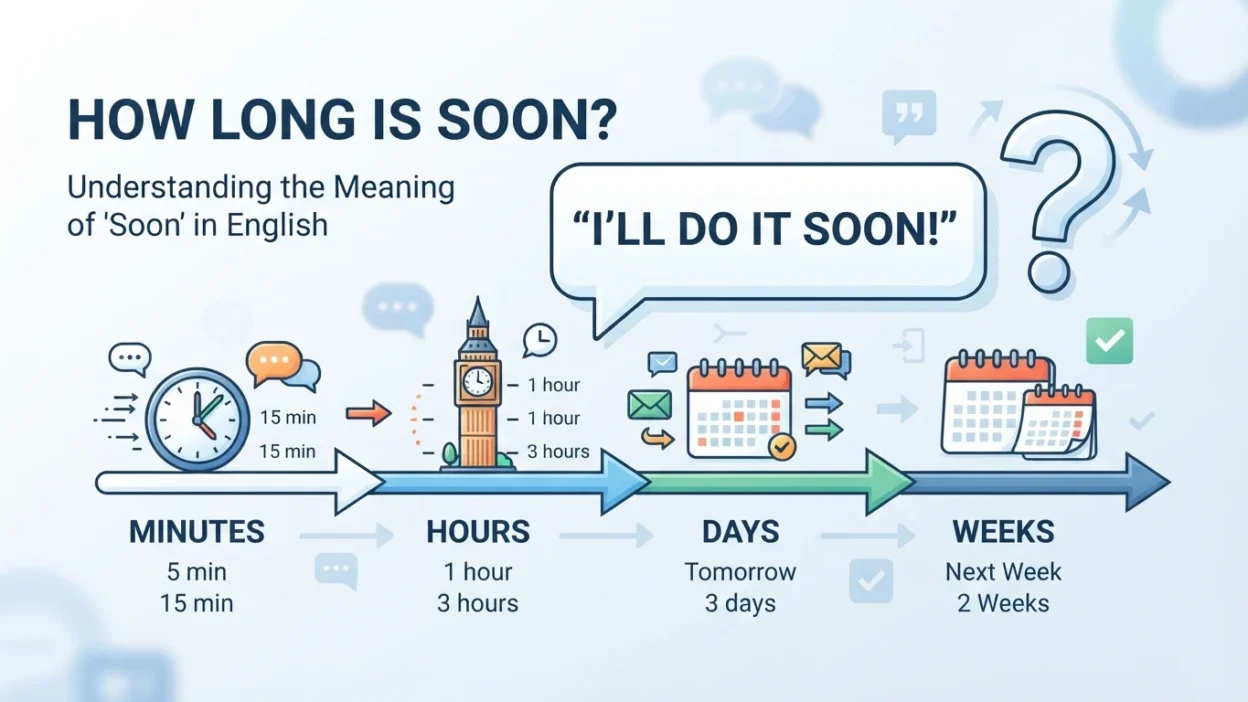
So, how long is soon? There is no universal answer. In a casual conversation, soon might mean a few minutes or a few hours. In a workplace, it might mean later today or within the next few days. For a major project, soon could even mean within weeks. Understanding the context, urgency, and surrounding words can help you interpret what someone really means when they say soon.
Quick Answer
Soon means in the near future, but it does not have a fixed length of time. Depending on the context, it can mean minutes, hours, days, or even weeks. If exact timing matters, ask, “How soon?” or “When exactly?”
Why People Ask “How Long Is Soon?”
People ask this question because soon is vague.
If someone says:
“I’ll call you soon.”
You know the call is supposed to happen in the near future, but you don’t know whether that means:
- In 5 minutes
- In 30 minutes
- Later today
- Tomorrow
- In a few days
The word itself does not provide an exact deadline.
That is why “soon” is a relative time expression. Its meaning changes according to the situation.
What Does “Soon” Mean?
Soon means after a short amount of time or in the near future.
For example:
I’ll be home soon.
The speaker expects to arrive relatively shortly.
The movie will start soon.
The movie is expected to begin in the near future.
She’ll reply soon.
The speaker expects a response without a long delay.
The important point is that soon describes closeness in time, not a specific duration.
How Long Can “Soon” Be?
There is no official time limit for soon.
In a Casual Conversation
Soon may mean:
- A few minutes
- 10–30 minutes
- Within an hour
- Later the same day
Example:
“Dinner will be ready soon.”
This usually suggests that dinner is relatively close to being ready.
In Work or Business
Soon could mean:
- Later today
- Tomorrow
- Within a few days
- Within a week
Example:
“We’ll send the report soon.”
This is vague unless the workplace has an established deadline.
For Long-Term Plans
In a larger project, soon can sometimes mean weeks or even longer.
“Construction will begin soon.”
If the project is still being planned, soon might mean several weeks away.
This is why context is essential.
Soon vs Very Soon
Very soon generally suggests a shorter wait than soon, but it is still not an exact measurement.
Compare:
I’ll call you soon.
I’ll call you very soon.
The second statement usually suggests that the call will happen sooner or that the speaker wants to emphasize its closeness.
However, neither expression guarantees a specific time.
Soon vs Shortly
Shortly and soon can have similar meanings.
The train will arrive soon.
The train will arrive shortly.
Both suggest that the train is expected in the near future.
However, shortly can sometimes sound more formal, while soon is extremely common in everyday conversation.
Soon vs Later
These words can also be compared:
Soon = relatively near in time.
Later = at some time after now, without necessarily suggesting that it is very near.
For example:
I’ll call you soon.
This suggests a relatively short wait.
I’ll call you later.
This simply means the call will happen afterward, possibly much later.
Soon vs In a Few Minutes
These expressions are not equally precise.
I’ll be there soon.
This is vague.
I’ll be there in five minutes.
This is specific.
If timing matters, an exact expression is better than soon.
Useful alternatives include:
- In five minutes
- Within an hour
- By this evening
- Tomorrow morning
- By Friday
- Within a few days
Examples of “Soon”
- I’ll call you soon.
The speaker intends to call in the near future. - Dinner will be ready soon.
Dinner is expected to be ready shortly. - She’ll arrive soon.
She is expected to arrive without a long wait. - The store will open soon.
The opening is approaching. - I’ll send you the details soon.
The details will be sent in the near future. - The results should be available soon.
The results are expected relatively shortly. - We’re moving soon.
The move is planned for the near future, but the exact date isn’t stated. - I’ll get back to you soon.
The speaker intends to respond after a relatively short delay. - The new product will be released soon.
The release is expected in the near future. - See you soon!
This means the speaker expects to see you again relatively soon, but no exact time is specified.
Common Mistakes
Mistake 1: Assuming “soon” always means minutes
Not necessarily.
“I’ll respond soon.”
Depending on the situation, that could mean later today or tomorrow.
Mistake 2: Treating “soon” as a specific deadline
Soon does not automatically mean within 24 hours, within an hour, or any other fixed period.
Mistake 3: Using “soon” when precision is important
If someone needs to know exactly when something will happen, saying soon may cause confusion.
Instead of:
I’ll send it soon.
Say:
I’ll send it by 5 p.m.
if that is the actual deadline.
Mistake 4: Assuming everyone interprets “soon” the same way
One person may consider tomorrow soon, while another may consider anything within an hour soon.
Context determines the meaning.
How to Ask Someone What “Soon” Means
If someone tells you something will happen soon, but you need a clearer timeline, you can ask:
- How soon?
- When exactly?
- Do you mean today?
- How long will it be?
- Can you give me an approximate time?
- When should I expect it?
- Do you mean within the next hour?
For professional situations, “When should I expect it?” is polite and useful.
American vs British English
There is no major difference between American and British English in the meaning of soon.
Both varieties use soon to mean in the near future.
For example:
I’ll see you soon.
is natural in both American and British English.
The exact interpretation still depends on context rather than the variety of English being used.
Similar Words
Shortly
In a short time.
The meeting will begin shortly.
In a little while
After a short period.
I’ll be back in a little while.
Before long
Within a relatively short period.
Before long, everyone knew about the news.
Momentarily
In some contexts, this can mean very soon or for a very short period, although its usage can vary.
Eventually
At some point in the future, but not necessarily soon.
She eventually found a new job.
Later
At a subsequent time.
I’ll talk to you later.
Unlike soon, later does not necessarily suggest that the wait will be short.
FAQs
How long is “soon” exactly?
There is no exact amount of time. Soon means in the near future, and its actual meaning depends on the context.
Does soon mean within an hour?
Not necessarily. In some situations it may mean within an hour, but in others it could mean later today, tomorrow, or even within a few days.
Is soon longer than shortly?
They are often interchangeable. Both generally mean that something will happen in the near future, although shortly can sound slightly more formal.
What does “I’ll do it soon” mean?
It means the speaker intends to do something in the near future, but they have not provided a specific deadline.
What does “see you soon” mean?
“See you soon” means the speaker expects to see you again in the relatively near future. It does not specify exactly when.
How do you politely ask how soon?
You can say “How soon?”, “When should I expect it?”, or “Could you give me an approximate time?”
Is “soon” a vague word?
Yes. Soon is a relative and context-dependent time expression rather than an exact measurement.
Final Verdict
Soon does not have a fixed duration. It simply means in the near future, and the actual amount of time can vary dramatically depending on the situation.
If a friend says, “I’ll be there soon,” they may mean minutes. If a company says, “The update is coming soon,” it could mean days or weeks. When the exact timing matters, don’t guess—ask “How soon?” or request a specific time or deadline.
Conclusion
The meaning of soon depends on context, expectations, and the situation being discussed. It can describe a relatively short wait without committing the speaker to an exact timeframe. That’s why the word is useful in everyday conversation but sometimes too vague for deadlines and professional commitments.
The best way to understand soon is to think of it as “not far away in time.” If you need certainty, replace it with an exact time, date, or deadline. That small change can make communication much clearer.
Remember This
Soon = in the near future, but NOT a fixed amount of time.
“Soon” could mean minutes, hours, days, or sometimes longer depending on context.
When you need a precise answer, ask:
“How soon?”
or
“When exactly?”

Daniel Whitmore is a faith-inspired author dedicated to writing content that uplifts and motivates. His focus is on hope, resilience, and moral clarity, offering readers guidance for navigating life with confidence and belief.