The phrases “what kind of” and “what kinds of” are both correct English expressions, but they are used differently depending on whether you are talking about one category or more than one category. This small grammar distinction can make a sentence sound more natural and precise.
In general, use “what kind of” when asking about one type, category, or variety. Use “what kinds of” when asking about multiple types or varieties. However, native English speakers sometimes use “what kind of” with plural nouns in informal conversation, so the distinction is not always as rigid as a simple singular-versus-plural rule suggests. Understanding both patterns will help you choose the best wording for formal and everyday English.
Quick Answer
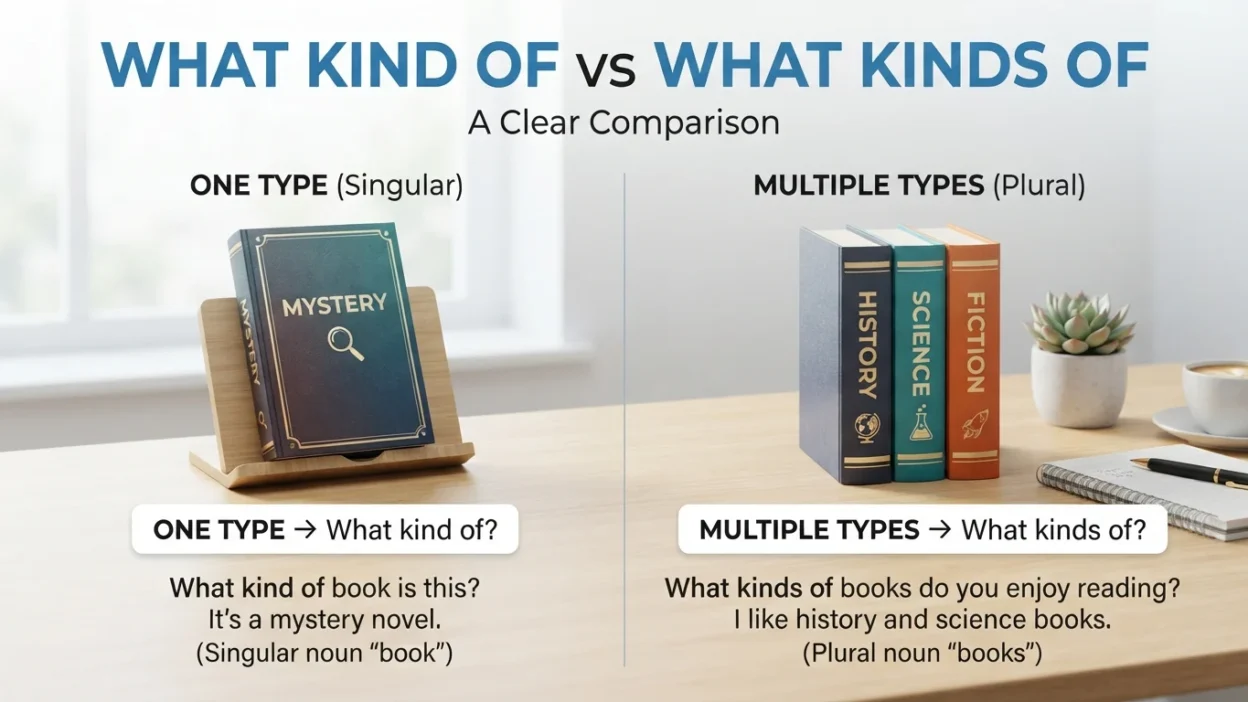
Use “what kind of” for one type or category: What kind of book do you like? Use “what kinds of” for multiple types: What kinds of books do you like? Both can be heard with plural nouns in informal English.
Why People Confuse It
The confusion happens because kind can be used as either singular or plural.
Compare:
- What kind of car…? → one type/category
- What kinds of cars…? → multiple types/categories
The noun after of usually follows the number of kind:
What kind of movie do you like?
What kinds of movies do you like?
However, English speakers frequently use “what kind of” as a general expression, even before plural nouns:
What kind of movies do you watch?
This is common and natural in conversation.
What Kind Of
What kind of is generally used when asking about a particular type, category, or variety.
Singular Example
What kind of music do you enjoy?
Here, music is an uncountable noun, and what kind of works naturally.
What kind of phone do you have?
The question asks about the type or model of one phone.
What kind of food does she like?
The focus is on the category of food.
Common Patterns
- What kind of book…
- What kind of car…
- What kind of job…
- What kind of music…
- What kind of food…
- What kind of person…
What Kinds Of
What kinds of is used when you are explicitly asking about multiple types, categories, or varieties.
For example:
What kinds of books do you read?
This suggests that you are interested in several categories of books.
What kinds of food are available?
This asks about different varieties or categories of food.
What kinds of jobs are available in this field?
This asks about multiple job categories.
Common Patterns
- What kinds of books…
- What kinds of movies…
- What kinds of jobs…
- What kinds of activities…
- What kinds of products…
- What kinds of problems…
What Kind of vs What Kinds of: Comparison Table
| Expression | Main Idea | Typical Noun | Example |
|---|---|---|---|
| What kind of | One type/category | Singular or uncountable noun | What kind of car do you drive? |
| What kinds of | Multiple types/categories | Plural noun | What kinds of cars are popular? |
The easiest formal rule is:
One category → what kind of
Multiple categories → what kinds of
When to Use Each
Use “What Kind of” for One Type
Use it when you have one particular category in mind.
What kind of phone do you need?
What kind of restaurant are you looking for?
What kind of exercise do you enjoy?
Use “What Kinds of” for Multiple Types
Use it when you want several categories or varieties.
What kinds of restaurants do you usually visit?
What kinds of exercises help with flexibility?
What kinds of phones are available?
Important: Plural Nouns Can Use “What Kind of”
This is where many learners become confused.
You may hear:
What kind of movies do you like?
This is completely natural English.
Here, kind can function as a general category label, while movies is plural because the speaker is referring to movies in general.
So these can both be grammatical:
What kind of movies do you like?
What kinds of movies do you like?
The first is extremely common in everyday conversation. The second emphasizes multiple categories or varieties.
Examples of What Kind of vs What Kinds of
- What kind of book are you reading?
One book and its type. - What kind of music do you listen to?
Asking about a category of music. - What kind of job are you looking for?
Asking about one general type of job. - What kind of car does he drive?
Asking about the type of one car. - What kinds of books do you enjoy?
Asking about multiple book categories. - What kinds of music are popular here?
Asking about different varieties of music. - What kinds of jobs are available?
Asking about several job categories. - What kinds of cars are common in your country?
Asking about different categories or models. - What kind of food should we order?
Asking about the type of food to choose. - What kinds of food are served at the festival?
Asking about several varieties. - What kind of person would enjoy this book?
Asking about a general personality or type. - What kinds of people attend the event?
Asking about different groups or categories.
Common Mistakes
Mistake 1: Thinking “What kinds of” is always better with plural nouns
Not necessarily.
Both of these can be natural:
What kind of movies do you watch?
What kinds of movies do you watch?
The second version emphasizes different categories. The first is more general and extremely common.
Mistake 2: Using “kind” with a clearly singular category incorrectly
If you are clearly talking about multiple categories, kinds is more precise.
What kinds of products does the store sell?
This sounds more appropriate than:
What kind of products does the store sell?
The second may still occur in informal speech, but the first makes the plural idea explicit.
Mistake 3: Forgetting subject-verb agreement
The noun after of does not determine the verb. The main noun in the sentence does.
What kind of book is this?
What kinds of books are popular?
The singular/plural pattern should remain consistent.
Mistake 4: Confusing “kind of” with “sort of”
Kind of and sort of can both refer to categories.
What kind of music do you like?
What sort of music do you like?
They are generally interchangeable in this context.
Memory Trick
Use this simple rule:
ONE → KIND
MORE THAN ONE → KINDS
Think:
One category = what kind of
Several categories = what kinds of
For example:
One: What kind of dessert would you like?
Several: What kinds of desserts are available?
But remember that “what kind of + plural noun” is also very common in natural English:
What kind of movies do you like?
So the key is not simply the number of the noun after of. Instead, ask whether you’re emphasizing one category or multiple categories.
American vs British English
There is no major American-versus-British difference in the grammar of what kind of and what kinds of.
Both forms are used in American and British English.
One difference you may notice is that “what kind of + plural noun” is very common in conversational English on both sides of the Atlantic.
For example:
What kind of books do you read?
This sounds natural in both American and British English.
What kinds of books is also correct and can sound more specific when emphasizing different varieties.
Similar Words
What Type of
This has essentially the same meaning as what kind of.
What type of computer do you use?
What Sort of
Another natural alternative, especially common in British English.
What sort of books do you enjoy?
Which Kind of
Used when the possible categories are limited or already known.
Which kind of tea would you like?
What Variety of
Often used when discussing different varieties or forms.
What variety of rice do you prefer?
What Category of
More formal and useful when discussing classification.
What category of product does this belong to?
FAQs
Is it “what kind of” or “what kinds of”?
Both are correct. Use what kind of when referring to one type or category, and what kinds of when emphasizing multiple types or categories.
Can “what kind of” be used with plural nouns?
Yes. What kind of + plural noun is very common in natural English.
What kind of movies do you like?
It is especially common in everyday conversation.
Is “what kinds of” grammatically correct?
Yes. It is correct when asking about multiple types, categories, or varieties.
What kinds of books do you read?
What is the difference between “what kind of” and “what kinds of”?
The main difference is whether kind refers to one category or several categories.
What kind of = one/general category.
What kinds of = multiple categories.
Is “what kind of books” correct?
Yes. What kind of books do you read? is natural and grammatically acceptable English.
Is “what kinds of book” correct?
Usually no. When kinds is plural, the noun after of is normally plural too:
What kinds of books do you read?
Is “what kind of” more common than “what kinds of”?
In everyday English, what kind of is extremely common, including before plural nouns. What kinds of is useful when you specifically want to emphasize multiple categories.
Final Verdict
What kind of and what kinds of are both correct. The traditional distinction is straightforward: use what kind of for one type or category and what kinds of for several types or categories.
However, real-world English is more flexible than that rule suggests. “What kind of movies do you like?” is completely natural even though movies is plural. If you want to emphasize that you’re asking about several different categories, “What kinds of movies do you like?” makes that meaning clearer.
Conclusion
When choosing between what kind of and what kinds of, focus on the meaning you want to express rather than simply looking at whether the following noun is singular or plural. Kind usually points to one category, while kinds highlights multiple categories.
For everyday conversation, what kind of is often the most natural choice, even with plural nouns. When you specifically want to ask about different varieties or categories, use what kinds of. Both expressions are useful, and understanding this subtle difference will make your English sound more precise and natural.
Remember This
What kind of = one/general type
What kind of movie do you like?
What kinds of = multiple types
What kinds of movies do you like?
But remember:
What kind of movies do you like? ✅
This is also perfectly natural English.

Lucas Bennett is an American writer passionate about spiritual insight and meaningful storytelling. His work blends faith-centered ideas with real-life experiences, encouraging readers to reflect deeply and live with intention.