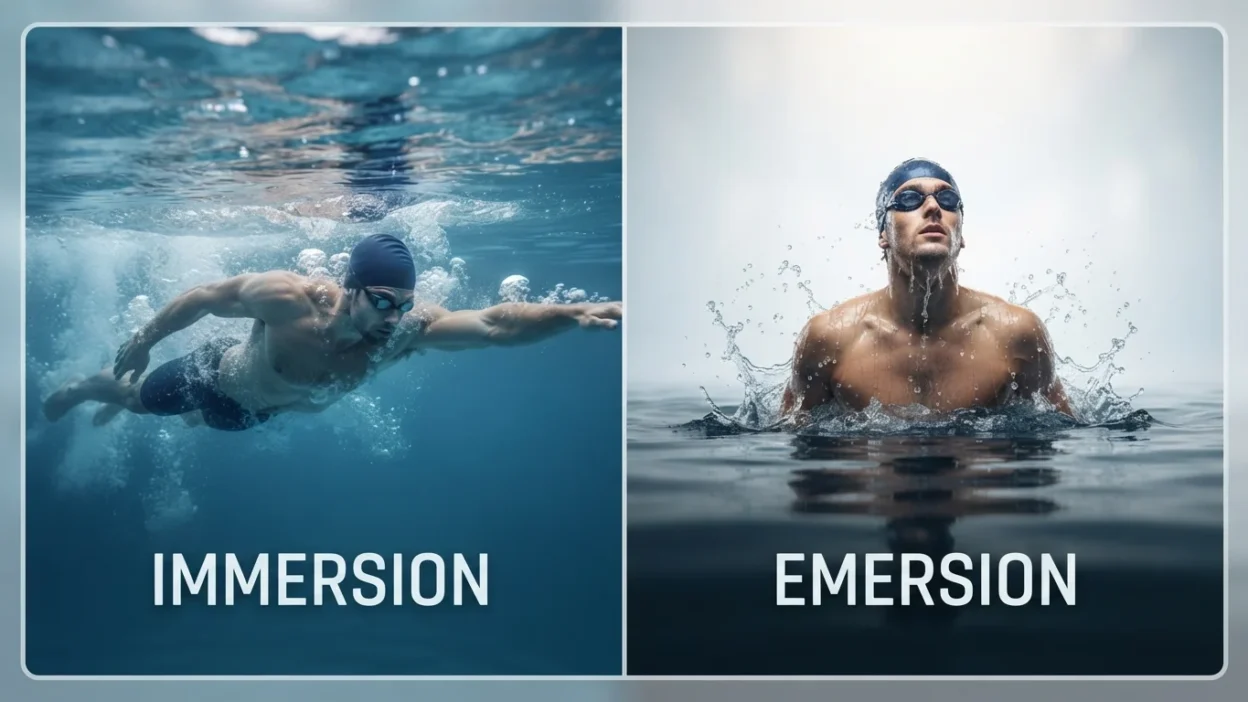
The words emersion and immersion look and sound very similar, but they describe opposite ideas. This makes them easy to confuse, especially because immersion is a common English word while emersion is much less familiar. Knowing the difference can help you choose the right word in academic, scientific, technical, and everyday writing.
Immersion generally refers to being put into or deeply surrounded by something. You can immerse an object in water, become immersed in a book, or experience complete immersion in a language or activity. Emersion, by contrast, refers to the act of emerging or coming out of something, particularly in technical or astronomical contexts. Once you understand the prefixes im- and e-, the distinction becomes much easier to remember.
Quick Answer
Immersion means being put into, covered by, or deeply involved in something. Emersion means emerging or coming out from something. For everyday English, immersion is far more common, while emersion is mainly used in specialized contexts.
Why People Confuse It
The confusion comes from their nearly identical spelling and related meanings.
Both words describe a relationship with being inside or outside something:
- Immersion → going into something.
- Emersion → coming out of something.
The prefixes provide a useful clue. Im- in immersion suggests movement or placement into something, while e- in emersion is associated with emerging or coming out.
For example:
The swimmer practiced immersion in cold water.
The swimmer goes into the water.
The telescope recorded the emersion of the moon from the shadow.
The moon emerges from the shadow.
Immersion
Immersion is the noun form related to immerse.
It means the act of putting something completely into a liquid or substance, or becoming deeply involved in an experience, environment, or subject.
The word has several common uses.
Physical Immersion
This refers to placing something into a liquid or other surrounding substance.
The immersion of the equipment in water was carefully controlled.
Language Immersion
This is a common educational concept in which learners are surrounded by and regularly use a language.
The students joined an English immersion program.
Cultural Immersion
This means becoming deeply involved in another culture or environment.
Traveling abroad can provide valuable cultural immersion.
Mental or Experiential Immersion
It can also describe becoming completely absorbed in an activity.
The novel provided an immersive reading experience.
Emersion
Emersion is a much less common noun.
It means the act or process of emerging from something, especially from a state of being hidden, covered, or immersed.
It can appear in astronomy, where an object becomes visible again after being hidden behind another celestial body or after passing out of a shadow.
For example:
Astronomers observed the emersion of the satellite from the planet’s shadow.
It can also be used more generally to describe something coming out of an obscuring or surrounding substance, although this usage is uncommon.
Because emersion is specialized and relatively rare, many everyday writers never need to use it.
Emersion vs Immersion: Comparison Table
| Word | Meaning | Common Context | Example |
|---|---|---|---|
| Immersion | Being put into or deeply involved in something | Water, language, culture, education, experiences | The course uses language immersion. |
| Emersion | Emerging or coming out of something | Astronomy, technical writing | Scientists observed the emersion of the moon from the shadow. |
The simplest distinction is:
Immersion = going in.
Emersion = coming out.
When to Use Each
Use immersion when something is being placed into something else or when someone becomes deeply involved in an experience.
Common contexts include:
- Water immersion
- Language immersion
- Cultural immersion
- Virtual reality
- Education
- Reading
- Training
- Religious or ceremonial practices
Use emersion when describing emergence from something, especially in specialized scientific or astronomical contexts.
Choose “immersion” when:
The object goes into something.
Choose “emersion” when:
The object comes out of something.
Examples of Emersion vs Immersion
- The swimmer practiced water immersion.
The swimmer entered the water. - The school offers a Spanish immersion program.
Students learn by being surrounded by Spanish. - Cultural immersion helped her understand local traditions.
She became deeply involved in the culture. - The scientist studied the effects of prolonged immersion in water.
The subject was placed in water for an extended period. - The virtual reality game provides a high level of immersion.
The player feels deeply involved in the experience. - The telescope detected the emersion of the moon from the shadow.
The moon became visible after emerging from the shadow. - The astronaut experienced a brief period of immersion during the training exercise.
The astronaut was placed into the relevant environment. - The astronomers carefully recorded the time of emersion.
They recorded when the celestial object emerged. - Language immersion can accelerate practical communication skills.
Learners are surrounded by the target language. - The emersion of the satellite was visible through the telescope.
The satellite emerged from an obscuring region. - Complete immersion in the book made her lose track of time.
She became deeply absorbed in reading. - The experiment involved immersion of the sample in a chemical solution.
The sample was placed into the solution.
Common Mistakes
Mistake 1: Using “emersion” when you mean “immersion”
❌ The students joined an English emersion program.
✅ The students joined an English immersion program.
Language programs use immersion because students are surrounded by the language.
Mistake 2: Assuming “emersion” is a spelling variation
Emersion is a real word, but it is not an alternative spelling of immersion.
They have different meanings.
Mistake 3: Using “immersion” for emerging
If something is coming out of a shadow or hidden state, emersion may be the appropriate technical term.
The astronomers observed the satellite’s emersion from the shadow.
Mistake 4: Thinking “immersion” only relates to water
Immersion can be physical, but it can also describe deep involvement.
For example:
- Language immersion
- Cultural immersion
- Immersion in literature
- Virtual reality immersion
Memory Trick
Use the prefixes to remember the difference:
IM = IN → IMMERSION = going in
E = EXIT → EMERSION = coming out
Think of it as a simple movement:
Immersion → IN
Emersion → EXIT
Another easy example:
Immersion: Get into the water.
Emersion: Come out of the water.
Although emersion is not commonly used for ordinary situations like getting out of a swimming pool, the contrast helps you remember the meanings.
American vs British English
There is no major American-versus-British spelling difference between immersion and emersion.
Both words have the same basic meanings in American and British English.
The bigger difference is frequency of use. Immersion is common in both varieties, especially in education, technology, travel, and everyday descriptions. Emersion is comparatively rare and tends to appear in specialized scientific or technical writing.
So whether you’re writing American or British English, the same distinction applies:
Immersion = being put into or deeply involved in something.
Emersion = emerging from something.
Similar Words
Immerse
To put something into a substance or become deeply involved in something.
She immersed herself in the language.
Immersive
Providing an experience that feels deeply involving or absorbing.
The museum created an immersive exhibition.
Emerge
To come out of something or become visible.
The sun emerged from behind the clouds.
Emergence
The act or process of appearing or coming out.
The emergence of new technology changed the industry.
Submersion
The act of completely putting something underwater or beneath a surface.
The device survived complete submersion.
Absorption
The process of taking in or becoming deeply occupied by something.
He was completely absorbed in the story.
FAQs
Is it emersion or immersion?
Both are real words, but they have different meanings. Immersion means being put into or deeply involved in something, while emersion means emerging from something.
What is the difference between immersion and emersion?
Immersion describes going into, being surrounded by, or becoming deeply involved in something. Emersion describes coming out or becoming visible after being hidden or covered.
Is “emersion” a correct English word?
Yes. Emersion is a legitimate but uncommon English word, particularly used in technical and astronomical contexts.
Is it an immersion program or an emersion program?
The correct phrase is immersion program. For example, a school may offer an English immersion program where students learn through extensive exposure to English.
What does emersion mean in astronomy?
In astronomy, emersion can describe the moment when a celestial object becomes visible again after being hidden, such as when it emerges from another object’s shadow.
Is immersion only used for water?
No. Immersion can describe physical placement in water or another substance, but it can also refer to deep involvement in language, culture, education, technology, or an experience.
Which word is more common: emersion or immersion?
Immersion is much more common in modern English. Emersion is relatively rare and is most likely to appear in specialized contexts.
Final Verdict
The difference between emersion and immersion comes down to direction. Immersion involves going into something, being surrounded by something, or becoming deeply involved in an experience. Emersion refers to emerging or coming out, particularly in specialized contexts.
If you’re talking about language learning, water, culture, virtual reality, or becoming deeply involved in something, immersion is almost certainly the word you need. If you’re discussing a celestial object emerging from a shadow or another technical situation involving emergence, emersion may be appropriate.
Conclusion
Although emersion and immersion are easy to mix up, their opposite meanings provide a reliable way to distinguish them. Think of immersion as movement or involvement into something and emersion as coming out of something.
For everyday English, you’ll encounter immersion far more often. Remember the simple contrast—immersion means in, emersion means out—and you’ll be able to choose the correct word confidently.
Remember This
Immersion = IN → going into or becoming deeply involved.
Emersion = EXIT → emerging or coming out.
Correct: The school offers a language immersion program.
Technical: Scientists observed the emersion of the satellite from the shadow.

Lucas Bennett is an American writer passionate about spiritual insight and meaningful storytelling. His work blends faith-centered ideas with real-life experiences, encouraging readers to reflect deeply and live with intention.