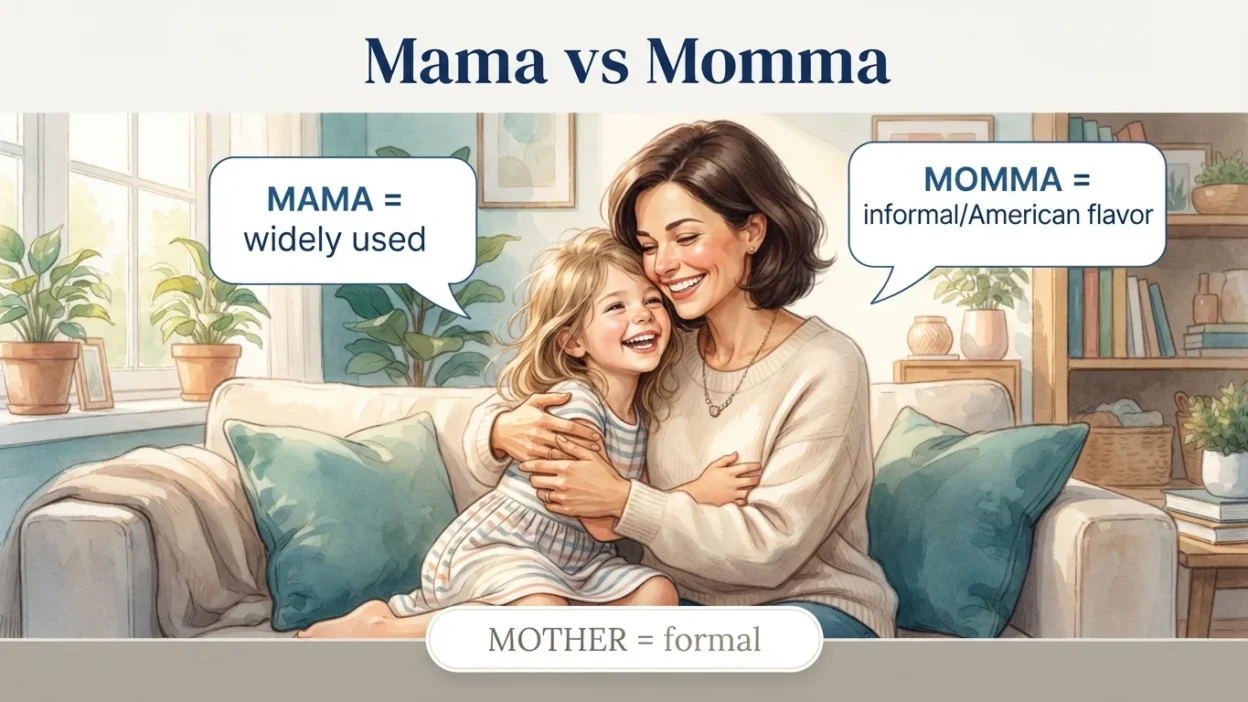
Momma and mama are both informal words for mother, but they have slightly different associations and usage patterns. Neither is simply “wrong.” The better choice depends on the tone, dialect, and context you want.
Mama is the more widely recognized spelling and is used across many varieties of English. Momma is especially associated with American English and can sound more folksy, affectionate, Southern, or childlike. Both can express warmth and familiarity. For example, a child might say, “Mama, can you help me?” or “Momma, can you help me?” Both are understandable and natural in the right context.
Quick Answer
Mama and momma both mean mother. Mama is the more widely used and neutral spelling, while momma often sounds more affectionate, informal, or distinctly American. Neither is inherently incorrect.
Why People Confuse It
The words are pronounced similarly, and both are informal terms for a mother.
The main difference is spelling and regional or stylistic preference, not basic meaning.
You may see:
- Mama
- Momma
- Mom
- Mommy
- Mum
- Mummy
- Ma
All can refer to a mother, but they don’t all have the same tone or regional usage.
Mama
Mama is an affectionate and widely recognized word for mother.
It can be used by children and adults.
Mama, can you help me?
I called my mama yesterday.
Her mama taught her how to cook.
What Does Mama Sound Like?
Mama can sound:
- Affectionate
- Warm
- Familiar
- Childlike
- Traditional
- Cultural or regional
It is not limited to one country or dialect.
Momma
Momma is also an affectionate term for mother, particularly associated with American English.
The extra m reflects the pronunciation and spelling style used in some American dialects and informal speech.
Momma, look what I found!
My momma always supported me.
What Does Momma Sound Like?
Momma can sound:
- Affectionate
- Folksy
- Informal
- Southern American
- Nostalgic
- Childlike
It can also be used intentionally in creative writing, songs, dialogue, or personal expressions to create a particular voice.
Momma vs Mama: Comparison Table
| Word | Meaning | Typical Tone | Usage |
|---|---|---|---|
| Mama | Mother | Affectionate, familiar, neutral | Very widely used |
| Momma | Mother | Affectionate, informal, folksy | Especially associated with American English |
| Mom | Mother | Casual | Common in American English |
| Mum | Mother | Casual | Common in British English |
| Mommy | Mother | Childlike/affectionate | Commonly used by children |
When to Use Each
Use “Mama”
Choose mama when you want a broadly understood, affectionate term for mother.
I love my mama.
Mama is making dinner.
My mama taught me to be kind.
It’s also a common word in many cultures and languages, making it familiar to English speakers around the world.
Use “Momma”
Choose momma when you want a more informal or distinctly American feel.
Momma always knows what to do.
I miss my momma.
Momma said I could go.
It can work particularly well in dialogue or personal writing when you want to preserve someone’s natural way of speaking.
Examples of Mama vs Momma
- Mama is waiting outside.
Refers affectionately to one’s mother. - Momma is waiting outside.
Same basic meaning, with a more informal flavor. - I love you, Mama.
Warm and affectionate. - I love you, Momma.
Equally affectionate, with a more folksy or American feel. - Mama always gives me good advice.
- Momma always gives me good advice.
- She called her mama after work.
- He called his momma before leaving town.
- “Mama, look at this!” she shouted.
- “Momma, look at this!” she shouted.
Both versions can be correct depending on the speaker’s preferred style.
Common Mistakes
Mistake 1: Thinking “Momma” Is Always Wrong
It isn’t.
Momma is an established informal spelling, particularly in American English.
Mistake 2: Thinking “Mama” Is Only for Young Children
Not necessarily.
Adults can use mama when speaking affectionately about or to their mother.
I called my mama last night.
Mistake 3: Assuming They Have Different Meanings
The basic meaning is the same:
Mama = mother
Momma = mother
The main difference is tone, spelling preference, and regional association.
Mistake 4: Using Either in Formal Writing
Both are informal terms.
For formal writing, use:
mother
For example:
My mother attended the meeting.
rather than:
My mama attended the meeting.
Memory Trick
Think of it this way:
MAMA = simple and widely used
MOMMA = more informal/American flavor
If you’re unsure which one to choose, mama is generally the safer choice when you want a broadly understood informal term.
American vs British English
This is where the distinction becomes more noticeable.
American English
Mom, momma, and mama can all be used.
My mom is here.
My momma is here.
My mama is here.
Momma can have a more regional or folksy quality.
British English
Mum and mummy are much more common than mom or momma.
My mum is here.
My mummy is here.
Mama can still be used, especially in particular families, communities, or cultural contexts.
Similar Words
Mom
A common informal American English term for mother.
My mom called me.
Mum
The standard informal British English term.
My mum called me.
Mommy
A childlike or affectionate American English term.
Mommy, I’m tired.
Mummy
A childlike or affectionate British English term.
Mummy, can you help me?
Ma
A short, informal term for mother.
Ma, where are my keys?
Mother
The standard and more formal term.
My mother works at a hospital.
FAQs
Is mama or momma correct?
Both are correct informal words for mother. Mama is more widely used, while momma has a stronger American and informal association.
Is momma an American word?
Momma is particularly associated with American English, especially informal, regional, or folksy speech.
Is mama more common than momma?
Generally, mama has broader international usage, while momma is more specifically associated with American informal English.
Is “momma” childish?
It can sound childlike or affectionate, but it is not exclusively used by children. Adults may use it affectionately as well.
Can adults say mama?
Yes. Adults commonly use mama when speaking affectionately about their mother, depending on family and cultural preference.
Which is more formal: mama or momma?
Neither is formal. Mother is the appropriate formal term.
Should I write mama or momma?
If you want a broadly understood informal term, mama is a safe choice. If you’re deliberately aiming for an American, folksy, affectionate, or regional voice, momma may be better.
Final Verdict
Mama and momma are both correct informal terms for “mother.” The difference is primarily one of style, regional association, and personal preference.
Choose mama for a widely understood, affectionate expression. Choose momma when you want a more informal, folksy, or American flavor. In formal writing, however, mother is the better choice.
Conclusion
The choice between mama and momma isn’t really about right versus wrong. Both words have a long history of informal use, and both can communicate affection and familiarity. Your choice can depend on where you are from, how your family speaks, and the tone you’re trying to create.
If you’re writing ordinary English and aren’t sure which spelling to use, mama is generally the more universally recognizable option. If you’re writing dialogue or want a distinctly American, warm, or folksy tone, momma can work beautifully.
Remember This
MAMA = widely used, affectionate
MOMMA = affectionate, informal, often American/folksy
MOTHER = formal
So:
Mama, I love you. ❤️
Momma, I love you. ❤️
Both can be correct.

Daniel Whitmore is a faith-inspired author dedicated to writing content that uplifts and motivates. His focus is on hope, resilience, and moral clarity, offering readers guidance for navigating life with confidence and belief.