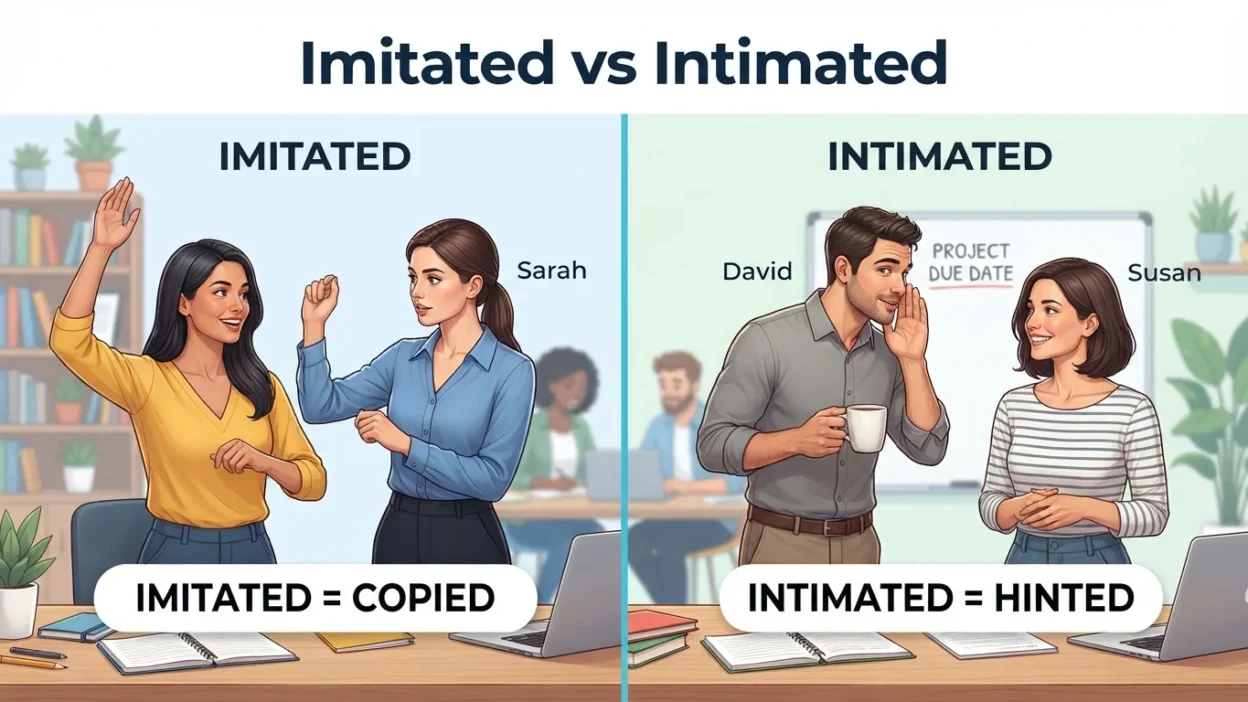
“Imitated” and “intimated” look and sound somewhat similar, but they have completely different meanings. This small spelling difference can cause confusion, especially when reading or writing formal English.
Imitated means copied or reproduced the actions, appearance, behavior, or style of someone or something. Intimated means hinted at, suggested, or communicated something indirectly.
For example, “The child imitated his father” means the child copied his father’s behavior. On the other hand, “She intimated that she was unhappy” means she indirectly suggested that she was unhappy.
Quick Answer
The easiest way to remember the difference is:
- Imitated = copied or mimicked
- Intimated = hinted or suggested
So, if someone copies another person, use imitated. If someone communicates something indirectly, use intimated.
| Word | Meaning | Example |
|—|—|—|
| Imitated | Copied or mimicked | The boy imitated his teacher. |
| Intimated | Hinted or suggested indirectly | She intimated that she might leave. |
Why Do People Confuse Imitated and Intimated?
The words are confusing because they have similar spellings and both begin with “imit-” or “intim-.” They also sound relatively similar when spoken quickly.
However, their meanings are unrelated. Imitated comes from imitate, meaning to copy, while intimated comes from intimate as a verb, meaning to communicate or suggest something indirectly.
A useful memory trick is to connect imitated with imitation and intimated with an indirect message.
What Does Imitated Mean?
Imitated is the past tense and past participle of imitate. It means copied, mimicked, or reproduced the behavior, appearance, speech, style, or actions of someone or something.
For example:
- The child imitated his mother.
- The comedian imitated the actor’s voice.
- She imitated the painting style of a famous artist.
- The student imitated the teacher’s pronunciation.
“Irmitated” is not the correct spelling. The correct word is imitated.
Examples of Imitated
- The young boy imitated his older brother.
- She imitated the singer’s voice perfectly.
- The parrot imitated the sounds it heard.
- He imitated his coach’s movements during practice.
- The artist imitated the style of a famous painter.
- The comedian imitated several celebrities.
- The child imitated the way his father walked.
- The students imitated the pronunciation of their instructor.
- The new product imitated the design of an older model.
- The actor imitated the politician’s mannerisms.
What Does Intimated Mean?
Intimated is the past tense and past participle of intimate when it is used as a verb. It means hinted, suggested, or communicated something indirectly.
It is often used when someone does not state something openly but gives another person an indication of what they mean.
For example:
- She intimated that she was considering resigning.
- He intimated that there might be a problem.
- The manager intimated that changes were coming.
In these examples, the person does not necessarily make a direct statement. Instead, they give a hint or indirect indication.
Examples of Intimated
- She intimated that she wanted to leave early.
- The manager intimated that the company would make changes.
- He intimated that he knew more than he was saying.
- The report intimated that the project had failed.
- She intimated that she was unhappy with the decision.
- The politician intimated that an announcement was coming.
- He intimated that he might accept the offer.
- The email intimated that the meeting could be canceled.
- She intimated that there was a problem with the plan.
- The director intimated that the movie would be delayed.
Imitated vs Intimated: Comparison Table
| Feature | Imitated | Intimated |
|---|---|---|
| Base word | Imitate | Intimate |
| Meaning | Copied or mimicked | Hinted or suggested |
| Part of speech | Verb | Verb |
| Past tense | Imitated | Intimated |
| Common context | Behavior, appearance, speech, style | Ideas, intentions, information, suggestions |
| Example | He imitated his teacher. | He intimated that he was worried. |
When to Use Imitated
Use imitated when someone or something copies another person or thing.
Common situations include:
- Copying someone’s behavior
- Copying someone’s speech
- Mimicking an accent
- Reproducing a style
- Copying movements
- Recreating a design
For example, “The child imitated his father” means the child copied his father’s behavior.
When to Use Intimated
Use intimated when someone gives an indirect indication, hint, or suggestion.
It commonly appears in formal or literary English.
For example:
- The manager intimated that the employee might be promoted.
- She intimated that she already knew the truth.
- He intimated that the situation was becoming serious.
A common structure is “intimated that…”
Imitated vs Intimated in Sentences
Here are some side-by-side examples:
- Imitated: The child imitated his brother’s dance moves.
Intimated: His brother intimated that he wanted to leave. - Imitated: The actor imitated the famous singer.
Intimated: The actor intimated that he was nervous about the role. - Imitated: She imitated her teacher’s accent.
Intimated: She intimated that the teacher had been unfair. - Imitated: The dog imitated the other dog’s behavior.
Intimated: The owner intimated that the dog needed training. - Imitated: He imitated the design of the original product.
Intimated: The company intimated that a new product was coming.
Common Mistakes
Mistake 1: Using “intimated” when you mean “copied”
Incorrect:
The child intimated his father’s movements.
Correct:
The child imitated his father’s movements.
Mistake 2: Using “imitated” when you mean “hinted”
Incorrect:
She imitated that she was unhappy.
Correct:
She intimated that she was unhappy.
Mistake 3: Confusing “intimate” with “intimated”
The adjective intimate can mean close, personal, or private, as in “an intimate friend.” But intimate can also function as a verb meaning to hint or suggest.
Therefore, intimated can mean “hinted,” depending on the context.
A Simple Memory Trick
Remember:
Imitated = imitation = copied.
Intimated = indication = hinted.
If someone copies something, they imitated it.
If someone gives an indication without saying something directly, they intimated it.
Another quick trick:
IMITATE → COPY
INTIMATE → HINT
Imitated vs Intimated: American and British English
There is no major difference in meaning between imitated and intimated in American and British English.
Both varieties use imitated for copying or mimicking and intimated for indirectly suggesting something.
However, intimated can sound somewhat formal, especially in everyday American English. In casual conversation, speakers may be more likely to say hinted or suggested.
For example:
- Formal: “She intimated that she disagreed.”
- More conversational: “She hinted that she disagreed.”
Similar Words
Synonyms for Imitated
- Copied
- Mimicked
- Reproduced
- Emulated
- Modeled
- Replicated
- Recreated
Synonyms for Intimated
- Hinted
- Suggested
- Implied
- Indicated
- Signaled
- Communicated
- Insinuated
Frequently Asked Questions
Is “imitated” the same as “intimated”?
No. Imitated means copied or mimicked, while intimated means hinted or suggested indirectly.
What does “imitated” mean?
Imitated means copied the actions, behavior, appearance, speech, or style of someone or something.
What does “intimated” mean?
Intimated means hinted at or suggested something without stating it directly.
Is “intimated” a real word?
Yes. Intimated is the past tense and past participle of the verb intimate, meaning to hint or suggest.
Is “imitated” a real word?
Yes. Imitated is the past tense and past participle of imitate, meaning to copy or mimic.
Which is correct: “He imitated that” or “He intimated that”?
It depends on the intended meaning. Use imitated for copying and intimated for indirectly suggesting something. With a “that” clause, intimated that is the natural construction when you mean “hinted that.”
Is “intimated” formal English?
Yes, intimated is often more formal than everyday alternatives such as “hinted” or “suggested.”
Final Verdict
Imitated and intimated are both correct words, but they are not interchangeable.
Use imitated when you mean copied or mimicked. Use intimated when you mean hinted, suggested, or indicated indirectly.
The easiest rule to remember is:
Imitated = copied.
Intimated = hinted.
Conclusion
Although “imitated” and “intimated” look similar, their meanings are completely different. Imitated describes copying a person, action, appearance, style, or sound, while intimated describes communicating an idea indirectly.
When you’re unsure, think about the action involved. If something is being copied, choose imitated. If someone is giving a hint, choose intimated.
Remember This
IMITATED = COPIED
INTIMATED = HINTED

Lucas Bennett is an American writer passionate about spiritual insight and meaningful storytelling. His work blends faith-centered ideas with real-life experiences, encouraging readers to reflect deeply and live with intention.