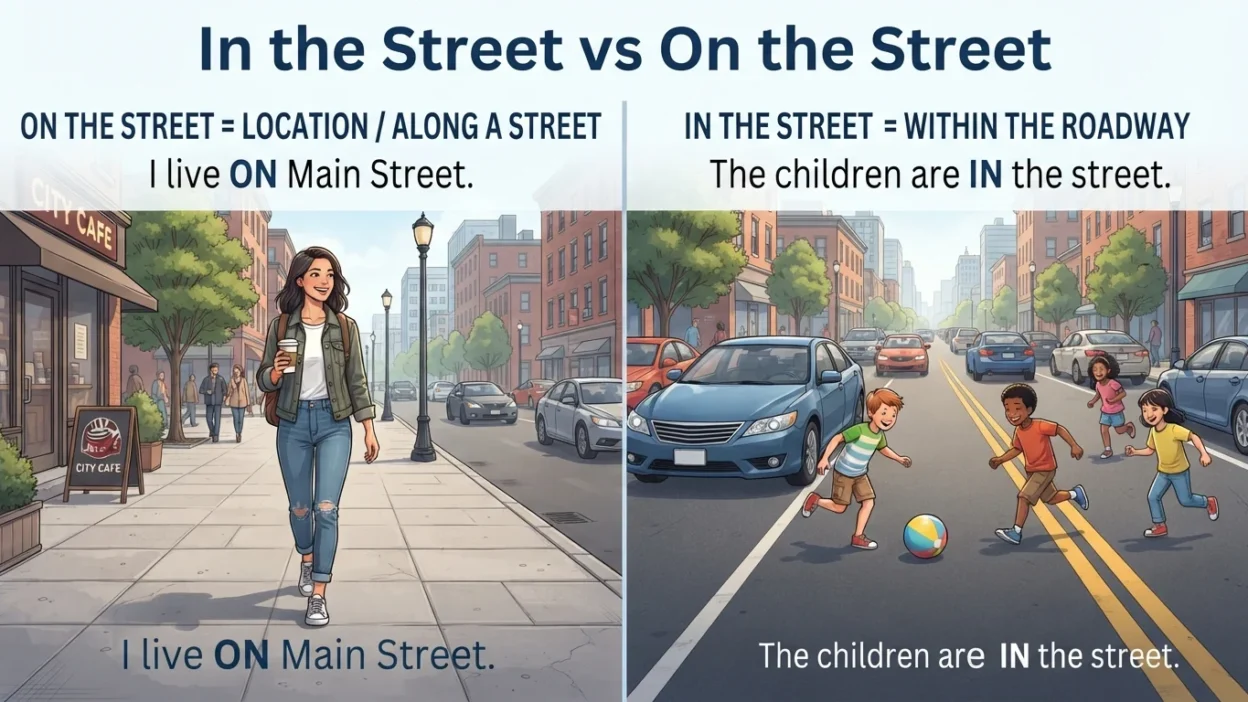
“In the street” and “on the street” are both correct English expressions, but they can emphasize slightly different ideas. The difference usually depends on whether you are focusing on being within the roadway/street area or simply being out on or along a particular street.
In everyday American English, on the street is generally the more common expression when talking about someone’s location on a particular street. For example, “I saw him on the street” means you saw him while he was outside along the street. In the street is more often used when someone or something is physically in the roadway or when referring to the street as an area or environment.
Quick Answer
Use “on the street” when you mean on or along a street or when talking about a street as a location.
Use “in the street” when you mean physically within the street, especially the roadway.
- On the street: I met her on the street.
- In the street: The children were playing in the street.
As a general rule, on the street is more common for ordinary location.
Why People Confuse “In the Street” and “On the Street”
The confusion comes from the fact that English uses different prepositions depending on how we imagine a location.
We commonly use on with streets:
She lives on Main Street.
But we can also use in when we imagine the street as a physical area:
There was a large crowd in the street.
So the choice is not simply about grammar. It depends on the meaning you want to express.
On the Street: Meaning and Use
On the street usually means on or along a street.
It is commonly used when talking about:
- Someone’s location
- Someone being outside
- A particular street
- Something happening along a street
- Street life or activity
Examples:
I saw him on the street.
There is a new restaurant on the street.
She lives on King Street.
We met on the street after work.
In these examples, on the street treats the street as a location or route.
In the Street: Meaning and Use
In the street usually emphasizes being within the street itself, especially the roadway.
For example:
A car stopped in the street.
This suggests that the car is physically occupying the roadway.
Another example:
The children were playing in the street.
Here, the emphasis is on their physical position within the street area rather than simply being somewhere along the street.
In the street can also be used more generally when a street is viewed as a public space or setting.
In the Street vs On the Street Comparison Table
| Expression | Main Idea | Typical Use | Example |
|---|---|---|---|
| On the street | On or along a street | Location/address/general activity | I saw her on the street. |
| In the street | Within the street/roadway | Physical position in the road | The children were playing in the street. |
| On Main Street | Located along a named street | Addresses/locations | The shop is on Main Street. |
| In the street | Street as an area | Crowds/events/activity | People were dancing in the street. |
When to Use “On the Street”
Use on the street in several common situations.
1. Talking about someone’s location
I ran into an old friend on the street.
I saw your brother on the street yesterday.
2. Talking about an address or location
The bank is on Oak Street.
She lives on Park Avenue.
3. Talking about something located along a street
There are several shops on this street.
A new café opened on our street.
4. Talking about street activity
There were musicians performing on the street.
People were walking on the street.
When to Use “In the Street”
Use in the street when you want to emphasize that someone or something is physically within the roadway or street area.
Examples:
There is a large hole in the street.
The children were playing in the street.
A truck broke down in the street.
Someone left a bicycle in the street.
The protesters gathered in the street.
The phrase often creates a stronger sense of physical presence within the street itself.
“On the Street” for Addresses
One particularly important rule is that English normally uses on with the names of streets.
Examples:
- I live on Green Street.
- The hotel is on Main Street.
- The office is on Baker Street.
- There is a pharmacy on this street.
This is especially important for learners because languages differ in how they express locations and addresses.
“In the Street” for Physical Position
Compare these sentences:
I saw Sarah on the street.
This simply tells us where you saw Sarah.
Sarah was standing in the street.
This emphasizes that Sarah was physically standing in the roadway or street area.
The difference can therefore be quite subtle:
on the street → location
in the street → physical position within the street
On the Street vs In the Street: Side-by-Side Examples
Example 1
I met John on the street.
You encountered John while outside on the street.
John was standing in the street.
John was physically standing in the roadway.
Example 2
There is a café on the street.
The café is located along that street.
There was a table in the street.
The table was physically placed in the street.
Example 3
We saw musicians on the street.
The musicians were performing along the street.
People were dancing in the street.
The people were occupying the street as a public space.
15 Examples of “On the Street”
- I saw her on the street yesterday.
- There is a bakery on this street.
- He lives on King Street.
- We met on the street after work.
- The hotel is on Main Street.
- There are several cafés on this street.
- I found my friend waiting on the street.
- A photographer was working on the street.
- She was walking on the street.
- The new store is on the same street.
- I left my car on the street.
- There were musicians playing on the street.
- The police were patrolling on the street.
- We stopped for coffee on the street.
- I recognized him from seeing him on the street.
15 Examples of “In the Street”
- The children were playing in the street.
- A car was blocking the street.
- There was a large hole in the street.
- The dog ran into the street.
- A truck stopped in the street.
- People were dancing in the street.
- The protesters gathered in the street.
- Someone left a chair in the street.
- The ball rolled into the street.
- Water was collecting in the street.
- A cyclist fell in the street.
- The workers were repairing a pipe in the street.
- A crowd formed in the street.
- The children ran out into the street.
- A fallen tree was lying in the street.
Common Mistakes
Mistake 1: Using “in” for a street address
❌ I live in Main Street.
✅ I live on Main Street.
When referring to a named street as an address, use on.
Mistake 2: Assuming “on the street” always means physically on the road
Not necessarily.
There is a restaurant on the street.
This means the restaurant is located along the street, not literally sitting on the roadway.
Mistake 3: Assuming “in the street” is always wrong
It isn’t.
The children are playing in the street.
This is perfectly natural because the children are physically within the street area.
Mistake 4: Confusing “in the street” with “into the street”
These express different ideas.
In the street = location
The ball is in the street.
Into the street = movement toward or inside the street
The child ran into the street.
In the Street vs On the Street in American English
In American English, on the street is particularly common for general location and addresses.
Examples:
She lives on Fifth Avenue.
I saw him on the street.
There is a store on the street.
In the street is commonly used when something is physically occupying the roadway or when the street is being treated as a public space.
In the Street vs On the Street in British English
British English also uses both expressions.
For example:
She lives on this street.
The children were playing in the street.
The basic distinction remains similar. However, exact usage can vary depending on the context, region, and speaker.
On the Street vs In the Street vs At the Street
These three expressions should not automatically be treated as interchangeable.
On the street
The shop is on the street.
This is the standard choice for a location along a street.
In the street
The children are playing in the street.
This emphasizes physical presence within the street.
At the street
At the street is less common when referring simply to a street location. Instead, English often uses more specific expressions such as:
at the corner
at the intersection
at the end of the street
For example:
I’ll meet you at the corner.
Similar Expressions
Here are some related expressions:
- On the road — traveling or located on a road
- In the road — physically within the roadway
- On the sidewalk — located on the sidewalk
- In the neighborhood — within a neighborhood
- At the corner — located at a street corner
- Along the street — extending or occurring beside/through a street
- Across the street — on the opposite side of the street
Examples:
The children are playing in the road.
The restaurant is on the corner.
The pharmacy is across the street.
Frequently Asked Questions
Is it “in the street” or “on the street”?
Both are correct. On the street is generally used for a location along a street, while in the street emphasizes being physically within the street or roadway.
Which is correct for an address: “in” or “on”?
Use on with a street name:
I live on Main Street.
Is “I saw him in the street” correct?
Yes. It is grammatically correct and can emphasize that you saw him physically within the street area. I saw him on the street is also natural for general location.
Is “on the street” more common?
For general location and street addresses, on the street is generally the more common choice, particularly in American English.
What is the difference between “in the street” and “on the street”?
On the street usually means on or along a street, while in the street often means physically within the street or roadway.
Can I say “I live in the street”?
Usually not when giving an address. Say:
I live on Main Street.
Is “the children are playing in the street” correct?
Yes. This is a natural sentence because the children are physically playing within the street area.
Can “on the street” mean homeless?
Yes. In some contexts, on the street can have the additional meaning of being homeless or living without permanent housing.
For example:
He spent several months on the street.
This is a different meaning from simply being located on a street.
Final Verdict
Both in the street and on the street are correct, but they are used differently.
ON THE STREET → general location, along a street, or a street address.
She lives on Green Street.
IN THE STREET → physically within the street or roadway, or using the street as a public space.
The children were playing in the street.
When talking about a named street as an address, on is the standard choice.
Conclusion
The difference between in the street and on the street is mainly about how you view the street. On the street is commonly used for locations, addresses, and activities taking place along a street. In the street emphasizes being physically within the street, especially the roadway.
A simple way to remember the distinction is to think of on as identifying a street as a location and in as placing someone or something inside the street area. Once you understand this difference, choosing between the two becomes much easier.
Remember This
ON THE STREET = location / along a street
I live on Main Street.
IN THE STREET = physically within the street
The children are playing in the street.
Easy rule:
Address → ON
Roadway → IN

Mason Harper is a content creator and author who writes about belief, discipline, and everyday wisdom. With a calm and practical tone, his writing aims to inspire readers to build strong foundations in both character and faith.