
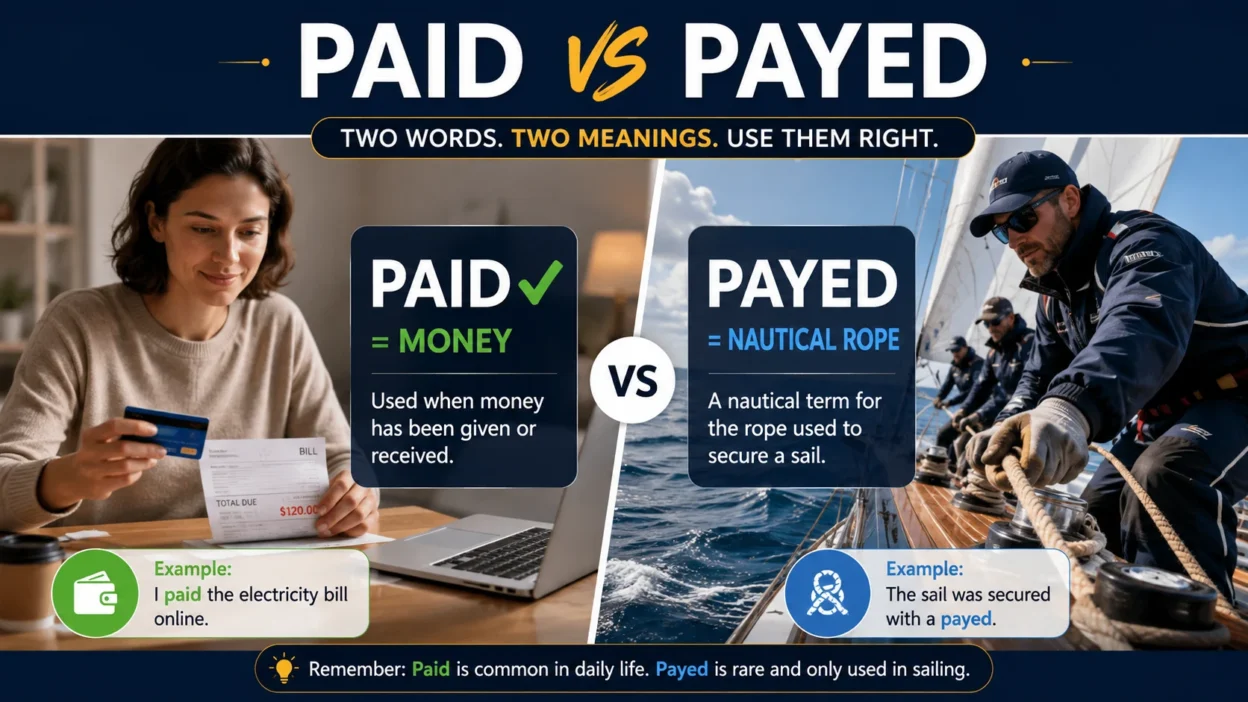
Paid and payed are easy to confuse because both come from the verb pay, but they are not interchangeable in modern English. In most everyday situations, paid is the correct past tense and past participle of pay. For example, you should write, “I paid the bill,” not “I payed the bill.”
Payed does exist, but it has a very specific and uncommon use related to nautical terminology. It can refer to letting out or loosening a rope, cable, or line. Unless you’re discussing sailing or maritime activities, paid is almost certainly the word you need. Understanding this small distinction can help you avoid one of the most common past-tense spelling mistakes in English.
Quick Answer
Paid is the correct past tense of pay when talking about money, bills, wages, or payments. Payed is a rare nautical term used for letting out a rope or line. In normal English, write paid, not payed.
Why People Confuse It
The confusion comes from regular English past-tense patterns.
Many verbs simply take -ed:
- play → played
- walk → walked
- work → worked
So it may seem logical to write:
pay → payed ❌
But pay is an irregular verb in its standard money-related meaning:
pay → paid
For example:
I paid for dinner.
She paid the rent.
He paid me yesterday.
Paid
Paid is the standard past tense and past participle of pay when referring to money or other forms of payment.
It can mean:
- Gave money for something
- Settled a bill
- Gave someone wages
- Provided payment
- Suffered a cost or consequence
- Gave attention or respect
Examples
I paid the electricity bill.
She paid $50 for the dress.
The company paid its employees on Friday.
He paid for his mistake.
Notice that paid is used even when the meaning is not literally about money.
Payed
Payed is a real word, but it is rare and has a specialized meaning.
It is primarily associated with nautical language, where it means to let out, slacken, or release a rope, cable, or line.
For example:
The sailors payed out the rope.
This is a specialized maritime use and is unlikely to appear in ordinary conversation.
So if you’re talking about money, payed is incorrect.
❌ I payed the bill.
✅ I paid the bill.
Paid vs Payed: Comparison Table
| Word | Correct in Everyday English? | Meaning | Example |
|---|---|---|---|
| Paid | ✅ Yes | Past tense of pay; gave money or fulfilled an obligation | I paid the bill. |
| Payed | ⚠️ Rare | Nautical term meaning to let out a rope or line | The crew payed out the rope. |
The Simple Rule
Money → PAID
Rope/nautical use → PAYED
For almost every everyday sentence, choose paid.
When to Use Each
Use “Paid”
Use paid when talking about:
- Bills
- Money
- Salaries
- Wages
- Purchases
- Debts
- Fees
- Taxes
- Rent
- Costs
- Consequences
Examples:
I paid the rent.
She paid the fee.
We paid for the tickets.
He paid his debt.
Use “Payed”
Use payed only in specialized nautical contexts involving ropes, cables, or lines.
The crew payed out the cable.
If you’re not talking about sailing or maritime equipment, paid is probably the correct choice.
Examples of Paid vs Payed
- I paid the bill yesterday.
Correct: money was given to settle the bill. - She paid for the meal.
Correct past tense of pay. - He paid his rent on time.
Correct. - We paid $100 for the tickets.
Correct. - The company paid its employees.
Correct. - I paid the registration fee online.
Correct. - She paid off her loan.
Correct. - He paid a high price for his mistake.
Paid can also be used figuratively. - They paid attention during the lesson.
The phrase pay attention uses paid in the past tense. - The sailors payed out the rope.
Correct only in the specialized nautical sense. - The crew payed out more cable as the boat moved.
Specialized maritime usage. - I payed for the groceries.
❌ Incorrect. Use paid.
Common Mistakes
Mistake 1: Using “payed” for money
❌ I payed the bill.
✅ I paid the bill.
This is the most common mistake.
Mistake 2: Treating “pay” as a regular verb
Although many verbs form the past tense with -ed, pay has the irregular past form paid.
pay → paid → paid
Mistake 3: Thinking “payed” is always wrong
Payed can be correct in specialized nautical writing.
However, this is uncommon in modern everyday English.
Mistake 4: Confusing paid with payed because of pronunciation
Paid is pronounced like “payed.”
That doesn’t mean the spelling is payed.
English has many words whose pronunciation doesn’t make their spelling obvious.
Memory Trick
Here’s the easiest rule:
PAID = PAYMENT
Both paid and payment begin with PAI.
Think:
PAY → PAID → PAYMENT
So:
I paid the payment.
More naturally:
I paid the bill.
For nautical ropes, remember:
PAYED = PAYED OUT A LINE
If you aren’t talking about ropes, cables, or sailing, choose paid.
American vs British English
There is no meaningful spelling difference between American and British English for the everyday past tense of pay.
Both use:
paid
For example:
American English:
I paid the bill.
British English:
I paid the bill.
The specialized nautical word payed is also not a normal alternative to paid in either variety.
Similar Words
Pay
The present/base form.
I need to pay the bill.
Paid
The past tense and past participle.
I paid the bill yesterday.
Payment
The money given to settle an obligation.
Your payment has been received.
Salary
Regular payment for employment.
She receives her salary monthly.
Fee
An amount charged for a service.
I paid the registration fee.
Wages
Money earned for work, often calculated hourly or weekly.
His wages were paid on Friday.
FAQs
Is it paid or payed?
For normal English involving money, the correct word is paid.
I paid the bill. ✅
Is “payed” a real word?
Yes, but it is a rare specialized word, mainly used in nautical contexts to describe letting out a rope, cable, or line.
Is “payed” ever correct?
Yes. For example:
The sailors payed out the rope.
But this usage is uncommon.
Why is the past tense of pay “paid”?
Pay is an irregular verb in its standard financial meaning, so its past tense is paid, not payed.
Is “I payed for it” correct?
No. The correct sentence is:
I paid for it.
Is “paid” past tense?
Yes. Paid is both the simple past tense and past participle of pay.
She paid yesterday.
She has paid already.
Is paid the same in American and British English?
Yes. Both American and British English use paid for the normal past tense of pay.
Final Verdict
When you’re talking about money, bills, wages, purchases, debts, or costs, use paid. It is the standard past tense and past participle of pay.
Payed is a legitimate but highly specialized word used mainly in nautical contexts, particularly with phrases such as “payed out the rope.” For everyday writing, the safe rule is simple: money = paid.
Conclusion
The difference between paid and payed becomes much easier when you focus on meaning. If someone gave money, settled a bill, received wages, or suffered a cost, the correct word is paid.
Although payed can appear in specialized nautical language, most English learners will rarely need it. Whenever you’re writing about everyday payments, remember: pay → paid.
Remember This
PAID ✅ = money or ordinary uses of “pay”
I paid the bill.
PAYED ⚠️ = specialized nautical use
The crew payed out the rope.

Ethan Caldwell is a U.S.-based writer focused on faith, personal growth, and mindful living. His work explores how timeless values can guide modern life, helping readers find clarity, purpose, and inner strength through thoughtful reflection.