
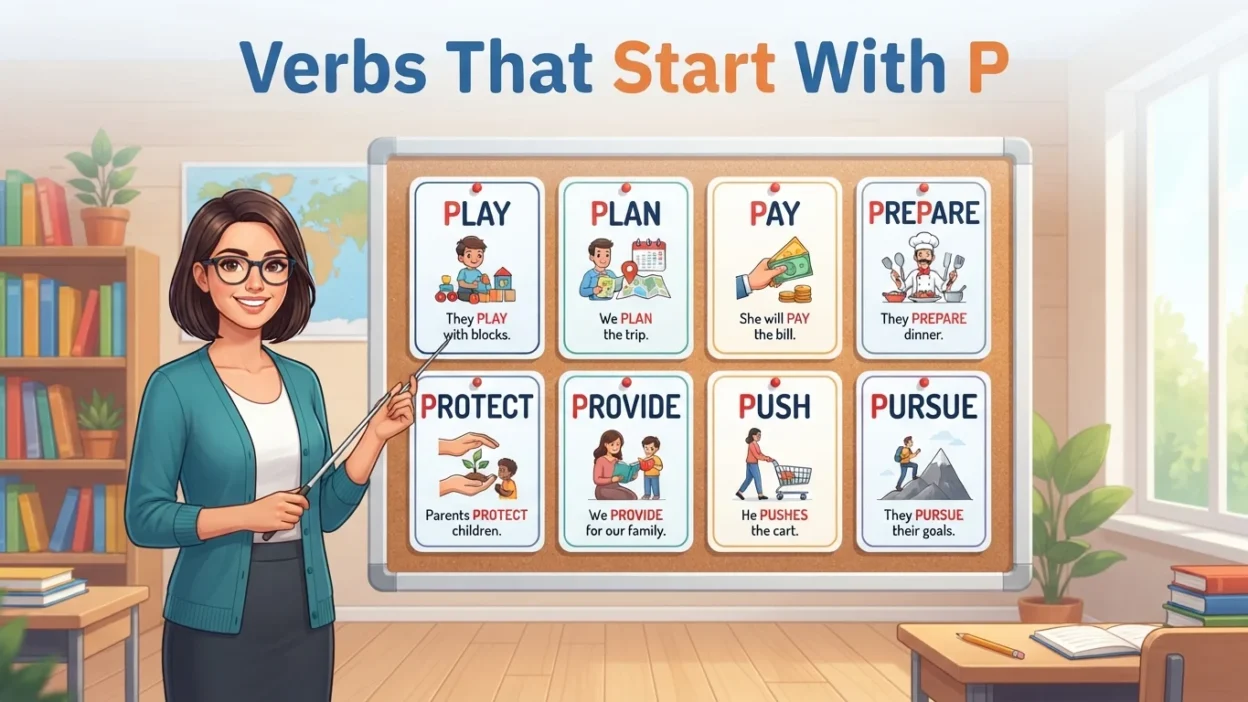
If you are looking for verbs that start with P, you have plenty of useful options to choose from. The letter P begins many common English verbs such as play, pay, plan, prepare, protect, provide, practice, and push. It also introduces more advanced verbs such as perceive, persuade, prioritize, procrastinate, and persevere.
Learning verbs alphabetically can make vocabulary building easier, especially for students, writers, teachers, and English learners. In this guide, you will find a comprehensive list of P verbs, their meanings, example sentences, common mistakes, and useful vocabulary for everyday and advanced English.
Quick Answer
Some common verbs that start with P include pack, paint, park, pass, pay, perform, pick, place, plan, play, pour, practice, prepare, prevent, produce, protect, prove, provide, publish, pull, push, and put.
More advanced P verbs include participate, perceive, persuade, ponder, predict, preserve, prioritize, proclaim, prohibit, promote, propose, prosper, provoke, pursue, and persevere.
Why People Search for Verbs That Start With P
People often look for verbs beginning with a particular letter when studying English vocabulary, completing word games, writing creatively, or preparing for language exams.
Verbs are especially important because they express actions, activities, conditions, and processes. Expanding your collection of verbs can help you write more naturally and avoid repeating the same words.
For example, instead of always using “do,” you might use perform, practice, produce, prepare, or participate, depending on the meaning.
Common Verbs That Start With P
Here are some of the most frequently used verbs beginning with P:
- Pack — to put things into a bag, box, or container.
- Paint — to cover a surface with paint.
- Park — to leave a vehicle in a particular place.
- Pass — to move beyond something or give something to someone.
- Pay — to give money for something.
- Peel — to remove the outer covering of something.
- Perform — to carry out an action or task.
- Pick — to choose or select something.
- Place — to put something somewhere.
- Plan — to decide what you intend to do.
- Play — to participate in a game, sport, or activity.
- Please — to make someone happy or satisfied.
- Point — to direct attention toward something.
- Pour — to make a liquid flow from one container to another.
- Practice — to do something repeatedly to improve.
- Pray — to communicate with God or express a religious request.
- Prepare — to make something ready.
- Present — to show, give, or introduce something.
- Prevent — to stop something from happening.
- Print — to produce words or images on paper.
- Produce — to make or create something.
- Promise — to say that you will definitely do something.
- Protect — to keep someone or something safe.
- Prove — to demonstrate that something is true.
- Provide — to give or supply something.
- Publish — to make written or other material available to the public.
- Pull — to move something toward yourself.
- Push — to move something away from yourself.
- Put — to move or place something in a particular position.
Advanced Verbs That Start With P
If you want to improve your vocabulary, these advanced P verbs are particularly useful:
- Participate — to take part in an activity.
- Perceive — to notice, recognize, or understand something.
- Persevere — to continue despite difficulty.
- Persuade — to convince someone to do or believe something.
- Ponder — to think about something carefully.
- Predict — to say what you think will happen in the future.
- Preserve — to protect something from damage or change.
- Prioritize — to decide which things are most important.
- Proclaim — to announce something publicly.
- Prohibit — to officially prevent or forbid something.
- Promote — to encourage, support, or help advance something.
- Propose — to suggest an idea or plan.
- Prosper — to become successful or wealthy.
- Provoke — to cause a reaction, especially an emotional one.
- Pursue — to follow or try to achieve something.
- Procrastinate — to delay doing something.
- Pronounce — to say a word in a particular way.
- Progress — to develop or improve gradually.
- Plagiarize — to copy another person’s work and claim it as your own.
- Presume — to believe something is true without complete proof.
Comparison Table
| Verb | Meaning | Example |
|---|---|---|
| Pack | Put things into a container | I packed my clothes. |
| Pay | Give money for something | She paid the bill. |
| Pick | Choose something | Pick your favorite color. |
| Plan | Decide what to do | We planned our trip. |
| Play | Take part in an activity | The children played outside. |
| Prepare | Make something ready | He prepared dinner. |
| Prevent | Stop something from happening | Exercise can prevent some health problems. |
| Produce | Make or create | The factory produces cars. |
| Protect | Keep safe | Helmets protect cyclists. |
| Provide | Give or supply | The hotel provides breakfast. |
| Persuade | Convince someone | She persuaded him to stay. |
| Pursue | Try to achieve or follow | He pursued his dream. |
When to Use Each P Verb
Different P verbs have different meanings, so choosing the correct one depends on the context.
Use pay when talking about giving money:
I paid for the meal.
Use plan when discussing something you intend to do:
We planned our vacation carefully.
Use prepare when making something ready:
She prepared for the exam.
Use prevent when stopping something from happening:
These measures can prevent accidents.
Use provide when giving or supplying something:
The organization provides food to families.
Use pursue when talking about following a goal, career, interest, or person:
She decided to pursue a career in science.
Examples of Verbs That Start With P
Here are more examples showing how P verbs work in everyday English:
- Please close the door quietly.
- Pack your bags before you leave.
- She painted the room blue.
- We parked the car near the entrance.
- Please pass me the salt.
- I need to pay the electricity bill.
- He picked an apple from the tree.
- They planned a surprise party.
- The children played football after school.
- She prepared a delicious meal.
- The teacher presented the lesson clearly.
- Regular exercise can prevent certain problems.
- The company produces electronic devices.
- Parents try to protect their children.
- The evidence proved that he was correct.
- The school provides students with useful resources.
- The author published a new book.
- He pulled the door open.
- She pushed the button.
- They participated in the competition.
- I persuaded my friend to join us.
- She pondered the question before answering.
- Experts predicted a change in the weather.
- We should prioritize the most important tasks.
- He pursued his goals despite many challenges.
Common Mistakes With P Verbs
Some P verbs can be confusing because they have similar meanings or forms.
Practice vs Practise
In American English, practice is used as both a noun and a verb.
I practice English every day.
In British English, practice is generally the noun, while practise is the verb.
I practise English every day.
Pay vs Paid
Pay is the base form, while paid is the past tense and past participle.
❌ I payed the bill yesterday.
✅ I paid the bill yesterday.
Put vs Putt
Put means to place something somewhere.
Put the book on the table.
Putt is a specific golf term.
He putted the ball into the hole.
Propose vs Purpose
Propose is a verb meaning to suggest or formally ask.
She proposed a new idea.
Purpose is normally a noun meaning the reason something exists or is done.
What is the purpose of this rule?
Memory Trick for P Verbs
A simple way to remember common P verbs is to group them according to what they do:
P + Action: play, push, pull, pick, pour
P + Preparation: plan, prepare, pack, practice
P + Protection: prevent, protect, preserve
P + Progress: pursue, promote, prosper, progress
This grouping makes it easier to remember vocabulary rather than memorizing a random list of words.
American vs British English
Most verbs beginning with P are spelled the same in American and British English.
One notable difference is practice/practise.
In American English:
She practices piano every day.
In British English:
She practises piano every day.
There can also be differences in pronunciation or preferred usage for some words, but the majority of common P verbs work in the same way in both varieties of English.
Similar Words to Learn
If you are expanding your vocabulary with P verbs, consider learning these related words:
- Prepare — organize or make ready
- Plan — decide what you will do
- Perform — carry out an action
- Practice — repeat an activity to improve
- Participate — take part
- Persuade — convince
- Promote — support or encourage
- Protect — keep safe
- Provide — supply
- Pursue — follow or work toward
- Predict — say what may happen
- Prioritize — decide what is most important
Learning related verbs together can help you understand subtle differences in meaning and use more precise English.
Frequently Asked Questions
What are common verbs that start with P?
Common P verbs include pack, paint, park, pass, pay, perform, pick, plan, play, practice, prepare, prevent, produce, protect, provide, pull, push, and put.
What is a powerful verb that starts with P?
Several strong P verbs can make writing more precise, including persuade, proclaim, pursue, protect, provoke, preserve, and prioritize.
What is a positive verb that starts with P?
Positive P verbs include praise, promote, prosper, protect, progress, and please. These can describe encouragement, improvement, success, or positive actions.
What is a P verb for “think”?
Ponder is a useful P verb meaning to think about something carefully.
She pondered the question before making a decision.
What is a P verb meaning “convince”?
Persuade means to convince someone to do or believe something.
He persuaded his friend to apply for the job.
What is a P verb meaning “stop”?
Prevent means to stop something from happening.
Wearing a seat belt can help prevent serious injuries.
What are some advanced P verbs?
Advanced P verbs include perceive, persevere, persuade, ponder, preserve, prioritize, proclaim, prohibit, propose, prosper, provoke, and pursue.
What P verbs are useful for writing?
For stronger writing, try verbs such as analyze, participate, perceive, predict, prioritize, propose, promote, protect, prove, and pursue. The best choice depends on the exact meaning you want to communicate.
Final Verdict
There are many useful verbs that start with P, ranging from simple everyday words such as pay, play, put, push, and pull to advanced vocabulary such as perceive, persuade, prioritize, preserve, and pursue.
For English learners, it is best to learn these verbs with their meanings and example sentences. This helps you understand not only what each verb means but also how it naturally fits into a sentence.
Conclusion
Learning verbs that start with P is an easy and effective way to expand your English vocabulary. Everyday verbs such as plan, practice, prepare, protect, provide, and produce are useful in countless conversations and writing situations.
As your vocabulary grows, add more advanced words such as persevere, persuade, ponder, prioritize, proclaim, and pursue. Understanding these verbs will help you express your ideas more clearly, accurately, and naturally.
Remember This
Common P verbs: Pay, Play, Plan, Prepare, Protect, Provide, Push, Pull
Advanced P verbs: Perceive, Persevere, Persuade, Ponder, Prioritize, Proclaim, Pursue
Best tip: Learn each verb with a meaning and example sentence instead of memorizing isolated words.
Meta Description
Discover useful verbs that start with P, including common and advanced P verbs, meanings, examples, common mistakes, and vocabulary tips for English learners.

Daniel Whitmore is a faith-inspired author dedicated to writing content that uplifts and motivates. His focus is on hope, resilience, and moral clarity, offering readers guidance for navigating life with confidence and belief.