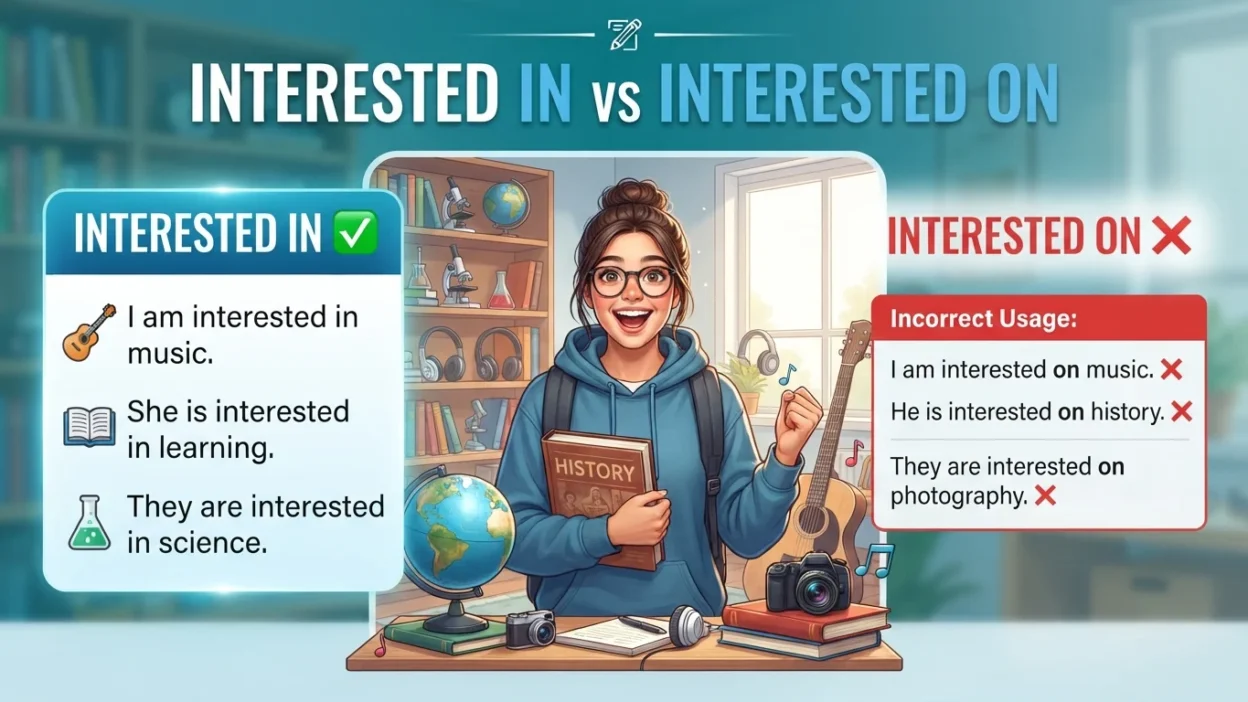
The correct expression in standard English is “interested in,” not “interested on.” We use interested in when we want to say that someone has curiosity, enthusiasm, or concern about a subject, activity, person, or thing. For example, “She is interested in photography” is correct.
The confusion often happens because English uses different prepositions with different adjectives. Although on can be used with many words when talking about a topic, interested normally takes in. So we say “interested in science,” “interested in learning English,” and “interested in the job.” Learning this common collocation will make your English sound much more natural and grammatically accurate.
Quick Answer
Interested in is correct in standard English. Use in after interested when talking about something that attracts your curiosity or attention. Interested on is generally incorrect.
I’m interested in music. ✅
I’m interested on music. ❌
Why People Confuse It
The confusion comes from translating directly from other languages or from thinking that on should be used because we talk about a topic.
English has fixed word combinations called collocations. The adjective interested normally collocates with the preposition in:
interested in something
Not:
interested on something
This applies to people, subjects, activities, ideas, jobs, hobbies, and many other things.
Interested In
Interested in means having curiosity, enthusiasm, or a desire to know more about something.
With Nouns
I’m interested in history.
She is interested in photography.
He’s interested in technology.
They are interested in the project.
With Activities
I’m interested in learning Spanish.
She is interested in studying abroad.
He’s interested in playing tennis.
Notice that after interested in, you can use a noun or a gerund (verb + -ing).
Interested On
Interested on is generally incorrect when you mean that someone has an interest in a subject or activity.
❌ I’m interested on science.
✅ I’m interested in science.
❌ She is interested on photography.
✅ She is interested in photography.
❌ He is interested on the position.
✅ He is interested in the position.
There are situations where interested and on might appear near each other in a longer sentence, but on is not the normal preposition directly following interested.
Interested In vs Interested On: Comparison Table
| Expression | Correct? | Usage | Example |
|---|---|---|---|
| Interested in | ✅ Correct | Showing curiosity or enthusiasm | I’m interested in art. |
| Interested on | ❌ Generally incorrect | Not the standard collocation | I’m interested on art. ❌ |
The Simple Rule
INTERESTED + IN
Think of it as one fixed phrase:
interested in
When to Use Each
Use “Interested In”
Use interested in when talking about:
- Hobbies
- Subjects
- Careers
- Activities
- People
- Ideas
- Opportunities
- Products
- Projects
- Learning
Examples:
She is interested in medicine.
I’m interested in this opportunity.
He’s interested in photography.
We’re interested in buying a house.
Don’t Use “Interested On”
Avoid:
interested on
when you mean having an interest in something.
Instead, use:
interested in
Examples
- I’m interested in English grammar. ✅
- She’s interested in learning French. ✅
- He is interested in photography. ✅
- Are you interested in this job? ✅
- They’re interested in buying a new car. ✅
- My brother is interested in football. ✅
- She became interested in psychology at school. ✅
- I’m very interested in your idea. ✅
- He’s interested in studying abroad. ✅
- We are interested in the new project. ✅
- I’m interested on learning English. ❌ Correct: I’m interested in learning English. ✅
- She is interested on photography. ❌ Correct: She is interested in photography. ✅
Common Mistakes
Mistake 1: Using “On” After Interested
❌ I’m interested on history.
✅ I’m interested in history.
Mistake 2: Using the Wrong Verb Form
After interested in, when you use a verb, use the -ing form.
❌ I’m interested in learn English.
✅ I’m interested in learning English.
❌ She is interested in study medicine.
✅ She is interested in studying medicine.
Mistake 3: Saying “Interested About”
This is also generally unnatural.
❌ I’m interested about science.
✅ I’m interested in science.
However, concerned about and excited about are different expressions:
I’m concerned about the problem.
I’m excited about the opportunity.
Memory Trick
Remember:
INTERESTED → IN
Think of interest going “in” to a subject.
Interested in music
Interested in sports
Interested in learning
Interested in you
So whenever you’re unsure, remember:
I am interested IN it. ✅
American vs British English
There is no meaningful difference between American and British English here.
Both varieties use:
interested in
For example:
American English:
I’m interested in learning French.
British English:
I’m interested in learning French.
Interested on is not the standard expression in either variety.
Similar Words
Interested In
She is interested in science.
Shows curiosity or enthusiasm.
Curious About
She is curious about science.
Means wanting to know more.
Excited About
She is excited about the trip.
Shows enthusiasm about something upcoming.
Concerned About
He is concerned about the situation.
Shows worry or concern.
Passionate About
She is passionate about education.
Shows strong enthusiasm.
These expressions take different prepositions, which is why memorizing common adjective + preposition collocations is useful.
FAQs
Is it interested in or interested on?
The correct expression is interested in.
I’m interested in art. ✅
Can I say “interested on”?
Generally, no. Interested on is not the standard English expression when you mean having an interest in something.
Which preposition comes after interested?
The normal preposition is in:
interested in something
Is “interested in learning” correct?
Yes.
I’m interested in learning English.
After in, a verb normally takes the -ing form.
Is “interested in” formal or informal?
Interested in is completely natural in both casual and formal English.
Can “interested in” be used for people?
Yes.
She is interested in him.
Depending on context, this can mean she is curious about him or romantically attracted to him.
What is the opposite of interested in?
Depending on the context, you can say not interested in, uninterested in, or disinterested in. However, these words can have subtle differences in meaning.
Final Verdict
Interested in is the correct and natural expression in standard English. Use it whenever you want to say that someone has curiosity, enthusiasm, or concern about a person, subject, activity, or thing.
Interested on is generally incorrect in this meaning.
The easiest rule is:
INTERESTED + IN = CORRECT
Conclusion
Choosing the right preposition can make a big difference in natural English. With interested, the standard combination is always interested in when you’re talking about something that attracts someone’s attention or curiosity.
So whether you’re interested in English, sports, music, science, a career, or learning a new skill, use in. Avoid interested on in standard English.
Remember This
Interested in ✅
I’m interested in English.
She’s interested in photography.
They’re interested in buying a house.
Interested on ❌
I’m interested on English.
The rule is simple:
INTERESTED → IN

Daniel Whitmore is a faith-inspired author dedicated to writing content that uplifts and motivates. His focus is on hope, resilience, and moral clarity, offering readers guidance for navigating life with confidence and belief.