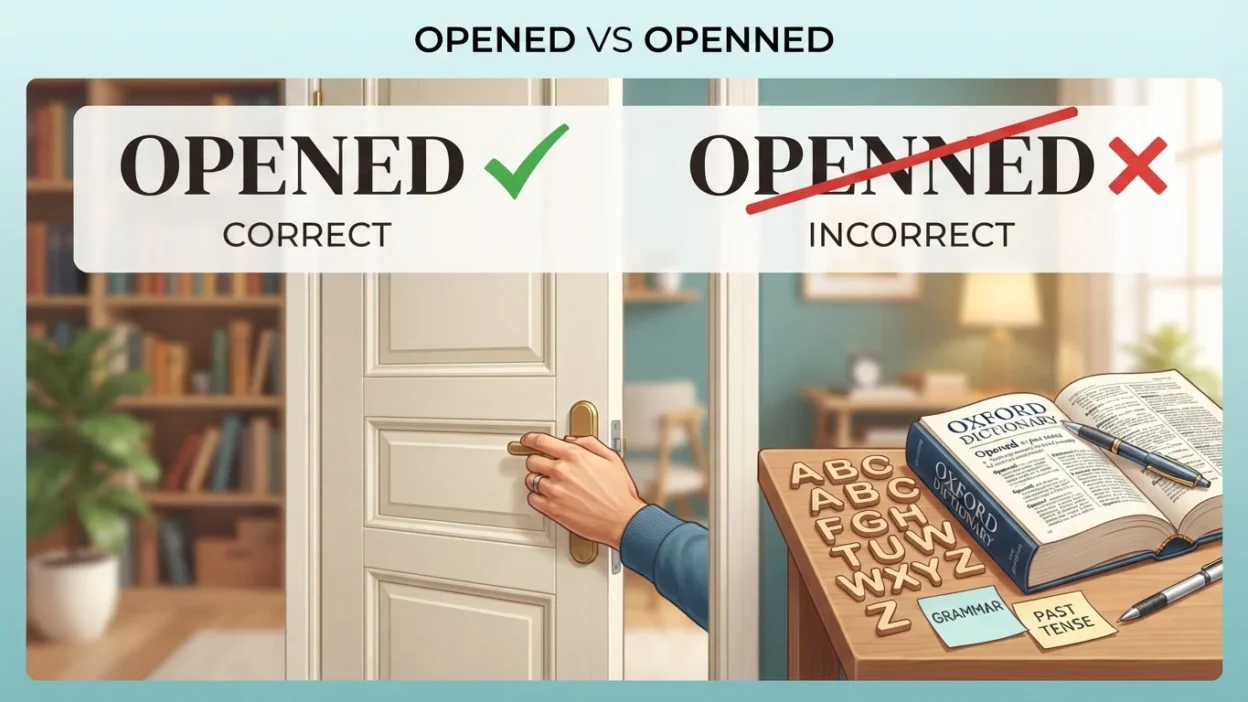
If you’re wondering whether the correct spelling is opened or openned, the answer is simple: opened is correct, while openned is a common spelling mistake. The confusion usually happens because English sometimes doubles the final consonant when adding -ed, as in planned or stopped. However, the verb open does not follow that pattern.
Opened is the past tense and past participle of open. It can describe physically opening something, beginning an event or business, making something accessible, or becoming available. For example, you can say, “She opened the door,” “The store opened at nine,” or “He opened the email.” In all these cases, the spelling remains opened, with only one n. Learning why the consonant is not doubled makes this common spelling question much easier.
Quick Answer
Opened is the correct spelling. Openned is incorrect. The verb open becomes opened by adding -ed without doubling the final n. Use opened for doors, accounts, stores, emails, conversations, events, and many other contexts.
Why People Confuse It
The confusion comes from English spelling rules involving final consonants.
Some verbs double their final consonant before adding -ed:
- stop → stopped
- plan → planned
- drop → dropped
Because open ends in n, some writers incorrectly assume:
open → openned ❌
But the correct form is:
open → opened ✅
The final n stays single.
Opened
Opened is the correct past tense and past participle of open.
It means that something was made accessible, uncovered, unlocked, started, or made available.
Physical Opening
She opened the window.
He opened the box carefully.
Beginning Something
The speaker opened the meeting.
The store opened at 10 a.m.
Digital Use
I opened the email.
She opened the app.
Figurative Use
He opened his heart to his family.
The discussion opened new possibilities.
Openned
Openned is not the standard spelling of the past tense of open.
❌ She openned the door.
✅ She opened the door.
The extra n should not be added.
If you see openned in an essay, email, article, or message, it is normally a spelling error.
Opened vs Openned: Comparison Table
| Spelling | Correct? | Meaning | Example |
|---|---|---|---|
| Opened | ✅ Yes | Past tense/past participle of open | She opened the door. |
| Openned | ❌ No | Incorrect spelling | She openned the door. |
The practical rule is:
OPEN + ED = OPENED
Not:
OPEN + NED = OPENNED
When to Use Each
Use “Opened”
Use opened whenever you’re describing something that happened in the past involving the verb open.
Examples:
- Opened the door
- Opened the window
- Opened the box
- Opened the store
- Opened an account
- Opened an email
- Opened a book
- Opened the discussion
- Opened a gift
- Opened a file
Avoid “Openned”
Do not use openned in standard English.
The correct spelling is always:
opened
Examples of Opened vs Openned
- She opened the door quietly.
Correct past tense of open. - He opened the window to let in fresh air.
Correct spelling. - The store opened at eight o’clock.
The business began operating. - I opened your message this morning.
Correct digital usage. - She opened the gift carefully.
Correct spelling. - The teacher opened the discussion with a question.
Here, opened means started. - He opened a new bank account.
Correct usage. - The museum opened its new exhibition.
The exhibition was made available to visitors. - She opened the book to the first page.
Correct physical usage. - The meeting opened with a short introduction.
The meeting began. - The application opened successfully on my computer.
Correct technical usage. - Openned is an incorrect spelling of opened.
Here, openned is being discussed as a spelling mistake.
Common Mistakes
Mistake 1: Doubling the “n”
❌ openned
✅ opened
The final n is not doubled.
Mistake 2: Applying the doubling rule to every verb
English does have a consonant-doubling rule, but it doesn’t apply automatically to every verb ending in a consonant.
For example:
- stop → stopped
- plan → planned
- open → opened
So you cannot simply assume that open becomes openned.
Mistake 3: Confusing “opened” with “opening”
Both are correct but have different grammatical roles:
She opened the door.
She is opening the door.
The past tense is opened, while the present participle is opening.
Mistake 4: Thinking pronunciation requires two Ns
The pronunciation of opened does not require a doubled n in spelling.
Correct:
opened
Memory Trick
Here’s the easiest rule:
OPEN + ED = OPENED
Simply add -ed to open.
OPEN → OPENED
Don’t add another n.
You can also remember:
Open only needs one N.
So:
OPENED ✅
OPENNED ❌
American vs British English
There is no spelling difference between American and British English here.
Both use:
opened
For example:
American English:
The store opened at nine.
British English:
The shop opened at nine.
The noun store/shop may differ depending on the variety, but the spelling of opened remains the same.
Similar Words
Open
The base verb.
Please open the window.
Opening
The present participle or gerund.
She is opening the door.
Closed
The opposite of opened.
The store closed at six.
Unlocked
Made accessible by removing a lock.
He unlocked the door.
Started
Began something.
She started the meeting.
Launched
Started or introduced something, especially a product, business, or project.
The company launched a new service.
FAQs
Is it opened or openned?
Opened is correct. Openned is an incorrect spelling.
Why isn’t the N doubled in opened?
The verb open does not follow the consonant-doubling pattern used in words such as stop → stopped. The standard form is simply opened.
Is “openned” a word?
No. Openned is not the standard English spelling of the past tense of open.
How do you spell opened?
It is spelled:
O-P-E-N-E-D
Opened.
Is opened past tense?
Yes. Opened is both the simple past tense and past participle of open.
She opened the door.
The door was opened by the staff.
Is “opened” the same in American and British English?
Yes. Both American and British English use opened.
What is the difference between opened and opening?
Opened is the past tense or past participle, while opening is the present participle or gerund.
He opened the door.
He is opening the door.
Final Verdict
Opened is the only standard spelling you should use for the past tense and past participle of open. Openned is simply a spelling mistake caused by incorrectly doubling the final consonant.
The easiest way to remember the correct form is OPEN + ED = OPENED. There is no need for an extra n.
Conclusion
The difference between opened and openned is straightforward once you understand that not every verb doubles its final consonant when -ed is added. While words such as planned and stopped use a doubled consonant, open becomes opened.
So whether you’re talking about opening a door, email, store, account, book, or conversation, always write opened. One n is enough.
Remember This
OPENED ✅ = correct
OPENNED ❌ = incorrect
Memory trick:
OPEN + ED = OPENED
Just add -ed to open—don’t double the n.

Lucas Bennett is an American writer passionate about spiritual insight and meaningful storytelling. His work blends faith-centered ideas with real-life experiences, encouraging readers to reflect deeply and live with intention.