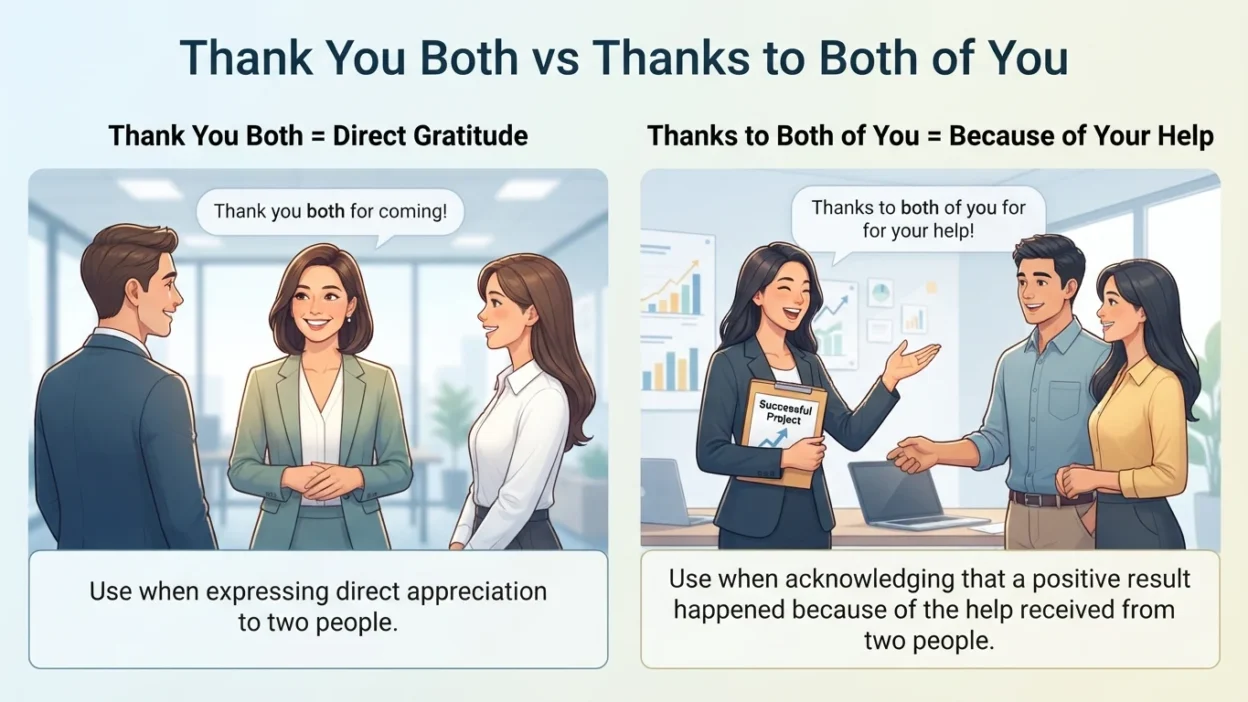
Both “thank you both” and “thanks to both of you” are grammatically correct, but they do not mean exactly the same thing. The first is a direct way to express gratitude to two people. The second can either be a less common way of saying thanks or, depending on the sentence, can mean that something happened because of those two people.
For example, if two friends helped you, you can naturally say, “Thank you both for helping me.” You can also say, “Thanks to both of you for helping me,” although “Thank you both” sounds more direct and natural. However, in a sentence such as “Thanks to both of you, I finished the project,” the phrase means “Because of both of you, I finished the project.” That distinction is important.
Quick Answer
“Thank you both” is the most natural choice when directly thanking two people. “Thanks to both of you” can also express gratitude, but it may mean “because of both of you” depending on context. For a simple thank-you, choose “Thank you both.”
Why People Confuse Them
The confusion comes from the word “thanks.”
Compare:
Thank you both.
= I am directly expressing gratitude to both of you.
Thanks to both of you.
= I appreciate what both of you did, but it can also mean that something happened because of you.
The second phrase is therefore more context-dependent.
Thank You Both
“Thank you both” is a direct and natural way to thank two people.
Examples:
Thank you both for coming.
Thank you both for your help.
Thank you both so much.
I really appreciate it. Thank you both.
Here, both tells the listener that you are thanking two people.
Why It Sounds Natural
The structure is:
Thank + you + both
It is similar to:
- Thank you.
- Thank you both.
- Thank you all.
- Thank you everyone.
If you’re addressing exactly two people, “Thank you both” is concise and natural.
Thanks to Both of You
“Thanks to both of you” has two possible uses.
Meaning 1: Expressing Gratitude
You can use it to thank two people:
Thanks to both of you for helping me.
This means:
Thank you both for helping me.
However, “Thank you both for helping me” is generally more direct.
Meaning 2: Because of Both of You
This is where the phrase becomes different.
Thanks to both of you, I passed the exam.
Here, thanks to means because of or as a result of the help from both people.
It does not simply function as a standalone thank-you.
For example:
Thanks to both of you, we finished the project on time.
This means:
Because both of you helped, we finished the project on time.
Thank You Both vs Thanks to Both of You: Comparison Table
| Expression | Main Meaning | Naturalness | Example |
|---|---|---|---|
| Thank you both | Directly thanks two people | ⭐⭐⭐⭐⭐ | Thank you both for your help. |
| Thanks to both of you | Thanks two people or means because of them | ⭐⭐⭐⭐ | Thanks to both of you, we succeeded. |
| Thanks, both of you | Casual direct thanks | ⭐⭐⭐⭐ | Thanks, both of you! |
For a simple expression of gratitude, “Thank you both” is usually the best choice.
When to Use Each
Use “Thank You Both” When Directly Thanking Two People
Thank you both for being here.
Thank you both for your support.
Thank you both for the wonderful gift.
Thank you both for helping me.
This is especially suitable when speaking directly to the two people.
Use “Thanks to Both of You” When Highlighting Their Contribution
Thanks to both of you, we completed the project.
Thanks to both of you, everything went smoothly.
Thanks to both of you, I was able to solve the problem.
Here, thanks to emphasizes that their actions caused a positive result.
Examples
- Thank you both for coming.
Directly thanks two people. - Thank you both for your kindness.
A polite expression of gratitude. - Thank you both so much.
Warm and natural. - Thank you both for helping me move.
Directly thanks two people for their help. - Thanks to both of you, I finished my assignment.
Their help made the result possible. - Thanks to both of you, the event was a success.
Their contribution led to the successful outcome. - Thank you both for your advice.
Natural and direct. - Thanks, both of you!
Casual and friendly. - I want to thank you both for your support.
Polite and slightly more formal. - Thanks to both of you, we arrived on time.
Means their help contributed to the result.
Common Mistakes
Mistake 1: Using “thanks to” when you simply want to say thank you
If you’re speaking directly to two people, this is usually clearer:
Thank you both. ✅
Rather than:
Thanks to both of you.
The latter can sound as though you’re explaining the result of their actions.
Mistake 2: Thinking “both” is incorrect after “you”
It is perfectly correct:
Thank you both.
Here, both means both of you.
Mistake 3: Saying “thank you both of you”
This is generally awkward.
Instead, use:
Thank you both. ✅
or:
Thank you to both of you. ✅
The first is more natural in most situations.
Mistake 4: Confusing “thanks to” with “thank you”
Thank you = direct expression of gratitude.
Thanks to = because of / as a result of, although it can also introduce an expression of gratitude.
Memory Trick
Remember:
Thank you both = I am thanking you.
Thanks to both of you = your actions helped cause something.
For example:
Direct thanks:
Thank you both for helping me.
Result:
Thanks to both of you, I finished the work.
This simple distinction will help you choose the right phrase.
American vs British English
Both expressions are understood in American and British English.
There is no important regional grammar difference here.
Thank you both.
and
Thanks to both of you.
are natural in both varieties.
The main difference is meaning and context, not American versus British usage.
Similar Expressions
Thank You Both
Thank you both for your help.
The most direct option.
Thanks, Both of You
Thanks, both of you!
Casual and friendly.
Thank You to Both of You
Thank you to both of you for your support.
Grammatical, but slightly more wordy than “Thank you both.”
I Appreciate You Both
I really appreciate you both.
Warm and personal.
Many Thanks to Both of You
Many thanks to both of you for your assistance.
More formal or written.
FAQs
Is “thank you both” grammatically correct?
Yes. “Thank you both” is completely correct and is a very natural way to thank two people.
Is “thanks to both of you” correct?
Yes, but its meaning depends on context. It can express gratitude or mean “because of both of you.”
Which is more natural: “thank you both” or “thanks to both of you”?
For directly thanking two people, “Thank you both” is usually more natural and concise.
Can I say “thank you both of you”?
It is better to say “Thank you both” or “Thank you to both of you.” The phrase “thank you both of you” sounds awkward.
Is “thanks to both of you” formal?
It can sound polite, but it is not necessarily formal. Its meaning depends on the surrounding sentence.
What does “thanks to both of you” mean?
It can mean “I appreciate what both of you did” or “because of both of you.”
Can I say “thanks, both of you”?
Yes. “Thanks, both of you!” is natural in casual conversation.
Final Verdict
If you simply want to thank two people, “Thank you both” is the clearest and most natural choice.
Use “thanks to both of you” when you want to emphasize their contribution to a result, especially in a sentence such as “Thanks to both of you, we succeeded.”
So remember:
Thank you both = direct gratitude.
Thanks to both of you = gratitude or “because of both of you,” depending on context.
Conclusion
Both phrases are correct, but “thank you both” is usually the better choice when you’re directly speaking to two people. It is simple, polite, and completely natural in everyday and professional English.
“Thanks to both of you” is useful when you’re connecting someone’s help to a positive result. Understanding this small difference will help your English sound more precise and natural.
Remember This
Thank you both → directly thanking two people.
Thank you both for your help. ✅
Thanks to both of you → often highlights their contribution or means “because of both of you.”
Thanks to both of you, we succeeded. ✅

Daniel Whitmore is a faith-inspired author dedicated to writing content that uplifts and motivates. His focus is on hope, resilience, and moral clarity, offering readers guidance for navigating life with confidence and belief.