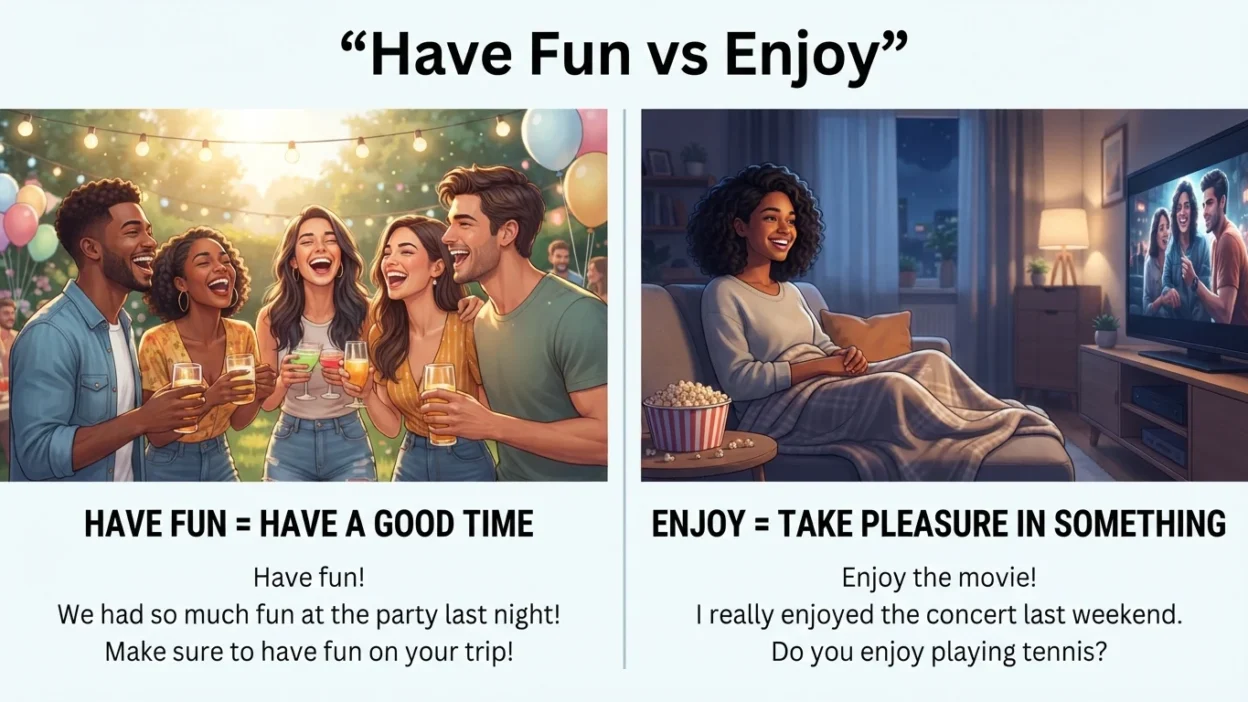
Have fun and enjoy are both common English expressions used when talking about pleasure, happiness, or having a good time. Because they can often appear in similar situations, English learners sometimes wonder whether they are interchangeable.
The good news is that both are correct, but they are used differently in sentences. Have fun is an expression that usually means to have an enjoyable or pleasant experience, while enjoy is a verb that means to take pleasure in something.
Understanding the difference between have fun vs enjoy will help you sound more natural in everyday English and avoid common grammar mistakes.
Quick Answer
Have fun means to enjoy yourself or have a good time, while enjoy means to take pleasure in something or experience something positively.
- Have fun → usually refers to having a good time.
- Enjoy → usually takes an object, such as an activity, event, meal, or experience.
Examples:
- Have fun at the party!
- I enjoyed the party.
Why People Confuse Have Fun and Enjoy
The confusion happens because both expressions are connected with pleasure and enjoyable experiences.
For example, you can say:
Have fun at the concert!
You can also say:
I enjoyed the concert.
Both sentences communicate a positive experience, but their grammatical structures are different.
Have fun is an expression made with the verb have and the noun fun. Enjoy is a verb that normally needs an object or reflexive pronoun.
Have Fun
Have fun means to enjoy yourself or have a good time.
It is extremely common in everyday spoken English and is often used when saying goodbye or wishing someone a pleasant experience.
Have fun at the beach!
Have fun at the party!
I hope you have fun.
You can also use have fun to describe your own experience.
We had fun at the festival.
The children had fun playing outside.
The word fun is a noun in this expression, so we say have fun, not have a fun when speaking generally.
Common Structures With Have Fun
Have fun + place/event
Have fun at the concert.
Have fun + -ing activity
We had fun swimming in the lake.
Have fun with + person/thing
She had fun with her friends.
Have fun!
Have fun on your trip!
Enjoy
Enjoy is a verb meaning to take pleasure in something or to experience something positively.
Unlike have fun, enjoy normally takes an object.
I enjoyed the movie.
She enjoyed the meal.
They enjoyed the concert.
You can also use enjoy + -ing when talking about an activity.
I enjoy reading.
He enjoys playing football.
She enjoys traveling.
When the subject and object are the same person, you can use enjoy yourself/yourselves.
Enjoy yourself at the party!
Did you enjoy yourself?
Comparison Table
| Expression | Meaning | Common Structure | Example |
|---|---|---|---|
| Have fun | Have a good time | have fun + place/activity | Have fun at the party! |
| Enjoy | Take pleasure in something | enjoy + noun | I enjoyed the party. |
| Enjoy | Like an activity | enjoy + -ing | I enjoy reading. |
| Enjoy yourself | Have a good time | enjoy + reflexive pronoun | Did you enjoy yourself? |
When to Use Have Fun
Use have fun when you want to say that someone should enjoy themselves or have a good time.
It is especially natural when wishing someone well before an activity.
Have fun at the wedding!
Have fun on your vacation!
Have fun tonight!
You can also use it to describe a past experience:
We had fun at the beach.
And you can use it with an activity:
We had fun playing games.
When to Use Enjoy
Use enjoy when you want to identify what someone takes pleasure in.
I enjoyed the movie.
She enjoyed the food.
They enjoyed the trip.
Use enjoy + -ing when talking about activities you like doing.
I enjoy cooking.
He enjoys swimming.
We enjoy spending time together.
You can also say enjoy yourself when you mean “have a good time.”
Enjoy yourself at the party!
Have Fun vs Enjoy Examples
Here are examples that show how the two expressions work:
- Have fun at the party!
- I enjoyed the party.
- We had fun at the beach.
- She enjoyed the beautiful scenery.
- Have fun on your trip!
- They had fun playing football.
- I enjoy reading books.
- He enjoyed the concert.
- Did you enjoy yourself at the wedding?
- We had fun together.
- She enjoys spending time with her family.
- I hope you have fun tonight.
- He enjoyed his vacation.
- The children had fun at the playground.
- We enjoyed watching the sunset.
Common Mistakes
Mistake 1: Using Enjoy Without an Object
❌ I enjoyed.
✅ I enjoyed the movie.
When enjoy means taking pleasure in something, it normally needs an object.
You can, however, use enjoy yourself when the meaning is “have a good time.”
I really enjoyed myself.
Mistake 2: Saying “Enjoy to Do”
After enjoy, use a noun or -ing form, not to + verb.
❌ I enjoy to read.
✅ I enjoy reading.
❌ She enjoys to dance.
✅ She enjoys dancing.
Mistake 3: Saying “Have a Fun”
When fun is being used in the common expression, we normally say:
❌ Have a fun!
✅ Have fun!
However, fun can sometimes be used with an article in other structures, especially when referring to a specific enjoyable experience.
Mistake 4: Confusing “Enjoy” With “Have Fun”
❌ I enjoyed at the party.
✅ I had fun at the party.
Or:
✅ I enjoyed the party.
Enjoy usually needs an object, while have fun can stand on its own.
Memory Trick
Remember this simple rule:
HAVE FUN = HAVE A GOOD TIME
ENJOY + SOMETHING
For example:
Have fun at the concert!
Enjoy the concert!
And for activities:
We had fun dancing.
We enjoyed dancing.
If you are wishing someone a good experience, Have fun! is often the easiest choice.
American vs British English
Have fun and enjoy are used naturally in both American and British English.
There is no major difference in meaning between the two varieties.
Americans and British speakers commonly say:
Have fun!
Enjoy your meal!
I enjoyed the movie.
We had fun on vacation.
One small vocabulary difference is that British English often uses holiday, while American English commonly uses vacation.
For example:
Have fun on your holiday! — British English
Have fun on your vacation! — American English
The expressions have fun and enjoy themselves remain the same.
Similar Expressions
There are several expressions related to have fun and enjoy:
- Have a good time — enjoy yourself
- Have a great time — have a very enjoyable experience
- Enjoy yourself — have a pleasant time
- Have a blast — have a very exciting or enjoyable time
- Have a wonderful time — enjoy an experience greatly
- Take pleasure in — enjoy something, usually more formal
- Love — enjoy something very much
For everyday conversations, Have fun!, Enjoy!, and Have a good time! are especially common.
Frequently Asked Questions
Is “have fun” the same as “enjoy”?
They have similar meanings, but they are used differently. Have fun means to have a good time, while enjoy means to take pleasure in something.
Can I say “enjoy yourself” instead of “have fun”?
Yes. Enjoy yourself and have fun can have essentially the same meaning.
Have fun at the party!
Enjoy yourself at the party!
Is it correct to say “enjoy to”?
Usually, no. After enjoy, use a noun or an -ing form.
❌ I enjoy to swim.
✅ I enjoy swimming.
Is “Have fun” grammatically correct?
Yes. Have fun is a standard and very common English expression.
Can I say “enjoy the party”?
Yes. Enjoy the party! is completely correct and means that you hope someone has a pleasant experience at the party.
Is “enjoy” a verb?
Yes. Enjoy is a verb meaning to take pleasure in something or to experience something positively.
What is the difference between “enjoy” and “enjoy yourself”?
Enjoy normally takes something as its object:
I enjoyed the movie.
Enjoy yourself means to have a good time:
I enjoyed myself at the party.
Should I say “have fun” or “enjoy” when saying goodbye?
Both can work, depending on the context. Have fun! is especially natural when someone is going somewhere or doing an enjoyable activity. Enjoy! is often used when the enjoyable thing is already understood.
Final Verdict
The difference between have fun and enjoy is mainly grammatical and contextual.
Use have fun to mean have a good time, especially when wishing someone an enjoyable experience. Use enjoy when talking about taking pleasure in a specific thing or activity.
The easiest rule is:
Have fun + activity/place
Enjoy + thing/activity
Conclusion
Have fun and enjoy are both positive expressions, but they are not always interchangeable. Have fun focuses on having a good time, while enjoy generally focuses on the thing or activity that gives someone pleasure.
Once you remember that enjoy normally takes an object or an -ing form, the difference becomes much easier. Say “Have fun!” when wishing someone a good time, and say “Enjoy the movie,” “Enjoy your meal,” or “I enjoy reading” when identifying what someone likes or takes pleasure in.
Remember This
Have fun = have a good time.
Enjoy + noun: I enjoyed the movie.
Enjoy + -ing: I enjoy reading.
Enjoy yourself = have a good time.
Easy rule:
👉 Have fun at the party.
👉 Enjoy the party.

Lucas Bennett is an American writer passionate about spiritual insight and meaningful storytelling. His work blends faith-centered ideas with real-life experiences, encouraging readers to reflect deeply and live with intention.