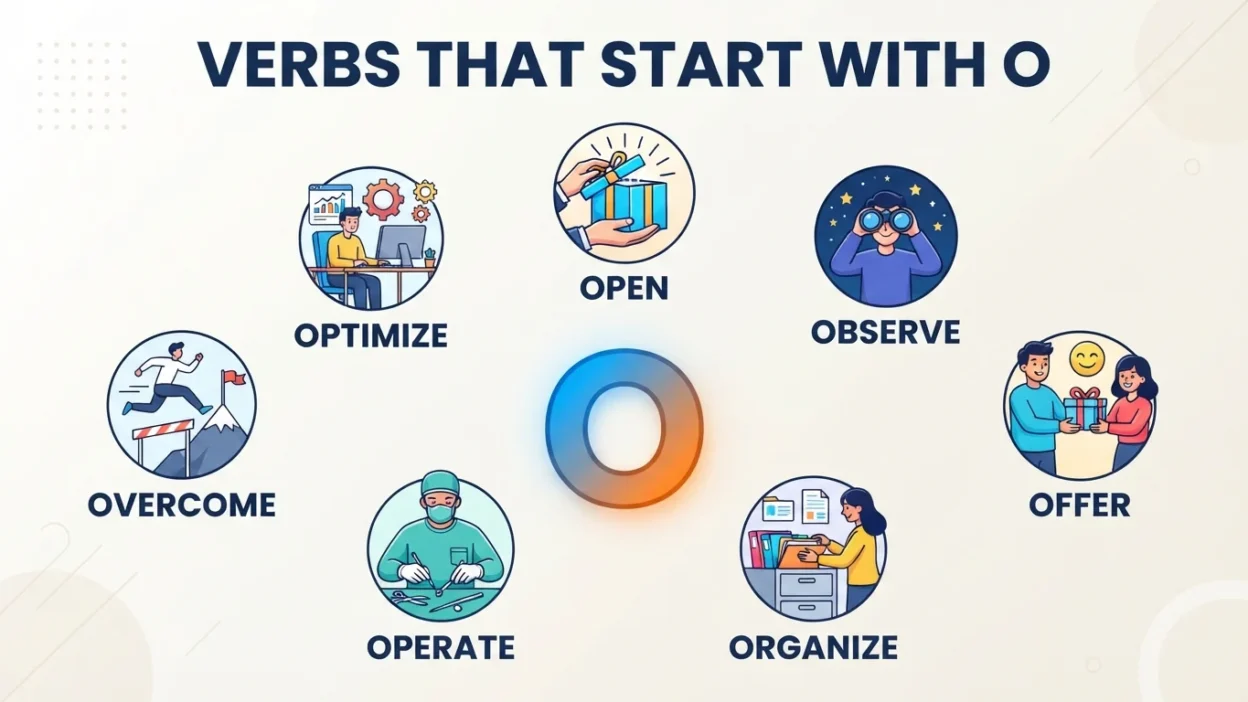
Looking for verbs that start with O? English has many useful action words beginning with the letter O, from everyday verbs such as open, offer, observe, organize, and obey to more advanced words such as originate, overcome, optimize, and overwhelm.
Whether you’re building your vocabulary, working on an English assignment, writing content, or playing a word game, learning O verbs can make your English more varied and expressive. Below, you’ll find a useful list of O verbs with meanings and example sentences, organized to make them easier to learn.
Quick Answer
Some common verbs that start with O include obey, object, observe, obtain, occur, offer, open, operate, oppose, organize, overcome, overlook, overtake, owe, and own. These verbs can describe actions, thoughts, events, possession, movement, and many other situations.
Verbs That Start With O
| Verb | Meaning | Example |
|---|---|---|
| Obey | Follow a rule or command | You must obey the law. |
| Object | Express disagreement | She objected to the proposal. |
| Observe | Watch or notice carefully | We observed the birds. |
| Obtain | Get or acquire something | He obtained permission. |
| Occur | Happen | The accident occurred yesterday. |
| Offer | Give or propose something | She offered me some advice. |
| Open | Make accessible or no longer closed | Please open the door. |
| Operate | Control or function | He operates the machine. |
| Oppose | Disagree with or resist | They opposed the new policy. |
| Organize | Arrange systematically | We organized the event. |
| Originate | Begin or come from somewhere | The tradition originated in Europe. |
| Outnumber | Be greater in number | Visitors outnumbered residents. |
| Overcome | Successfully deal with a difficulty | She overcame her fear. |
| Overlook | Fail to notice | I overlooked an important detail. |
| Overtake | Catch up with and pass | The car overtook the truck. |
| Owe | Have a debt or obligation | I owe him $20. |
| Own | Have something as property | They own a small business. |
Common Verbs Starting With O
1. Obey
Meaning: To follow a rule, order, or instruction.
Children should obey their parents.
2. Object
Meaning: To express disagreement or opposition.
She objected to the decision.
3. Observe
Meaning: To watch, notice, or examine carefully.
Scientists observed the changes closely.
4. Obtain
Meaning: To get or acquire something.
He obtained a copy of the document.
5. Occur
Meaning: To happen or take place.
The meeting will occur tomorrow.
6. Offer
Meaning: To present or give something for someone to accept.
He offered me a seat.
7. Open
Meaning: To move something from a closed position or make something accessible.
Please open the window.
8. Operate
Meaning: To control, use, or cause a machine or system to function.
She knows how to operate the equipment.
9. Oppose
Meaning: To disagree with, resist, or fight against something.
Many people opposed the plan.
10. Organize
Meaning: To arrange things in an orderly way.
We need to organize the files.
More Verbs That Start With O
Here are additional O verbs to expand your vocabulary:
- Oblige — require or force someone to do something
- Obscure — make difficult to see or understand
- Observe — watch or notice
- Occupy — use or fill a place or period of time
- Offend — upset or insult someone
- Offset — counterbalance something
- Omit — leave something out
- Oppress — treat someone cruelly or unfairly
- Optimize — make something as effective as possible
- Orchestrate — organize or coordinate something carefully
- Orient — position or familiarize someone with something
- Outdo — do better than someone or something
- Outgrow — become too large or mature for something
- Outlast — last longer than something else
- Outperform — perform better than another person or thing
- Outrun — run faster or farther than someone or something
- Outshine — perform or appear better than something else
- Outsmart — defeat someone through cleverness
- Overcome — successfully deal with a problem
- Overestimate — estimate something as greater than it really is
- Overload — put too much pressure or demand on something
- Overpower — defeat using greater strength
- Overreact — react more strongly than appropriate
- Oversee — supervise
- Oversleep — sleep longer than intended
- Overstate — describe something as more important or serious than it is
- Overturn — reverse a decision or cause something to turn over
- Overwhelm — affect someone very strongly or give them too much to handle
Action Verbs That Start With O
If you’re specifically looking for action verbs, these are useful choices:
- Obey
- Object
- Observe
- Occupy
- Offer
- Open
- Operate
- Oppose
- Organize
- Originate
- Overcome
- Overhaul
- Overpower
- Overreact
- Oversee
- Overtake
- Overturn
- Overwhelm
- Outrun
- Outsmart
- Outperform
- Outshine
Positive Verbs That Start With O
For positive or constructive writing, try:
- Offer — provide help or something useful
- Open — make accessible
- Optimize — improve efficiency
- Organize — arrange effectively
- Outperform — achieve better results
- Overcome — successfully defeat a challenge
- Outshine — excel beyond expectations
Examples:
The team overcame several challenges.
She offered valuable advice.
The company optimized its workflow.
Advanced Verbs That Start With O
If you want more sophisticated vocabulary, consider:
Orchestrate
To carefully organize or coordinate something.
She orchestrated the entire event.
Obfuscate
To make something deliberately difficult to understand.
The report seemed designed to obfuscate the facts.
Operationalize
To put an idea, plan, or strategy into practical operation.
The organization operationalized its new strategy.
Oscillate
To move repeatedly between two positions or states.
The temperature oscillated throughout the day.
Ostracize
To exclude someone from a group or society.
The community ostracized him after the dispute.
Outmaneuver
To gain an advantage over someone through clever strategy.
The player outmaneuvered his opponent.
O Verbs for Writing and Essays
When writing an essay, these verbs can make your sentences more precise:
- Observe — examine or notice
- Obtain — acquire
- Outline — describe the main points
- Oppose — disagree with
- Organize — arrange
- Originate — begin
- Overcome — successfully deal with
- Overestimate — judge too highly
- Overlook — fail to notice
- Override — reject or take priority over
- Omit — leave out
- Optimize — improve
For example:
This study observes changes in consumer behavior.
The researchers obtained important evidence.
The author outlines three major arguments.
Verbs Starting With O for Kids
If you’re teaching children English, start with simple O verbs:
- Open
- Obey
- Offer
- Observe
- Organize
- Own
- Owe
Simple examples:
Open the box.
Obey the rules.
Offer your friend some water.
Observe the animal.
Organize your toys.
Verbs Starting With O and Their Past Tenses
| Present | Past |
|---|---|
| Obey | Obeyed |
| Object | Objected |
| Observe | Observed |
| Obtain | Obtained |
| Occur | Occurred |
| Offer | Offered |
| Open | Opened |
| Operate | Operated |
| Oppose | Opposed |
| Organize | Organized |
| Overcome | Overcame |
| Overtake | Overtook |
| Owe | Owed |
| Own | Owned |
Notice that occur becomes occurred, with a doubled r, while open becomes opened, with only one n.
FAQs
What are some common verbs that start with O?
Common examples include open, offer, obey, observe, obtain, occur, operate, oppose, organize, owe, and own.
What is a positive verb starting with O?
Some positive O verbs include offer, organize, optimize, overcome, outperform, and outshine.
What is an action verb that starts with O?
Open, observe, operate, organize, overcome, overtake, outrun, and outperform are all examples of action verbs beginning with O.
What are advanced verbs beginning with O?
Advanced examples include orchestrate, obfuscate, operationalize, oscillate, ostracize, and outmaneuver.
Is “open” a verb?
Yes. Open is a verb meaning to move something from a closed position or make something accessible.
Is “own” a verb?
Yes. Own is a verb meaning to possess something.
Final Verdict
There are many useful verbs that start with O, ranging from simple everyday words such as open, offer, obey, and observe to advanced vocabulary such as orchestrate, optimize, oscillate, and outmaneuver.
For everyday English, start with the most common O verbs. As your vocabulary grows, add more precise and advanced verbs to make your speaking and writing more expressive.
Conclusion
Learning verbs alphabetically is a practical way to expand your English vocabulary. O verbs are particularly useful because they cover many different ideas, including actions, communication, organization, movement, observation, and problem-solving.
Whether you need a simple verb for a school assignment or a stronger word for professional writing, there is a wide range of O verbs to choose from. Start with words like open, offer, observe, organize, overcome, and optimize, then gradually add more advanced vocabulary.
Remember This
Some of the most useful O verbs are:
Obey • Observe • Obtain • Occur • Offer • Open • Operate • Oppose • Organize • Overcome • Overtake • Owe • Own

Daniel Whitmore is a faith-inspired author dedicated to writing content that uplifts and motivates. His focus is on hope, resilience, and moral clarity, offering readers guidance for navigating life with confidence and belief.