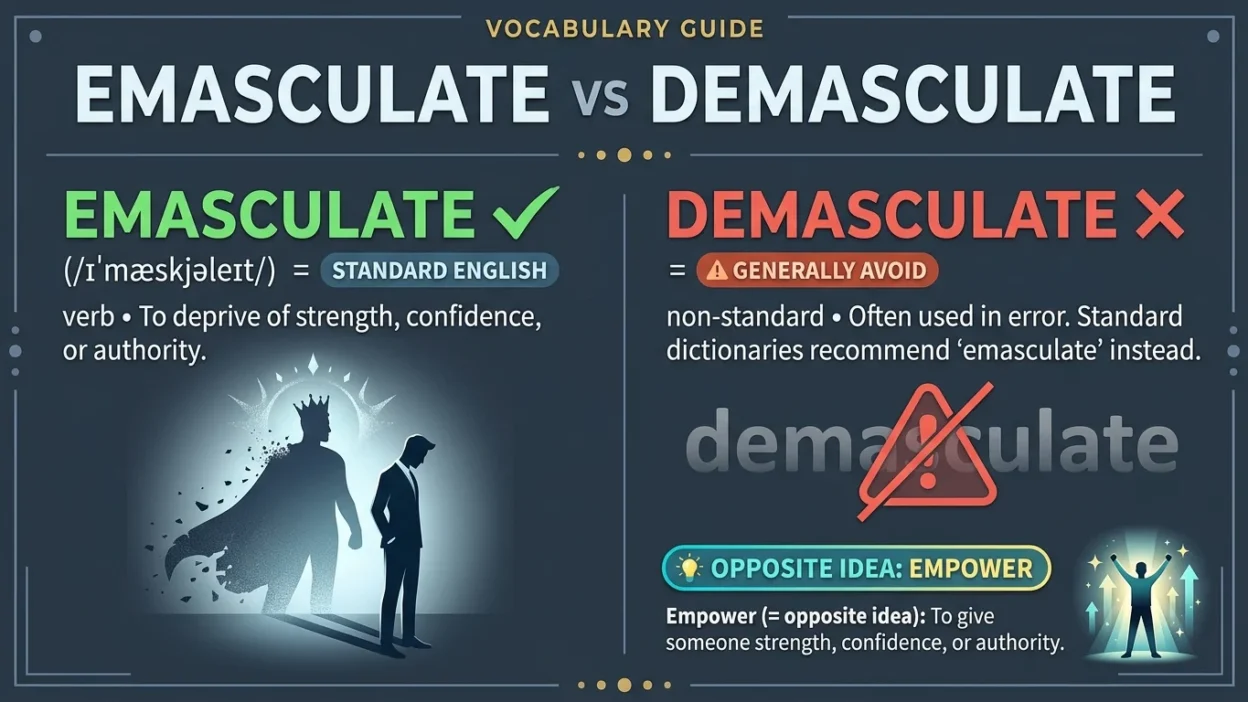
Emasculate and demasculate may look like related words, but they are not equally standard in English. Emasculate is the established and widely recognized English word, while demasculate is generally considered nonstandard or extremely rare.
Emasculate can mean to remove a male’s reproductive organs or, more commonly in figurative use, to make a man feel less masculine, powerful, or confident. It can also describe weakening or depriving something of its strength or effectiveness.
If you’re wondering whether “demasculate” is the correct alternative to “emasculate,” the safest answer is no. In standard English, use emasculate.
Quick Answer
The simplest distinction is:
- Emasculate = the standard English word
- Demasculate = generally nonstandard and rarely used
For example:
The criticism made him feel emasculated.
Not:
The criticism made him feel demasculated.
What Does Emasculate Mean?
Emasculate is a verb with both literal and figurative meanings.
Literally, it can mean to castrate or remove the male reproductive organs. This is a relatively technical or biological use.
Figuratively, emasculate can mean to make someone feel less masculine, powerful, confident, or authoritative.
It can also mean to weaken or deprive something of its effectiveness or strength.
Examples of Emasculate
- The experience made him feel emasculated.
- He worried that asking for help would make him seem emasculated.
- The policy was criticized for emasculating the organization.
- The new restrictions emasculated the committee’s authority.
- The character felt emasculated after losing control of the situation.
- The law was accused of emasculating the institution.
- Constant criticism can leave someone feeling emasculated.
- The changes emasculated the original proposal.
- He felt emasculated when his decisions were repeatedly ignored.
- The reforms significantly emasculated the agency’s powers.
What Does Demasculate Mean?
Demasculate is not a standard, commonly accepted English word in the way emasculate is.
You may occasionally encounter demasculate online or in informal writing, usually as an attempted opposite or variation of emasculate. However, it is not the normal choice in standard English.
If you want to express the idea of making someone less masculine or weakening their power or authority, use emasculate and choose a different construction when you need the opposite meaning.
For example:
- Emasculate → make someone feel less masculine or weaken something.
- Restore confidence → make someone feel more confident.
- Empower → give someone more power or authority.
Emasculate vs Demasculate: Comparison Table
| Feature | Emasculate | Demasculate |
|---|---|---|
| Standard English? | Yes | Generally no |
| Common usage | Yes | Extremely rare |
| Part of speech | Verb | Rare/nonstandard verb |
| Main meaning | Castrate, weaken, or make less masculine/powerful | Usually intended as a supposed opposite or variation |
| Recommended? | Yes | No |
| Example | The criticism emasculated him. | Avoid in standard English. |
Is “Demasculate” a Word?
You may find demasculate in some dictionaries, specialist sources, or historical texts, but it is extremely uncommon and is not the normal word used in contemporary standard English.
This is an important distinction: a word can appear somewhere without being a natural or recommended choice for everyday modern English.
If your goal is clear, standard writing, emasculate is the safer choice.
Emasculate vs Castrate
These words can overlap in their literal meanings, but they are not always interchangeable.
Castrate specifically refers to removing or disabling the testicles or reproductive capacity, depending on the context.
Emasculate can have that literal meaning, but it is also widely used figuratively.
For example:
The animal was castrated.
But:
The criticism made him feel emasculated.
The second sentence uses emasculated figuratively to describe a loss of confidence, masculinity, or power.
Emasculate in Figurative English
The figurative meaning of emasculate is particularly common in discussions about confidence, authority, identity, and social expectations.
For example:
He felt emasculated when his colleagues dismissed his decisions.
Here, the word does not necessarily mean anything physical. It describes a feeling of reduced masculinity, authority, confidence, or power.
The figurative use can sometimes carry a negative or gender-stereotyped implication, so writers should consider whether a more precise word such as undermine, disempower, or humiliate would communicate the intended meaning better.
Common Mistakes
Mistake 1: Using “demasculate” as the opposite of “emasculate”
It may seem logical that de- should be added to create an opposite, but English does not always form words that way.
Demasculate is not the standard everyday counterpart of emasculate.
Mistake 2: Assuming “emasculate” only has a physical meaning
Emasculate can be used figuratively.
For example:
The criticism emasculated his confidence.
Here, it means that his sense of confidence or power was weakened.
Mistake 3: Using “emasculate” when “weaken” is clearer
Although emasculate can mean weaken, it often carries a connection to masculinity or masculine power.
Instead of:
The changes emasculated the system.
You might simply write:
The changes weakened the system.
The best choice depends on the intended nuance.
A Simple Memory Trick
Remember:
EMASCULATE = STANDARD WORD
Think of male → masculine → emasculate.
If you mean making someone feel less masculine or weakening their authority, emasculate is the established word.
For the opposite idea, don’t automatically invent demasculate. Choose a precise word such as:
- Empower
- Strengthen
- Support
- Encourage
- Reinforce
Emasculate vs Demasculate: American and British English
There is no major difference between American and British English regarding the standard use of emasculate.
Emasculate is recognized in both varieties.
Demasculate, however, remains uncommon and nonstandard in ordinary contemporary English in both varieties. For formal writing, academic work, professional communication, and general usage, emasculate is the safer choice.
Better Alternatives to “Demasculate”
If you are looking for a word meaning the opposite of emasculate, choose the word that expresses your exact meaning:
If you mean “give someone confidence”
- Encourage
- Reassure
- Support
- Build confidence
If you mean “give someone power”
- Empower
- Authorize
- Strengthen
- Enable
If you mean “make something stronger”
- Reinforce
- Strengthen
- Improve
- Fortify
Frequently Asked Questions
Is “demasculate” a correct word?
Demasculate is extremely uncommon and is generally not the preferred word in standard contemporary English. Emasculate is the established and widely used term.
Is emasculate the opposite of masculinize?
Not exactly. Emasculate means to make less masculine, remove masculine power or confidence, or literally castrate. Masculinize means to make something more masculine.
What does emasculate mean?
Emasculate means to castrate literally or, figuratively, to make someone feel less masculine, powerful, or confident. It can also mean to weaken something’s strength or effectiveness.
What is the opposite of emasculate?
The best opposite depends on the context. Empower, strengthen, encourage, and reinforce can all work in different situations.
Is emasculate an offensive word?
It is not inherently a swear word, but its figurative use can be sensitive because it connects confidence or power with masculinity. In some contexts, undermine, humiliate, or disempower may be more neutral and precise.
Is emasculate only used for men?
The literal and traditional figurative meanings are connected to masculinity, so it is most commonly associated with men. However, it can also be used more broadly to describe weakening or depriving an organization, policy, or system of power.
Which is correct: emasculated or demasculated?
Emasculated is the standard and natural form. Demasculated should generally be avoided in standard English.
Final Verdict
Emasculate is the correct and established English word. Demasculate is extremely rare and generally not recommended in standard contemporary English.
Use emasculate when you mean to castrate, make someone feel less masculine or powerful, or weaken something’s effectiveness. If you need the opposite idea, use a more precise word such as empower, strengthen, or encourage rather than automatically using “demasculate.”
Conclusion
The apparent similarity between emasculate and demasculate can make the two words confusing, but standard English strongly favors emasculate. It has both literal and figurative meanings and is widely understood in modern English.
If you’re writing an article, email, academic paper, or professional document, avoid demasculate unless you have a specific historical or specialized reason to use it. In most situations, emasculate or a more precise alternative will be the better choice.
Remember This
EMASCULATE = STANDARD
DEmasculate = GENERALLY AVOID
For the opposite idea, choose the exact word you need:
Empower = give power
Strengthen = make stronger
Encourage = build confidence

Ethan Caldwell is a U.S.-based writer focused on faith, personal growth, and mindful living. His work explores how timeless values can guide modern life, helping readers find clarity, purpose, and inner strength through thoughtful reflection.